Contents
The red-shanked douc langur, Pygathrix nemaeus, is a primate found only in Southeast Asia, where it is endemic to Laos, Cambodia and Vietnam. Its red legs, white arms and orange face make it one of the most visually striking primates in the world. In Laos its local name, khadeng, translates to “red leg”1. Douc langurs are more closely related to proboscis monkeys and snub-nosed monkeys than to other langurs, according to Animal Diversity Web2.
What does a red-shanked douc langur look like?
Adult males are noticeably larger and heavier than females. Males typically weigh 8 to 11.6 kg and females 6 to 8 kg. Male body length ranges from 55 to 63 cm, against 49 to 57 cm for females, and the tail measures about 52 to 66 cm in males1 and 42 to 59 cm in females. Animal Diversity Web, in an account last updated in 2003 that treats the black-shanked and gray-shanked doucs as subspecies, gives average weights of 10.9 kg for males and 8.2 kg for females2.
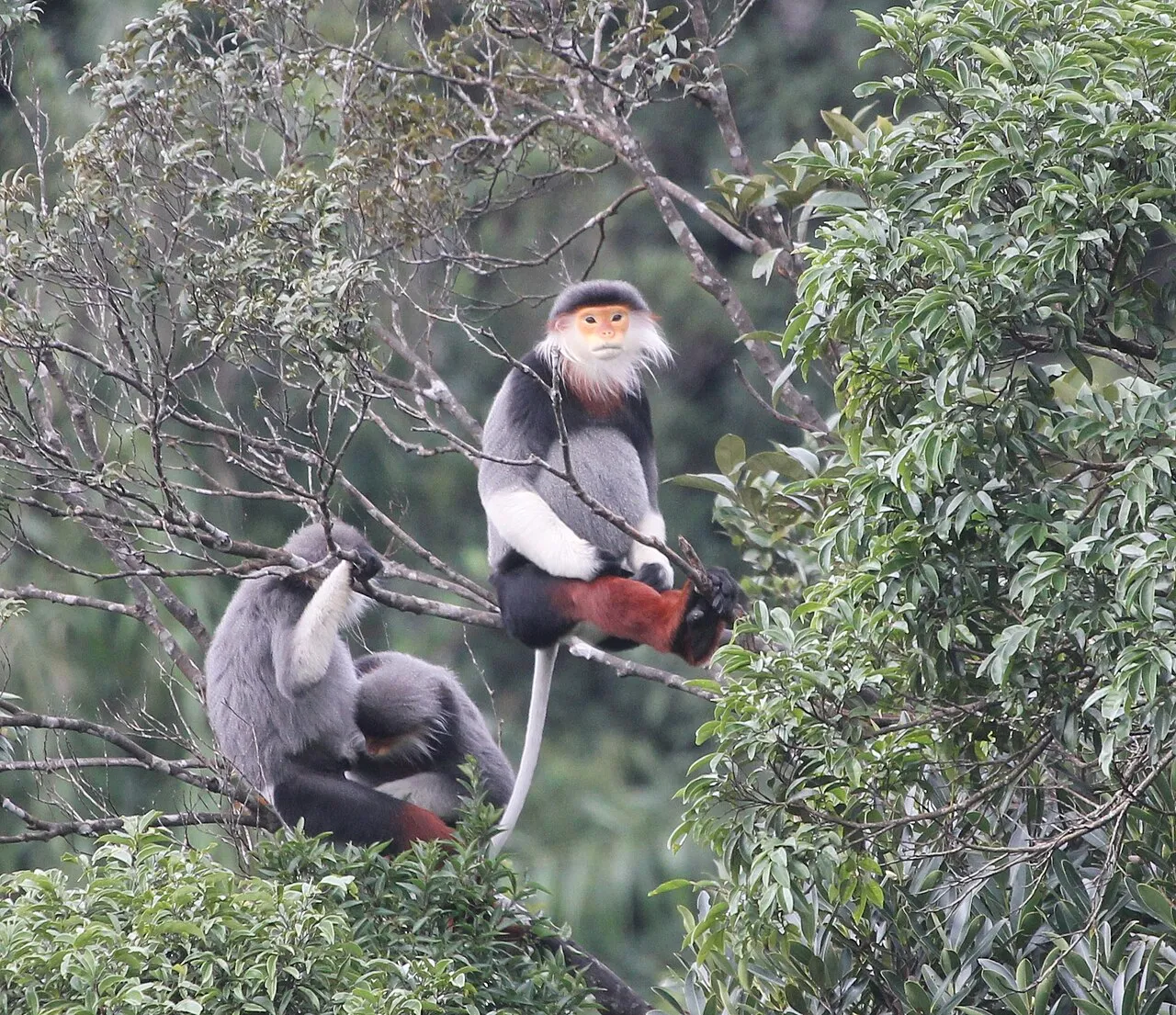
The eyes are set in a yellow-orange face, framed by long white whiskers, and the flattened nose has wide, outward-facing nostrils. A band of reddish fur encircles the neck, leading into darker bluish-gray fur over most of the upper body. The name comes from the vivid red fur below the knees, which looks like red stockings against the black toes. The forearms are white, ending in black hands and fingers, and the long white tail often ends in a thick tassel. The belly often looks pot-bellied because the enlarged digestive system1 stores and processes large amounts of plant material.
Males can be distinguished by white spots on the rump, along with a white scrotum and a red penis. These white rump patches are absent on females2. Infants are born with dark faces and muted colors, and the yellow-orange face typically develops by around age 21.
Where do red-shanked douc langurs live?
Red-shanked douc langurs are endemic to Laos, Cambodia and Vietnam, with the largest population in Laos. Animal Diversity Web places them in north and central Vietnam, east-central Cambodia and possibly on the Chinese island of Hainan. They are strictly arboreal and live in tropical, montane, evergreen and secondary growth forests, the last of which develop after disturbances such as agriculture, logging and fires. Animal Diversity Web gives an elevation range of 0 to 2,000 m2. National parks such as Nakai-Nam Theun in Laos, Son Tra in Vietnam1 and Virachey in Cambodia serve as refuges.
What do red-shanked douc langurs eat?
Leaves make up about 82% of the diet, unripe fruits and their seeds 14% and flowers 4%, in figures Animal Diversity Web takes from the Wisconsin Primate Research Center. Red-shanked doucs prefer young leaves because they are softer, easier to digest and higher in sugars, and they also eat flowers, bark and seeds. A four-chambered stomach breaks plant material down by bacterial fermentation, a slow process that requires long periods of rest. During the dry season, when fruits and flowers are less available, they shift to eating more mature leaves. They are selective feeders that typically take small amounts from a tree1 before moving on. Animal Diversity Web reports that douc langurs don’t drink water2 and obtain the moisture they need from their food.
How do red-shanked douc langurs live?
Red-shanked douc langurs are diurnal and highly arboreal, and they rarely descend to the ground. They move through the canopy on all fours and by semi-brachiation, with typical leaps of about 1.5 to 1.8 m, and often follow familiar pathways through the trees. On average they travel about 500 m per day, a distance that may decrease during the rainy season. In large, undisturbed forests they may spend about 40% of their active time feeding, 33% resting and 10% on the move; in more disturbed parts of Vietnam they tend to spend around 29% on the move1 and about 14% feeding.
Groups range from small family units of about 3 individuals to up to 50, and Animal Diversity Web gives a usual size of 4 to 15. They are often found in one-male units of a single male with several females and their offspring, but also form multi-male, multi-female groups and all-male groups, or live alone for a time. A typical one-male unit may include around 6 individuals; when food is abundant, several units may form bands that come together and split apart throughout the day. According to Animal Diversity Web, each sex apparently has its own dominance hierarchy and males are dominant over females2. Both males and females eventually leave their natal group1.
Aggression is shown by staring with raised eyebrows and a jutting jaw, and a grimace that shows the teeth signals submission. Known calls include low-pitched “wroo” calls and high-pitched, harsh “friii” calls that carry over long distances. Louder barks are most often used to signal potential threats, particularly farther away, and doucs may switch to growls as an intruder gets closer. In the wild, females tend to spend more time grooming1 than other group members.
How do red-shanked douc langurs reproduce and how long do they live?
Births can occur throughout the year but tend to peak between February and June. Gestation lasts about 6.5 months. A single infant is typically born, weighing about 450 to 460 g; twins are rare. Infants cling to their mother’s belly for the first few months and develop a full set of milk teeth by around two months, when they begin exploring solid food. Other females help carry and care for the infant for short periods while the mother forages nearby. The coat begins to resemble adult coloration between 8 and 18 months1. Captive females have an interbirth interval of around 2 years2.
Females reach full maturity between 4 and 6 years and males between 4 and 9 years. Animal Diversity Web puts sexual maturity at 4 years for females and about 4 to 5 years for males. Reliable data on lifespan in the wild is limited, but captive individuals have lived into their mid-twenties1. Animal Diversity Web gives a captive lifespan of 24 years or more2.
Is the red-shanked douc langur endangered?
The IUCN lists the red-shanked douc langur as Critically Endangered3, under Red List version 2022.2. In 2015, scientists estimated that the global population had declined by more than 80% over the past 36 years. Habitat loss and hunting are the greatest threats: doucs are heavily hunted for the bushmeat trade and for use in traditional medicine, and orphaned infants are sometimes sold in the illegal pet trade. Their forests are frequently cleared for hydroelectric projects, plantations and mining1. Animal Diversity Web adds that in areas of Vietnam where defoliants were used during the war2, reproduction has suffered.
The species is listed in Appendix I of CITES and is legally protected from hunting and trade across Vietnam, Cambodia and Laos. Although hunting is officially prohibited, the New England Primate Conservancy calls enforcement a major challenge1.
Similar species
- Gray-shanked douc langur (Pygathrix cinerea): endemic to the Central Highlands forests of Vietnam and possibly a small area of Cambodia. It has gray arms and legs4, where the red-shanked douc has red legs. Red-shanked doucs have been observed interbreeding with gray-shanked doucs1.
- Black-shanked douc langur (Pygathrix nigripes): found only in northeast Cambodia and southern Vietnam. Adult males have dark blue faces with cream-colored rings5 around the eyes, and black or gray hair over the arms and legs.