Contents
The chacma baboon, Papio ursinus, also known as the Cape baboon, is one of the largest monkey species1, found in southern Africa. It lives in Angola, Botswana, Mozambique, Namibia, South Africa and Zambia, and its distribution is primarily water limited. The species is part of a complex of closely related African baboon species. Chacma baboons are highly social animals2 with a complex multi-male, multi-female social structure, within which one-male units may form.
What does a chacma baboon look like?
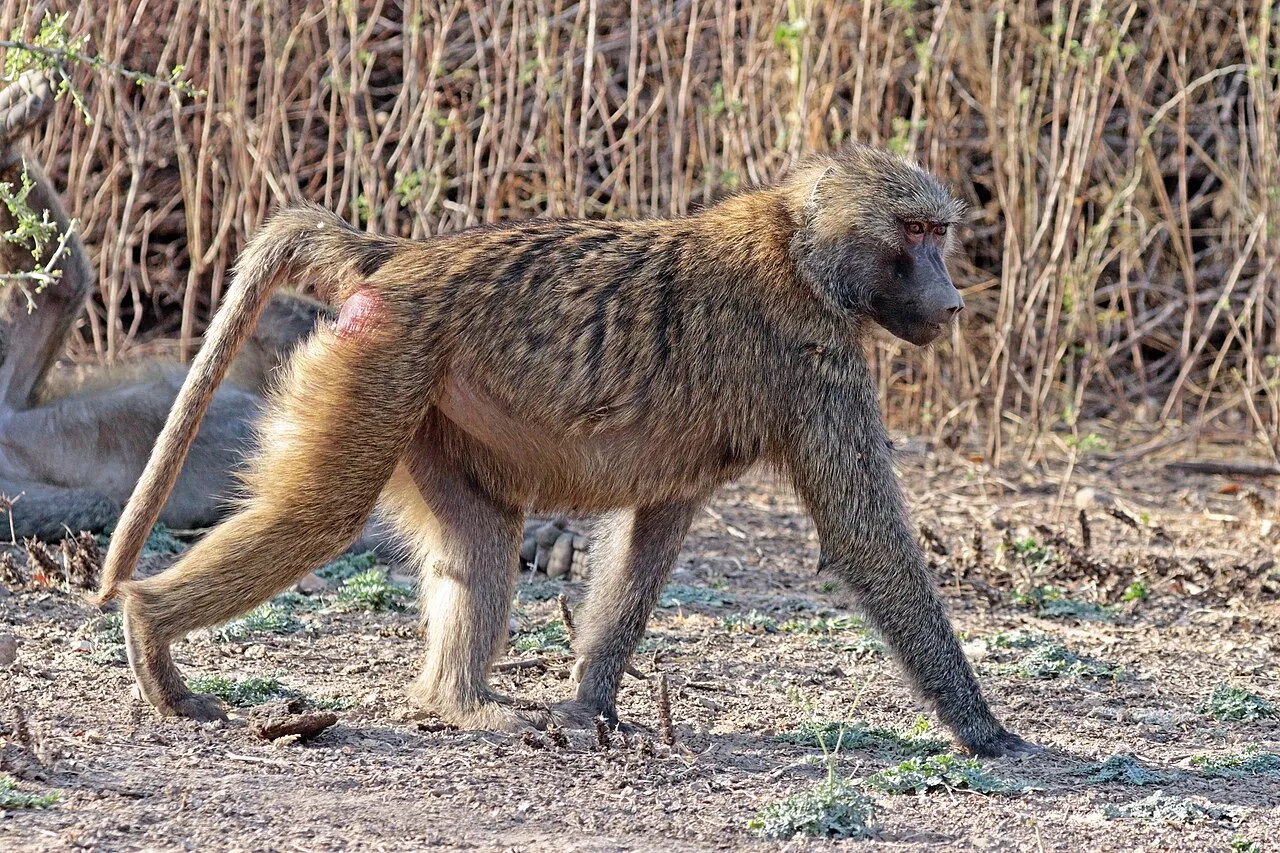
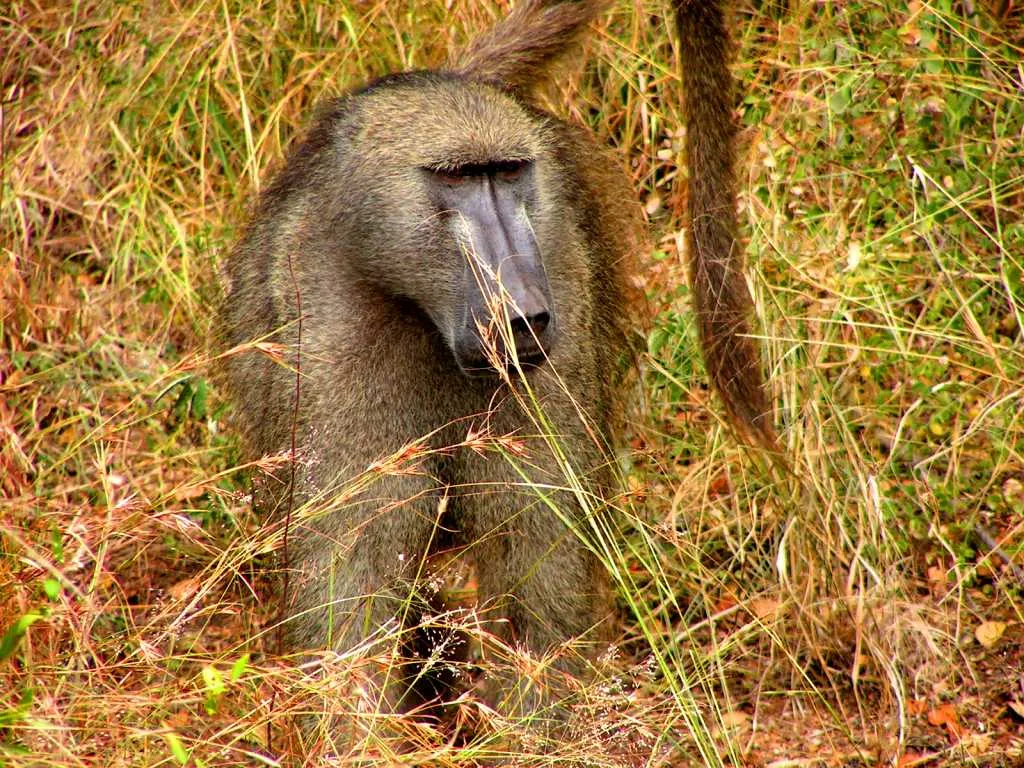
Chacma baboons are sexually dimorphic in size and pelage. Males weigh 26 to 31 kg and females around 15 kg. Head and body length is reportedly between 508 and 1,143 mm, with the tail adding 456 to 711 mm. Animals in the Kalahari desert are reported to be somewhat smaller than average. Males have large canine teeth2, whereas the teeth of the females are much smaller.
Typical chacma baboons are dark brown to black dorsally, with the underparts and sides of the muzzle lighter. The fur on the hands and feet is black. The skin of the face is dark, purple-black, and the face has a characteristic downward flex. Males lack a mane, though they carry longish tufts of hair at the nape. The natal pelage is black and is replaced by adult-like fur around 6 months of age2.
The New England Primate Conservancy recognises three subspecies: the typical chacma baboon, P. u. ursinus, the grey-footed baboon, P. u. griseipes, and the Namibian chacma baboon, P. u. ruacana. The grey-footed baboon has a more golden-coloured coat and grey hands and feet, and it is smaller than the common chacma baboon. The Namibian chacma baboon is significantly darker than the grey-footed baboon1.
Where do chacma baboons live?
The species is found in southern Africa, including the Zambezi Valley, southwestern Zambia, Caprivi and the coasts of southern Angola. The typical chacma baboon inhabits the more southern and western regions of the range, including South Africa and some parts of Botswana. The grey-footed baboon lives in southwestern Zambia, Zimbabwe, Mozambique south of the Zambezi, parts of the Limpopo Province of South Africa, and the Okavango Delta in Botswana. The Namibian chacma baboon is located in Namibia and southwestern Angola1.
Animal Diversity Web lists wooded highlands, grassland steppe and savanna2 as habitats. The New England Primate Conservancy adds subdeserts and mountainous regions, and notes that the habitat is limited by water availability. Chacma baboons require daily hydration, and arid areas with scarce water are usually avoided. A few populations have adapted to drought-prone areas by eating moist plant matter or relying on artificial water sources1.
Home ranges between 910 and 3,370 ha have been reported, and the daily range of a troop varies between 1,609 and 14,484 m. Animal Diversity Web counts both among the largest for savanna baboon species2.
What do chacma baboons eat?
The diet is omnivorous. They eat fruits, leaves, tree gums, insects, eggs and seeds2, as well as flowers, water lilies, grass, rhizomes, corms, roots, tubers and small vertebrates. The New England Primate Conservancy adds mushrooms, acorns and bark, marine vegetation, soil and even young antelopes. They also often eat carcasses of already-killed animals, and recent studies show that they feed on antelope excrement. Chacma baboons have cheek pouches1 that they use to store food.
In some regions, around 38% of their plant diet is made up of alien species introduced by humans. Black wattle, native to Australia, has become one of their most coveted foods. The plant contains twice as much potassium and four times as much copper1 as needed, leading to nutritional imbalances.
How do chacma baboons live?
On the ground they move as quadrupedal, mainly terrestrial primates. They are active during the day, but tend to become more active at night as the days grow shorter. Members of a troop travel, forage and sleep together, and an average troop may hold 20 to 80 animals. The New England Primate Conservancy gives group sizes ranging from 15 to 200 individuals1. Troops bed down on rocks or cliffs2, so their activity must be coordinated to reach one of a set number of sleeping sites by nightfall.
All males emigrate from their natal troops before they reach full adult size. Females do not emigrate from their natal groups, and female kinship forms the core and stability of the society. A troop has a dominance hierarchy of matrilines2 which is very stable over time, and a female generally ranks immediately below her mother and her younger sisters. Male ranking, by contrast, is particularly unstable. Once a male establishes himself as alpha, he kills any infants of the previous dominant male1 to induce the females to mate with him.
One-male units are especially common in populations inhabiting the mountains of eastern South Africa. In multi-male troops females typically bite one another on the tail, but in these groups females do not exhibit the tail lesions2.
Adult males give a “wahoo” call towards feline predators or towards other males. In Botswana the known predators are leopards and lions2, and the predation rate has been estimated at 9 percent of the population per year.
How do chacma baboons reproduce and how long do they live?
Females have an estrous cycle of 31 to 35 days, and mating can occur throughout the year. Females carry their young for six months1 and give birth to a single baby; twins are rare. The interbirth interval ranges from 18 to 24 months. Data on nursing in this species are scanty, and timing likely resembles other members of the genus; in the olive baboon, weaning typically occurs around 420 days of age2.
Both sexes reach maturity at around five years old. Males usually start mating only between seven and ten years old1, when they are strong enough to challenge other males.
A chacma baboon is reported to have lived 45 years in captivity, and the average captive lifespan is 27.6 years2. It is unlikely that many individuals live this long in the wild.
Is the chacma baboon endangered?
No: the IUCN classified it as Least Concern3 in its 2018 assessment. The New England Primate Conservancy describes it as widespread and thriving, with no major threats believed to be impacting its numbers. Chacma baboons are often killed by locals who see them as vermin, and sometimes by indiscriminate trapping. Changes in agricultural practices have fragmented their populations and caused habitat loss. Their meat is sold in markets in South Africa, as it is believed to have medicinal properties. The New England Primate Conservancy lists the species in Appendix II of CITES1.
Similar species
- Hamadryas baboon (Papio hamadryas): males of this species have a mane. Chacma males are not maned, as they are in anubis, hamadryas and guinea baboons2.
- Olive baboon (Papio anubis): the most broadly distributed baboon species, ranging through most of central sub-Saharan Africa. Its coat is a dark, olive-grey4, and males have a large mane.
- Yellow baboon (Papio cynocephalus): found through most of Eastern Africa south of the equatorial rain forests. The face of a yellow baboon is normal in orientation5, against the downwardly flexed face of the chacma baboon.