Contents
The drill, Mandrillus leucophaeus, is a large, short-tailed monkey that lives in Nigeria, Cameroon and Bioko Island in Equatorial Guinea. It is one of two species in the genus Mandrillus, together with the mandrill, and is known for a face that is jet black except for the bright red lower lip3. Drills were once placed by some in the baboon genus Papio, but genetic analyses found Mandrillus closer to the mangabey genus Cercocebus. Primate Info Net treats the drill as having no subspecies (Groves 2005)2, while the New England Primate Conservancy names two, M. l. leucophaeus on the mainland1 and M. l. poensis on Bioko.
What does a drill look like?
Drills are highly sexually dimorphic, and the sources give different weights. Animal Diversity Web gives an average of 25 kg for males and 11.5 kg for females; Primate Info Net gives 32.3 kg for males and 11.7 kg for females2. Members of the genus measure 610 to 764 mm in length, with the tail adding 52 to 76 mm3. The New England Primate Conservancy gives 82 cm for males and 66 cm for females1.
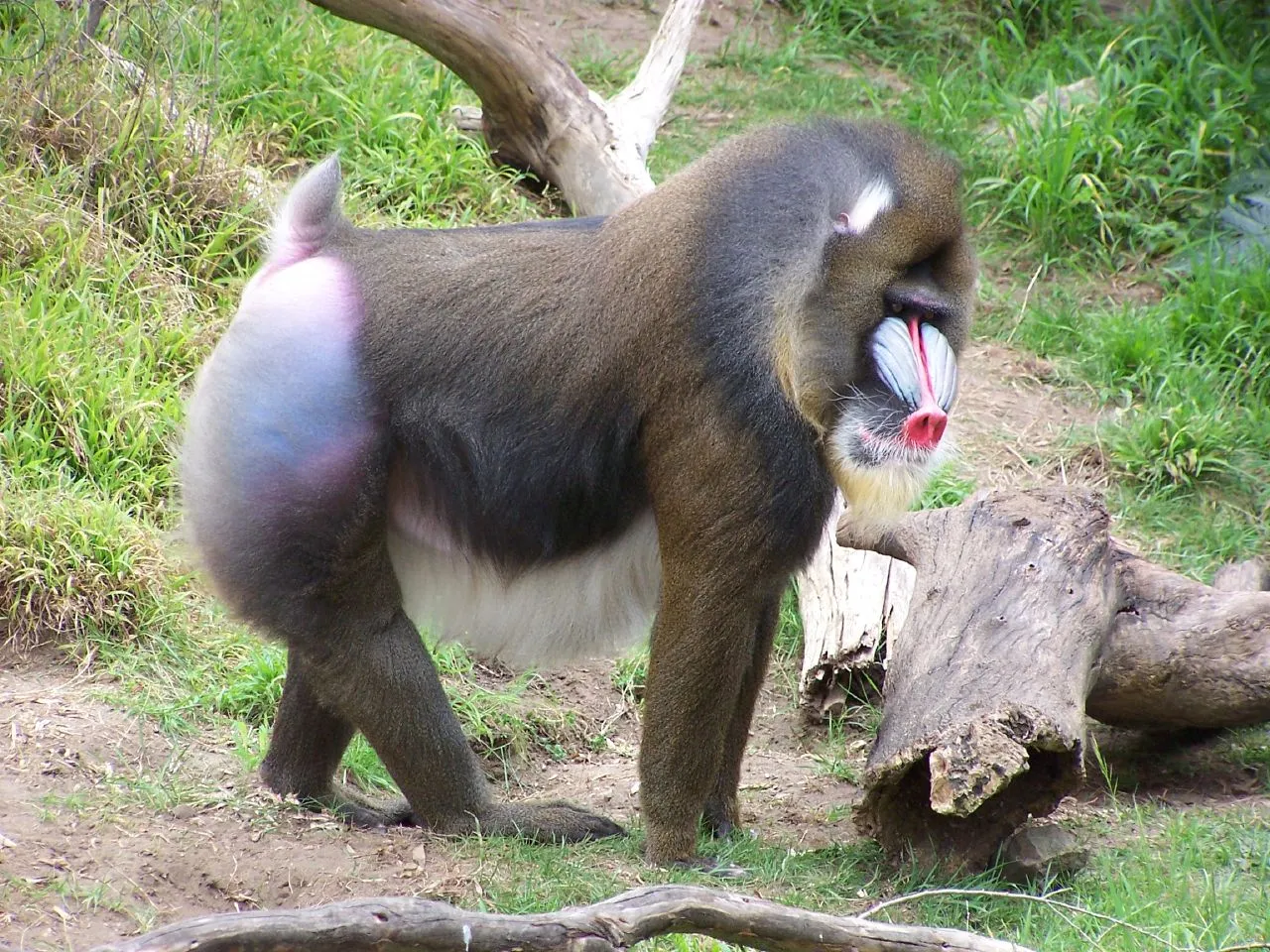
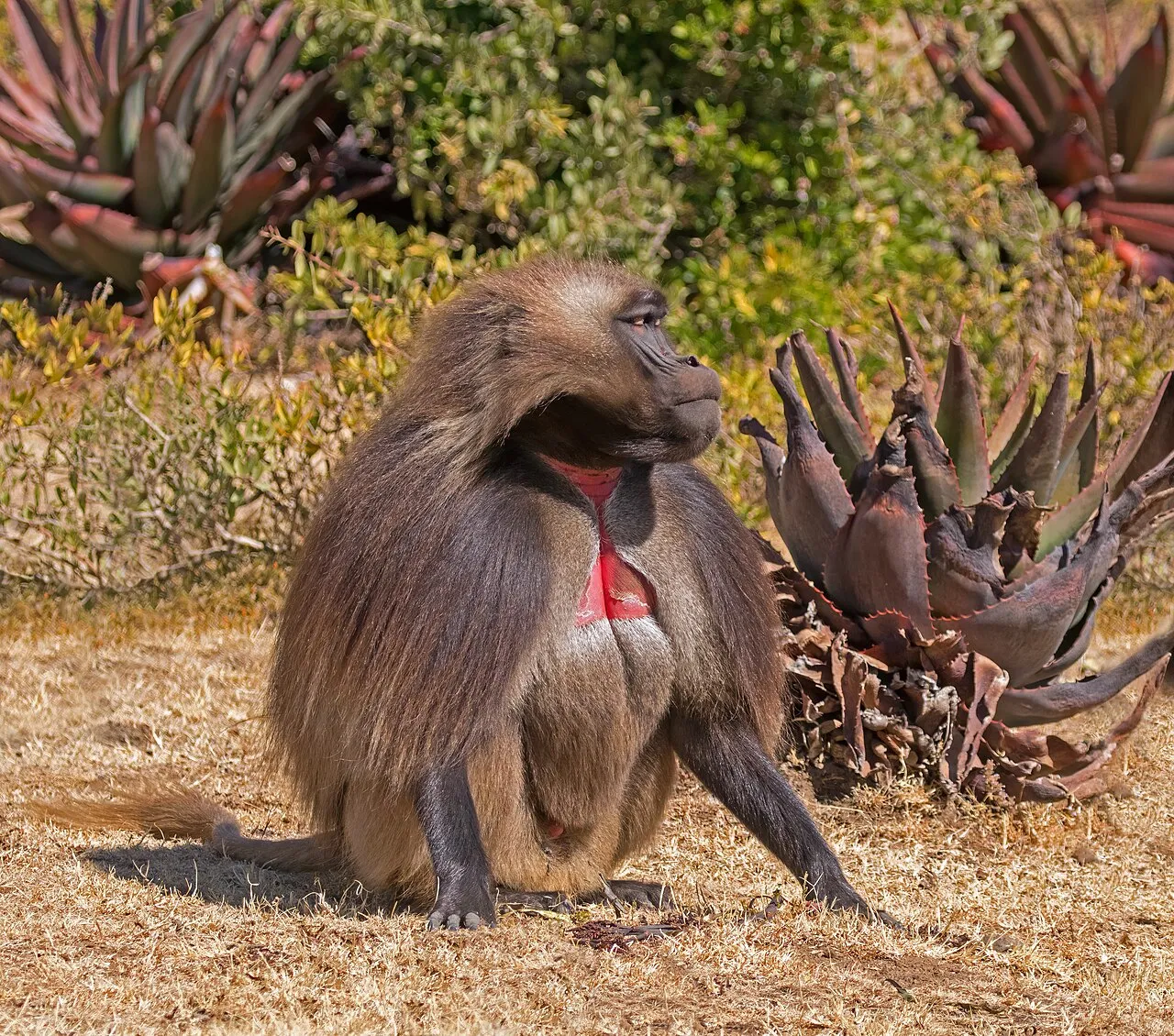
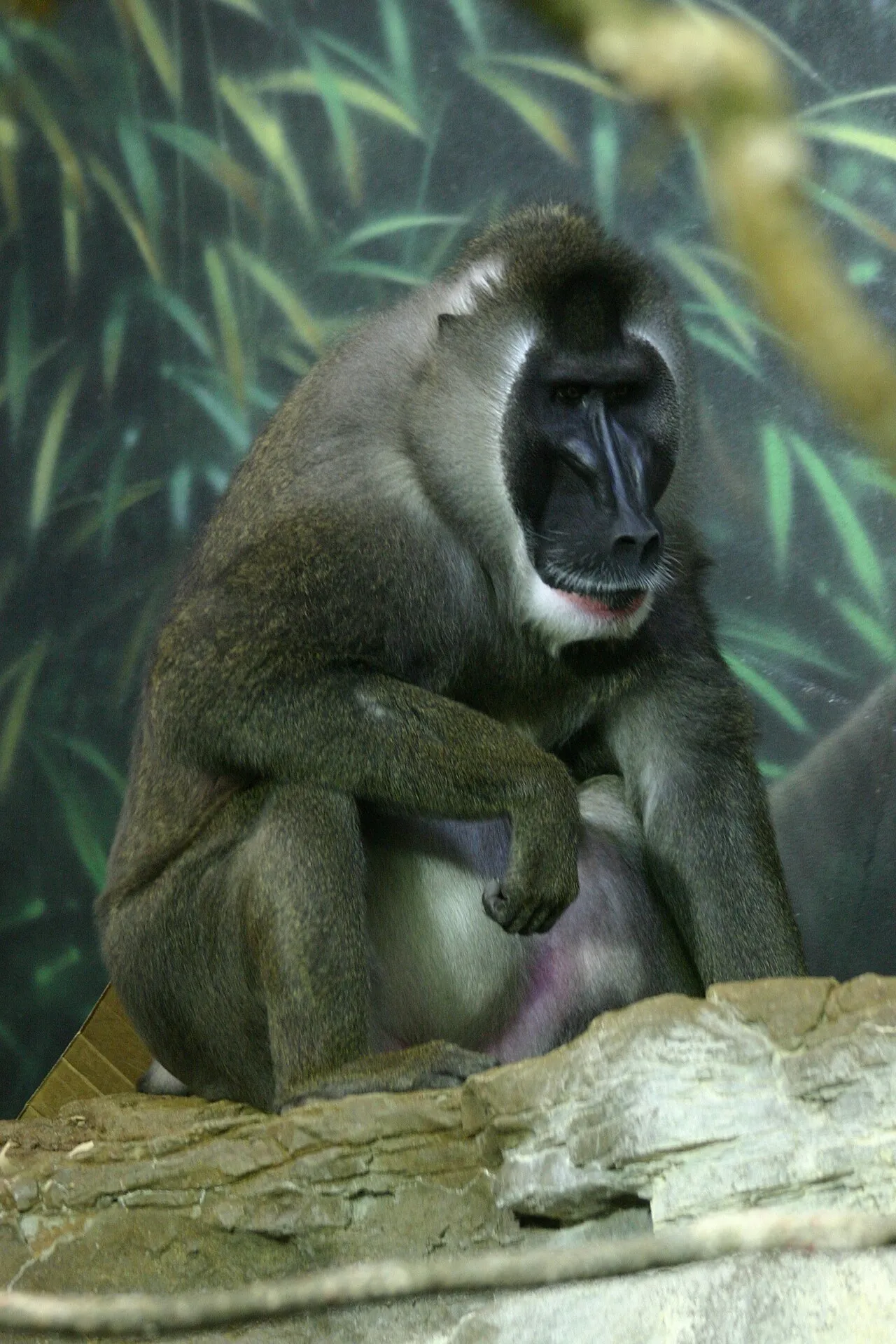
The coat is greenish gray or brown overall with a whitish belly, and drills have a white beard. The rest of the face is shiny black, with smooth swollen ridges on top of the elongated snout, with a ruff of white hair around the face. Males typically have larger paranasal muzzle swellings than females. In males the chin and lower lip are marked red, and the buttocks and groin show shades of red, blue, lilac, pink and white; in females these areas are generally brown and much more subdued1. An infant’s face is light in colour and fades to black by 8 months (Böer 1987)2.
Male drills are told from male mandrills by the absence of brightly coloured facial skin3 and of prominent grooves in the facial ridges.
Where do drills live?
The species occurs in Cameroon, Nigeria and Equatorial Guinea, though in Equatorial Guinea only on Bioko Island. On the mainland they occur in west and southwest Cameroon as far south as the Sanaga River and in south-eastern Nigeria as far west as the Cross River. The range is discontinuous: the mainland range is split into a minimum of 11 areas, and inland the distribution is limited by savannah (Harrison 1988)2. The mainland range covers less than 20,000 km². On Bioko, most drills live in the remote southwestern sector of the Gran Caldera Scientific Reserve1, and they have been seen on beaches along the island’s southern coast.
Habitat ranges over coastal, lowland, premontane, submontane and montane forest and montane savannah, up to 2,000 m above sea level2. They prefer mature forests but are seen on occasion in young secondary forest, and they avoid open country away from forest. Males are mostly terrestrial3, while the smaller females and young climb into the lower canopy for food and shelter.
What do drills eat?
The diet is omnivorous3, built on fruit, leaves and invertebrates, mainly termites. On the mainland they have been seen eating seeds, fruits, insects, green leaves and mushrooms. On Bioko Island the diet is fruit 58%, insects 25%2, other vegetation such as leaves and stems 16%, and other invertebrates such as snails 1%.
Forest fruit is the most preferred food1, depending on which trees fruit in the rainy season; in the dry season, leaves and grasses take priority. Drills also raid manioc and palm oil plantations3, and farmers often shoot them as crop pests.
How do drills live?
Drills live in multi-male, multi-female troops of 15 to 75, with about one adult male for every 20 troop members. Troops sometimes join into super groups of more than 1001. Recorded average group sizes include 93.1, 52.3 and 9.1, and one group was estimated at as many as 400 individuals. Groups on Bioko appear smaller than on the mainland, usually fewer than 20. Solitary males are sometimes encountered2. In captivity, drills form one-male or multi-male groups of 20 to 25 individuals3.
Depending on the season, a troop may migrate, led by the dominant male. Among adult males, dominance lasts about three years. Drills walk on all four limbs, forage mostly on the ground and are good climbers. A troop stays within 5 km² of its sleeping tree for a season; Primate Info Net, however, calls the drill’s home range unknown (Astaras et al. 2008)2. At night drills shelter in the trees, and when threatened they often flee into the canopy. Their natural predators include the leopard, crowned eagle and Central African rock python1.
Much of drill communication is visual, with displays of brightly coloured rumps. Drills regularly grunt and scream, and they mark branches with scent glands on the chest3. In captivity, the drill’s “smile” signals a friendly approach2.
How do drills reproduce and how long do they live?
The female cycle lasts about 33 days, and the birth season is thought to run between December and April3. Gestation lasts 179 to 182 days, with 17 to 19 months between births (Böer 1987). Females give birth to a single infant, and a newborn female weighs about 722 g. Young are weaned at 15 to 16 months. Females reach sexual maturity at the age of three1, and males in captivity at around six years2.
In the wild the average drill may live up to 10 years1. The captive record belongs to a wild-born female that was about 39 years old when she died; claims of drills living up to 46 years4 have not been verified.
Is the drill endangered?
The IUCN lists the drill as Endangered5, in Red List version 2022.2. In 2024, the New England Primate Conservancy put the mainland population at about 4,000 mature individuals and the Bioko population at an estimated 600. The largest threats are hunting, habitat loss and habitat fragmentation. In Nigeria forest is cleared for large-scale plantation projects1; in Cameroon, commercial logging has opened new road access for hunters and cultivators.
Hunting of mainland drills is probably the biggest threat to the species. In the 1990s, several hunters killed over one hundred individuals in a few trips. On Bioko, drill meat is sold in markets and considered a delicacy. Killing a drill is illegal and punishable by large fines and prison, but a 2005 study by Wild et al.2, cited by Primate Info Net, found that such penalties had never been imposed in practice and that enforcement was often difficult or nonexistent, even in protected areas.
The drill is listed on CITES Appendix I. In Cameroon it is protected in Korup, Takamanda, Bakossi and Mount Cameroon National Parks1; in Nigeria in Cross River National Park, Afi Mountain Wildlife Sanctuary and the Mbe Mountains Community Forest; and on Bioko in the Gran Caldera de Luba Scientific Reserve.
Similar species
- Mandrill (Mandrillus sphinx): the drill’s only congener, found south of the Sanaga River, with the drill to the north. The mandrill has an orange beard, where the drill’s is white, and a face with swollen blue ridges and a red nose and lips2.
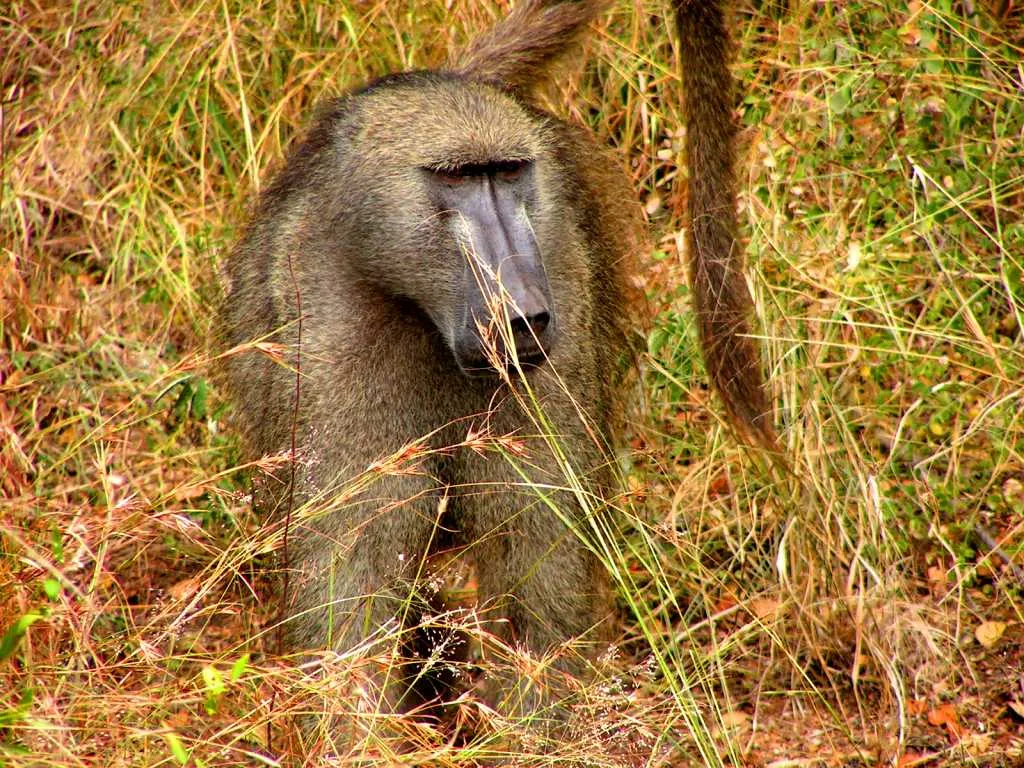
- Olive baboon (Papio anubis): a baboon ranging through most of central sub-Saharan Africa, with a dark olive-gray coat. Its tail is long, adding 560 mm in an average male6, against the drill’s 52 to 76 mm3.