Contents
The gelada, Theropithecus gelada, is a species of Old World monkey1 found only in the highlands of Ethiopia and Eritrea2, where most populations live in the Gich and Sankaber areas of the Semien Mountains National Park. It lives almost entirely on grass: grass, its seeds and sedges make up 90 percent of its calories. Geladas are also called bleeding heart monkeys, after a shiny patch of skin on the chest that resembles an inverted heart. Scientists once called them gelada baboons, but since 1979 geladas have been placed in their own genus, Theropithecus3, apart from the true baboons in the genus Papio.
What does a gelada look like?
Males weigh an average of 20.25 kg and measure 69 to 74 cm in body length, with a tail of another 45 to 50 cm. Females weigh an average of 14.8 kg2, with a body length of 50 to 65 cm and a tail of 30 to 41 cm. The New England Primate Conservancy gives males up to 20 kg, standing 74 cm tall3, against around 14 kg and 60 cm for females.
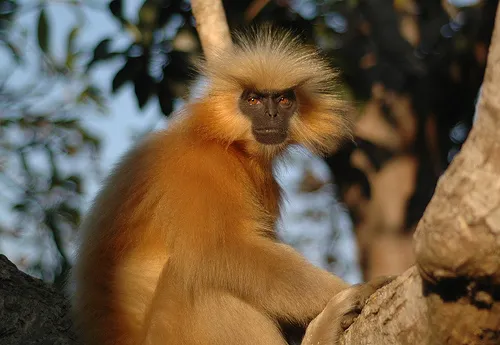
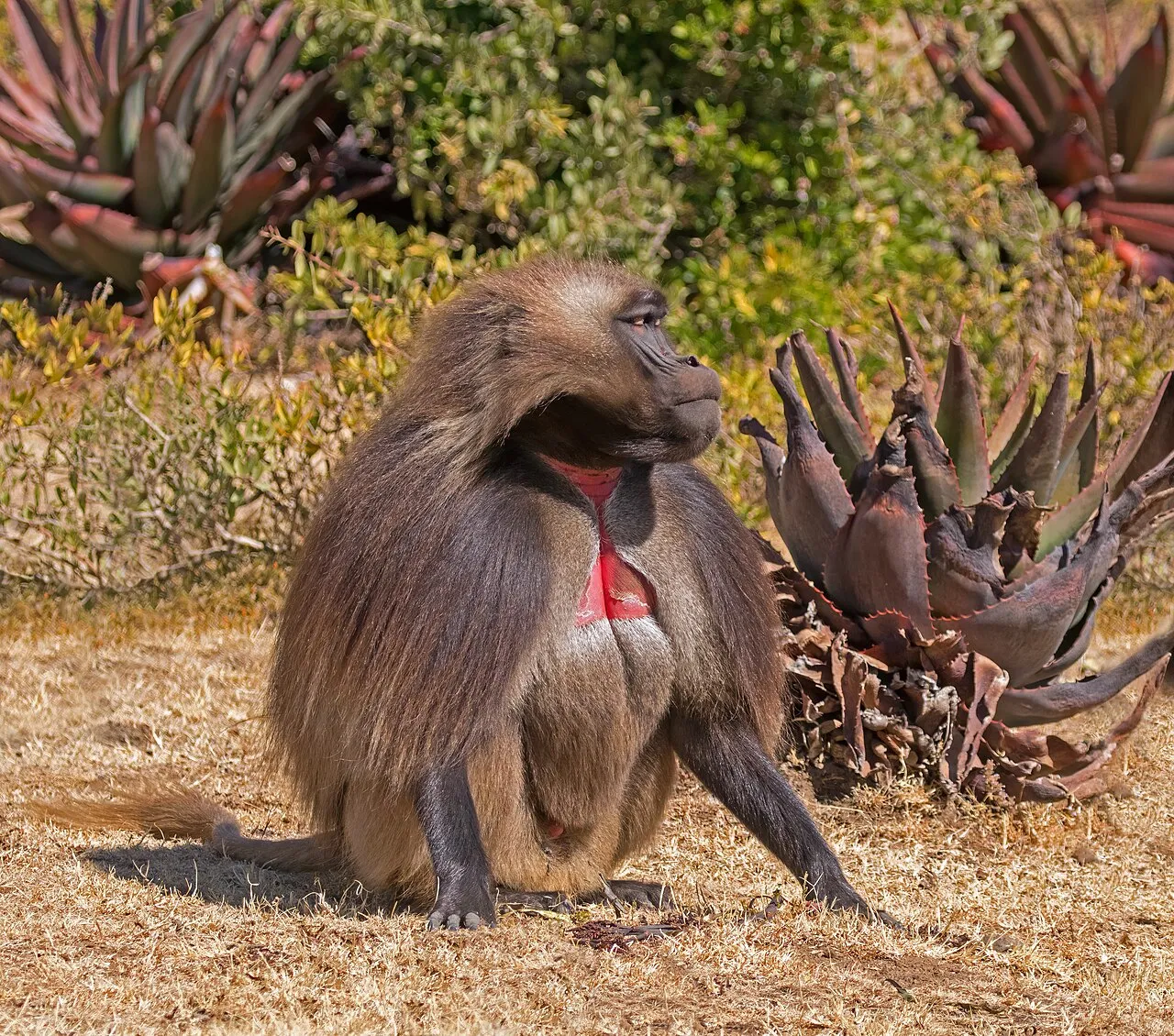
Both sexes have short rostrums and wide nostrils, short brown fur and pale eyelids that are used for expression. Males are marked by whiskers and a brown hairy mantle2; the New England Primate Conservancy describes a mane that descends into a shaggy cape along the back. Beneath the mane are pink eyebrows, golden eyes and a wrinkled dark brown face3 that protrudes in a snout.
A hairless patch on the chest2 marks both sexes, usually triangular and outlined by white hairs. Females have the patch, but not as vibrantly as the males; during estrus a female’s patch brightens and grows a “necklace” of fluid-filled blisters. The dominant male of a unit has the reddest chest patch3 of all the males, and the more females he has, the redder it becomes.
Around the rump, geladas have a thick layer of callouses over a layer of fat, the ischial callosities, which prevent soreness during long periods of sitting and scooting. The long, slender tail is not prehensile3 and ends in a tuft of fur. The opposability of the first two digits is the highest of all the catarrhine primates2, which allows geladas to pick grass blades individually, and short, robust phalanges let them dig for tubers.
Two subspecies are of note: the northern gelada, T. g. gelada, and T. g. obscurus to the south and east, sometimes known as Heuglin’s gelada. Geladas in the south have a shorter snout than those in the north3, and northern geladas have a larger and rounder skull.
Where do geladas live?
Animal Diversity Web places geladas in the highlands of Ethiopia and Eritrea2, while the New England Primate Conservancy describes them as endemic to Ethiopia. Their highest populations live in the north, around the highland meadows of the Simien Mountains. Gelada communities are also found in areas around Addis Ababa3, including Guassa, Wollo province, Debre Libanos and the Wof-Washa Forest.
Animal Diversity Web finds most populations foraging in grasslands between 2,000 and 5,000 meters2. Geladas prefer to sleep on rocky cliffs, from which they descend in the morning to forage in the nearby grasslands. The New England Primate Conservancy gives altitudes of up to 4,400 meters and counts geladas among the highest-dwelling nonhuman primates. In the Simien Mountains, temperatures range between 10 °C and 21 °C, and the grasslands are sparsely forested with junipers, shrubs and lobelia trees. Aside from humans, geladas are the world’s most terrestrial primate species3; the only time they are seen in a tree is during sentry duty.
What do geladas eat?
Geladas are exclusively herbivorous, and their choice of food changes with the season. In the wet season of July and August, green grass blades make up 93% of the diet. In November, when the grasses have seeded, seeds make up 70% of the diet, and in the dry season of January and February, 67% of the food is grass rhizomes and 25% grass blades. Geladas also harvest fruits, tubers, flowers and stems throughout the year2.
The New England Primate Conservancy adds roots, flowers and the occasional insect to the remaining tenth of the diet, mainly in the dry season. Geladas spend ten hours a day grazing. While feeding they use a shuffle gait: they squat on their hind legs, then move along, plucking grasses, without changing their posture. Enlarged molars and reduced incisors help grind the grass3 before digestion, and gut microbes break down cellulose through fermentation in the hindgut.
How do geladas live?
Geladas are diurnal2. At dawn they wake on the sleeping cliffs, spend a small amount of time grooming and sunning, then go off to the grasslands to forage. At night they huddle closely together3 on the narrow shelves of the cliffs.
The most common unit of gelada society is the reproductive unit: a dominant female elder, her close female kin, usually one to twelve females, their offspring, a dominant male leader and occasionally a few follower males. All-male units hold between two and fifteen males. A band is made up of two to about twenty-seven reproductive units and several all-male units. A herd of about sixty reproductive units3 can be as large as a thousand individuals or more. Geladas are not territorial2, and separate bands often graze together wherever conditions are favourable.
The females within a unit are generally the true leaders of the group2. A dominant female holds the most sway over the social decisions of the unit, and the others, mostly her close relatives, look to her for decisions, including whether to accept a new leading male. Female geladas stay in a reproductive unit for life, while young males typically remain for four or five years on average. About 17 percent of a unit’s offspring3 are fathered by subordinate males.
Geladas employ 30 different vocalizations3, including wobbles, grunts, groans and squeals, and string these sounds together with a length and complexity that depend on the context. They also use visual signals such as facial expression and body posture2, and males often smell the reddened chest patch of females in estrus.
Ethiopian wolves move through gelada herds, and among the herd they have a hunting success rate of 67 percent, against 25 percent3 outside it. Geladas flee from domestic dogs, which are much more likely to prey on them than any wolf.
How do geladas reproduce and how long do they live?
Geladas have no specific mating season, though the birth rate is higher during the rainy season. Gestation is estimated at 5 to 6 months, and females generally give birth to one infant at a time. Newborns weigh roughly 460 g and have black fur, closed eyes and a red face. Lactation lasts for about 12 to 18 months. Females reach sexual maturity at about 4 or 5 years2, males not until 5 or 7 years. AnAge gives an average inter-litter interval of 740 days4, and the New England Primate Conservancy says females reproduce only once every two years3.
When a rival male replaces the dominant male, roughly 80 percent of pregnancies are terminated in the weeks that follow, a response known as the Bruce effect. Around 60 percent of all infant mortality3 is thought to be due to infanticide.
In the wild, geladas live to be about 15 years old3 according to the New England Primate Conservancy, and nearly double that in captivity. Animal Diversity Web cites an average lifespan of 20.0 years in the wild2 and 20.8 years in captivity, from the Max Planck Institute for Demographic Research. The longevity record in AnAge is 36 years in captivity4: a wild-born female who was likely around 36 when she died.
Is the gelada endangered?
The IUCN lists the gelada as Least Concern1, in Red List version 2022.2. About 500,000 geladas existed in the wild in the 1970s; in 2024 the New England Primate Conservancy said the number is thought to be about 200,000, though official surveys still need to be conducted. Under the current climate, suitable habitat covers approximately 90,891 square kilometers3, and species distribution modelling projects a 36 percent decrease by 2050.
People moving into the Ethiopian Highlands are converting home ranges into farmland and pastures for cows and goats, and competition with livestock has pushed geladas onto gorge slopes where the grass is less productive. Where geladas are accused of raiding crops, they are shot by farmers2. In the past, males were hunted for their capes of hair, used in Oromo coming-of-age ceremonies, and government-sanctioned trophy hunting by tourists is allowed in certain regions. Tapeworm cysts, with their high mortality rate, also affect gelada populations3.
The gelada is listed in appendix II of CITES2, which permits only monitored trade between countries. In 2024 the New England Primate Conservancy wrote that hunting and trapping of geladas is expressly forbidden unless the government permits it in the name of science or national interest, though it still occurs where the law can’t be enforced. The Simien Mountains National Park region offered the largest sanctuary for gelada populations, and the park and its surrounding regions are thought to hold around 4,260-4,560 geladas3. Two other sites have been proposed for protecting geladas: Blue Nile Gorges National Park and Indeltu (Shebelle) Gorge Reserve.
Similar species
- Hamadryas baboon (Papio hamadryas): found around the southern Red Sea in Ethiopia, Somalia and Eritrea, and in Saudi Arabia and Yemen. Its males have a bushy, silver-colored mane5 and pink or bright red skin on the muzzle and face, where a male gelada has a brown mantle. Unlike a gelada male, a hamadryas male rules by force3.
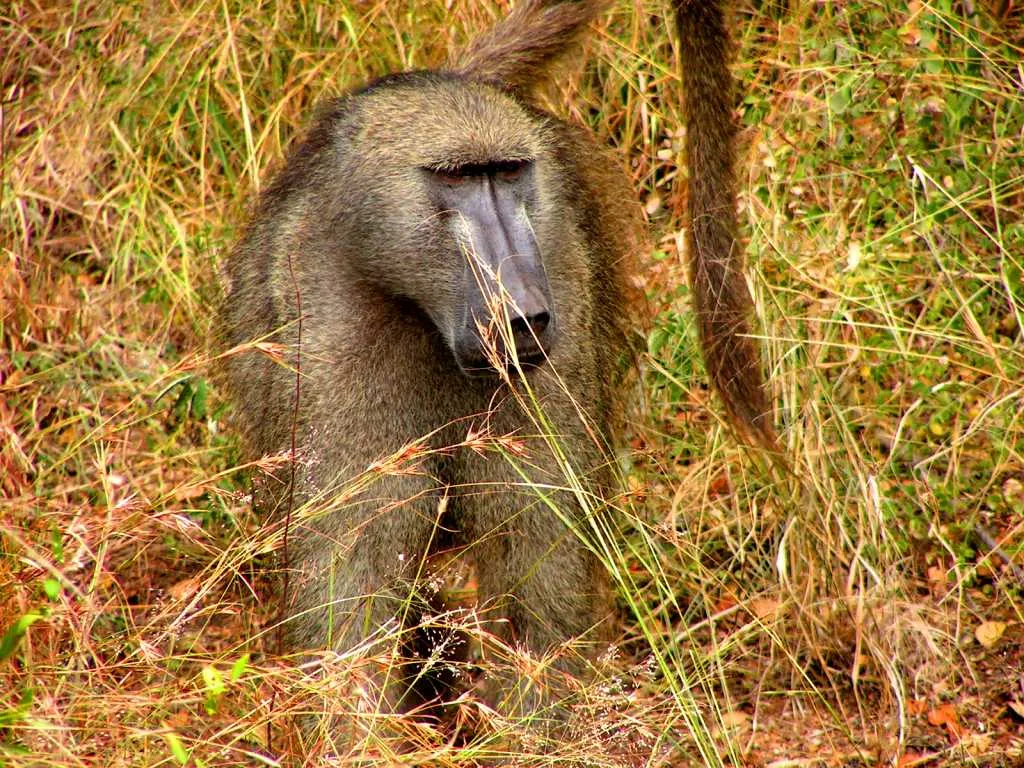
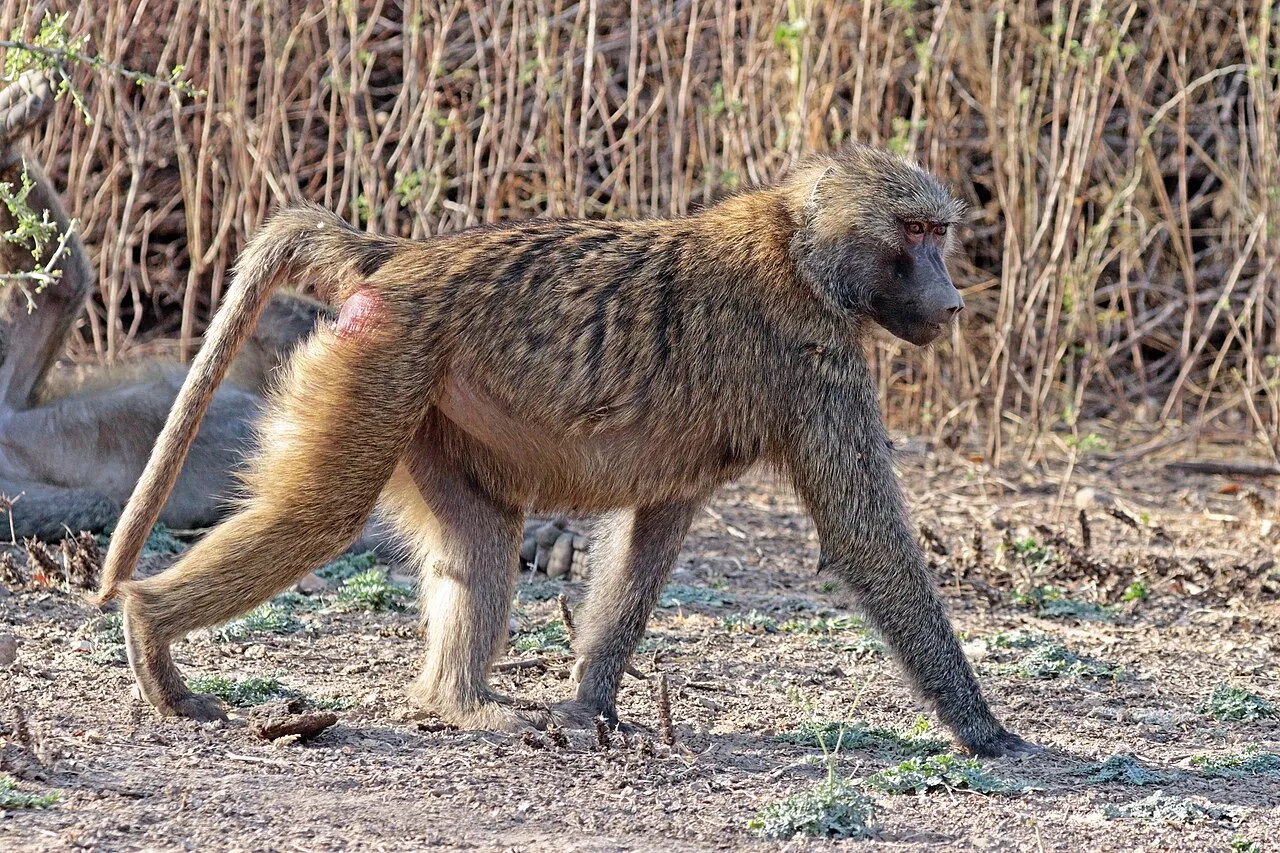
- Anubis baboon (Papio anubis): the most broadly distributed baboon species, ranging through most of central sub-Saharan Africa. Its coat is a dark, olive-gray6, the skin of its face and around the ischial callosities is dark gray to black in both sexes, and females lack a mane.