Contents
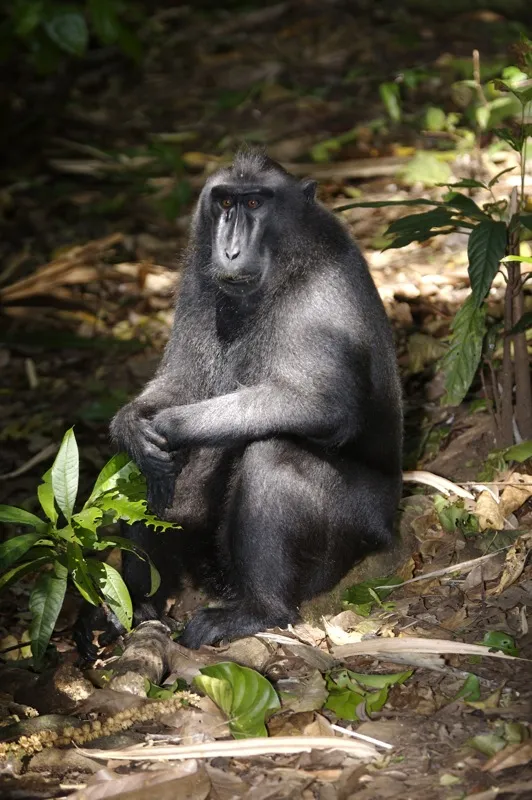
The Celebes crested macaque, Macaca nigra, is one of seven macaque species endemic to Sulawesi in Indonesia. It lives only in northeast Sulawesi and the nearby islands of Manadotua and Talise, with an introduced population on Bacan in the Maluku Islands. Its crown hair forms a crest pointing backward and up, and its tail is so short, about 20 mm1, that it is commonly mistaken for an ape. Other names include crested black macaque, Celebes macaque and black ape2.
What does a Celebes crested macaque look like?
The face and body are entirely black, except for the bright pink ischial callosities, the hairless pads on the rump. The face is thinly haired, while the body hair is dense, coarse and woolly. The head has prominent, bony cheek ridges and a shelf-like brow bone2, and the skull is more baboon-like than in other macaques1.
Males are almost twice the size of females. Males measure 520 to 570 mm and weigh 9.9 kg on average, while females measure 445 to 570 mm and weigh 5.5 kg on average. Animal Diversity Web gives a mass range of 5 to 18 kg1. Males also have enlarged canine teeth2, which they use in fights with other males over females and in clashes between groups over food.
Adult females are paler than adult males. Juveniles are paler than adults and look more brown than black. As adult males age, their hair greys and becomes grizzled1, most of all on the upper body.
Of the Sulawesi macaques, it is most difficult to distinguish from the Gorontalo macaque1, Macaca nigrescens. Both have black skin, but the upper half of the body is darker and duller in the Celebes crested macaque. It is semi-terrestrial and walks on all fours on the ground and through the trees2.
Where do Celebes crested macaques live?
On Sulawesi the species lives at the tip of the northeastern-most peninsula. On Bacan, an island 345 miles from Sulawesi, it was introduced by humans in 18672. It used to live on Lembeh Island too, but has since been made locally extinct there3.
Primate Info Net lists Sulawesi sites in Tangkoko Batuangus-Dua Sudara, Gunung Ambang and Gunung Manembonembo nature reserves and in Bunaken Marine National Park. Most of the population lives in Tangkoko, where most of the field research2 has been done.
The habitat includes lowland and montane primary forests, early and mature secondary forest, mangroves, cultivated land surrounded by forest, logged forest and areas of dense human settlement and farming. In actively logged forest the macaques occur at lower densities. At Tangkoko they do not range above 1100 m2. Animal Diversity Web places them at moderate elevations of 700 to 1100 m1.
What do Celebes crested macaques eat?
They mainly eat fruit, spending 70% of their time feeding on fruits2. They also eat seeds, leaves, flowers, pith, herbs, grass seeds, fungus, bird eggs, birds and small vertebrates such as lizards and frogs. Figs make up the majority of their diet, but they eat more than 145 species of plants, mostly fruit. When fruit is scarce they add insects, shoots, young leaves1 and the stems of flowering plants.
They have been seen preying on fruit bats, forest geckos and frogs, and on the eggs of the red junglefowl and the black-naped monarch flycatcher. They also raid crops, including maize, yams, cassava, papayas, bananas and cacao. They forage through the day and sometimes store food in their cheek pouches. As fruit-eaters they disperse the seeds of rainforest trees1, especially figs.
How do Celebes crested macaques live?
They live in large groups with several males and several females. At Tangkoko a group holds 27 to 97 individuals, and the home ranges of groups overlap. Groups on Bacan are much smaller, with 20 individuals on average2. Groups generally include more females than males1.
Females remain in the group into which they were born, while males move to unrelated groups when they reach sexual maturity. Females have an egalitarian social structure, whereas males form a linear dominance hierarchy1. Males are generally dominant over females at feeding sites. Group movements are coordinated by either males or females2.
The species is diurnal and spends 59% of its waking hours foraging, feeding and moving. The macaques generally socialise in the morning, rest in the afternoon and sleep in trees. They spend more than 60% of their day on the ground foraging and socialising. A group travels an average of 2.4 km per day1. With access to primary forest they spend much less time traveling2.
Fully adult males, especially high-ranking ones, give loud calls, raspy and repetitive cackles that neighbouring groups can hear. Groups generally stay more than 500 m apart. Within a group, “coos” are contact calls2, and lipsmacking may be used as a sign of appeasement or reconciliation after a conflict. A yawn by a male shows off its canine teeth3 and can be a sign of aggression.
How do Celebes crested macaques reproduce and how long do they live?
Both males and females have multiple mates. Females show a swelling of the anogenital area that signals ovarian activity and readiness to mate. They breed year-round1, with births peaking between January and May. Gestation lasts 174 days2.
Females give birth to a single offspring every 18 months. Infants spend much less time with their mother at 4 months of age and are completely weaned by 1 year. Infants often cling to their mother’s belly for protection. Females reach sexual maturity at 49 months2. Males produce sperm around 3 or 4 years of age1, but need another 3 to 6 years to reach the body mass needed for mating.
The average lifespan in the wild is 18 years. The oldest individual in captivity survived 34 years1.
Is the Celebes crested macaque endangered?
The IUCN lists the Celebes crested macaque as Critically Endangered4, under Red List version 2022.2. Animal Diversity Web reports that the population has decreased by 80% in the last 40 years1, citing studies from 2000 and 2006, mainly through hunting and habitat loss. Scientists cited by the New England Primate Conservancy believe there is just a single viable population3 left, in the Greater Tangkoko Conservation Area.
Primate Info Net’s 2006 conservation notes put the population on Sulawesi at 4000 to 6000 individuals, with estimates of up to 100,000 on Bacan. The same notes call hunting an even more severe threat than habitat destruction. Among Christians on Sulawesi, monkey meat is a traditional food and a delicacy for special occasions, including Christmas dinner. The macaques are also trapped as crop pests, and some are caught for the pet trade. Forest is lost to subsistence and commercial agriculture2, the collection of forest products, roads, and the extraction of timber and minerals. The New England Primate Conservancy names climate change3 as another looming threat.
The species is listed in CITES Appendix II3. The protected land it inhabits covers 16,848 ha1, less than for any other macaque on Sulawesi.
Similar species
- Gorontalo macaque (Macaca nigrescens): lives on Sulawesi’s northern peninsula, from the Bolango River to the Onggak Dumoga River. Its crest is less dramatic than the tall, upright crest of the Celebes crested macaque. Its ischial callosities are gray5, not bright pink.
- Tonkean macaque (Macaca tonkeana): another Sulawesi macaque with an ape-like appearance, found in central Sulawesi and the nearby Togian Islands. Its groups are generally around 10–30 individuals6.
- Heck’s macaque (Macaca hecki): another Sulawesi macaque, living in groups of 10 to 15 individuals7.