Contents
The golden snub-nosed monkey, Rhinopithecus roxellana, is an Old World monkey1 of the mountain forests of China. It lives in the Sichuan, Gansu, Hubei and Shaanxi provinces2 around the edges of the Sichuan Basin, and withstands the coldest average temperatures of any non-human primate. The scientific name comes from the concubine of the Ottoman sultan Süleyman the Magnificent3, who was known for her reddish-golden hair.
What does a golden snub-nosed monkey look like?
Average head-and-body length varies by subspecies, from 58.2 to 68 cm in males and from 47.5 to 51.8 cm in females. Animal Diversity Web gives a wider head-and-body range of 570 to 760 mm without separating the sexes, with a tail of 510 to 720 mm1. Weighed specimens average 17.9 kg for males and 11.6 kg for females, but body weight estimates are considered somewhat more reliable; these place males at 19.8 kg and females at 12.4 kg (Jablonski & Pan 1995)2. There may be significant weight fluctuations with the seasons and between populations.
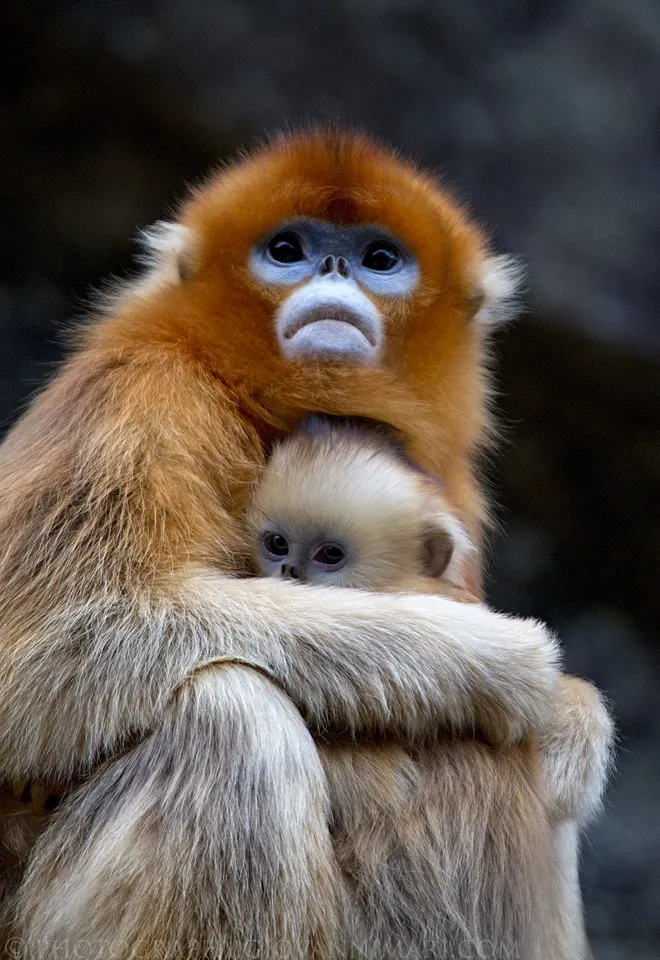
The body and limbs are yellowish-red, from somewhat browner to a brighter orange-red. Black or dark brown on the back runs down the limbs as a stripe and more solidly down the tail, and the belly side is yellowish-white or white-orange. The muzzle is white and hairless and the area around the eyes is pale blue2. The nose is flattened, with the nostrils facing forward; two flaps of skin on the nostrils1 form peaks that almost touch the forehead.
Adult males are larger than adult females and brighter in colour than other age and sex classes. Longer golden back hairs start growing in adult males after about six years and can be up to 55 cm. Adult males also have a wart-like growth at the corners of the mouth2, the sole example of such a feature among the primates; females and the other members of the genus lack it.
Where do golden snub-nosed monkeys live?
Within the four provinces, habitats are often separated and the distribution is not contiguous. Each of the three subspecies has its own area: R. r. roxellana in western Sichuan and southern Gansu, R. r. qinlingensis only in the southern Qinling Mountains of Shaanxi, and R. r. hubeiensis in western Hubei and south-eastern Sichuan, within and around the Shennongjia forest region. Their presence in India near the Chinese border appears supported only by anecdotal evidence2.
The monkeys inhabit mountainous temperate forests of evergreen conifers and deciduous broadleaf trees. They will use secondary and shrub forest but prefer primary forest, and they use many dead trees, which host more of their food lichens than live trees. The Primate Info Net gives an altitude range of 1,200 to 3,300 m; Animal Diversity Web gives 1,600 to 4,000 m1 and notes that the monkeys may migrate to slightly lower elevations during the winter. They may have to forage in snow for up to four months, with cover usually stable from December to March. On the northern slope of the Qinling Mountains, January temperatures reach as low as −8.3 °C2.
What do golden snub-nosed monkeys eat?
Golden snub-nosed monkeys are primarily herbivores, consuming mainly lichens, followed by other plant foods from trees, shrubs and vines, as well as insects. Over one year, lichens of the family Usneaceae accounted for 43.28% of feeding (Li 2006), followed by young leaves at 28.71% and fruits or seeds at 14.57%2.
Lichens and bark are available year-round, while buds, leaves, flowers, fruits and seeds are only seasonally available. The diet consists of mostly lichens from November to April, leaves and lichens from May to July, and fruits, seeds and lichens from August to October2. The species has been observed eating snow in the winter. Although it feeds largely in the trees, it will descend to the ground to feed on grasses and wild onions1. The New England Primate Conservancy notes that the monkeys also eat insects and other invertebrates, for example cicadas3, and that researchers have suggested they might feed on insects more often than previously thought.
How do golden snub-nosed monkeys live?
Smaller social groups almost always join into well-organised troops of up to several hundred individuals and as many as 600. The basic units are the one-male unit, usually of several females, one male and their young, averaging 9 to 18 individuals, and the all-male unit, averaging 4 to 7. The male is the highest-ranking monkey in his unit, and the females rank after him in an unstable hierarchy among themselves. When the troop moves, males buffer both ends with the one-male units in the middle. Males leave their natal unit when they are forced out at 3 years old2 by their father, while most females seem to stay.
Animal Diversity Web describes the society as fission and fusion: when cold weather sets in, large groups break up into subgroups of 60 to 70 individuals1, which merge again in the spring. Some researchers instead suggest that troops are stable and do not fluctuate in size2.
The species is diurnal. The day is broken into two halves, with a rest period at noon and travel peaks in the morning and afternoon. Home ranges cover 18.3 to 40 km², and those of different groups can overlap. In one wild study the monkeys spent 97.1% of their time in trees (Yi 2007), though in captivity and in other wild studies they spend more time on the ground. Locomotion is 43% quadrupedal, 33% leaping and jumping, and 24% brachiation2.
There are 18 different types of vocalization reported in the wild, and the monkeys can call in a ventriloquial manner, without any visible sign that they are doing so. Captive male-female pairs often vocalize in duets1. Goshawks have been seen attacking a juvenile golden snub-nosed monkey2; other potential and actual predators include the red dog, wolf, leopard and golden eagle.
How do golden snub-nosed monkeys reproduce and how long do they live?
In the Qinling Mountains, copulations are most frequent between September and November, peaking in November, with births between March and May, peaking in April. Females usually start the courtship, with a prostration posture2: head down, arms outstretched and legs curled up.
Observed gestation in captivity ranges from 174 to 208 days, and in the wild it is estimated at 6 months. AnAge gives an average of 199 days4 and Animal Diversity Web about seven months1. Usually one offspring is born. In the wild, infants eat solid food at 5 months old and travel with the group at 6 months. Other females in the unit help raise them, and weaning is complete around the 19th and 20th month. The interbirth interval is 18 to 20 months2.
In captivity, first births occur at around 5, and males may not successfully reproduce until 7 to 8 years old2. Animal Diversity Web puts sexual maturity at 4 to 5 years for females and 7 for males1.
The New England Primate Conservancy wrote in 2024 that little is known about their life expectancy3. In captivity they have lived past 23 years2, and AnAge records a maximum of 29.5 years4: one wild-born specimen was 29 to 30 years old when it died in captivity.
Is the golden snub-nosed monkey endangered?
The IUCN lists the golden snub-nosed monkey as Endangered5, under Red List version 2022.2. The total population has been estimated at 8,000 to 10,000 (Ren et al. 1996/1997), and at roughly 20,000 (Zhang et al. 2002)2 by extrapolation from known local numbers. The New England Primate Conservancy put it at around 8,000 to 15,000 in 20243.
The Primate Info Net’s conservation notes, last updated in 2007, name habitat loss and degradation2 as the main threats: commercial logging, firewood cutting, and forests often cleared for agriculture and pastoralism. The monkeys are also hunted for their fur and trapped by poachers, and they are sometimes killed in wire snares set for musk deer. In 2024 the New England Primate Conservancy also named tourism, illegal hunting for meat and climate change; it is estimated that by 2080 their home range will be reduced by as much as 80%3.
As of 2024 the species is listed in Appendix I of CITES. Animal Diversity Web, in an account last updated in 1999, also gives it as endangered on the US Federal List1. By 2007 the Chinese government had enacted protective laws and established reserves2, and the species often benefits from reserves dedicated to the giant panda, with which it is sympatric. In 2024 the New England Primate Conservancy listed populations in Baihe Nature Reserve, Foping National Nature Reserve, Shennongjia National Geopark and Wanglang National Nature Reserve, with an estimated over 1,4003 in Shennongjia National Park.
Similar species
- Black snub-nosed monkey (Rhinopithecus bieti): confined to the Hengduan Mountains of south-west China and Tibet, at 2,625 to 4,600 m. It is the only black and white snub-nosed monkey with long hair6, with a white face and pink lips, where the golden snub-nosed monkey is yellowish-red and pale blue around the eyes.
- Gray snub-nosed monkey (Rhinopithecus brelichi): also endemic to China. Its long hair generally grades from brown on the upper body to gray on the lower body7, with a white patch between the shoulder blades, and its head, neck and the ends of its limbs are black except for a golden brow.