Contents
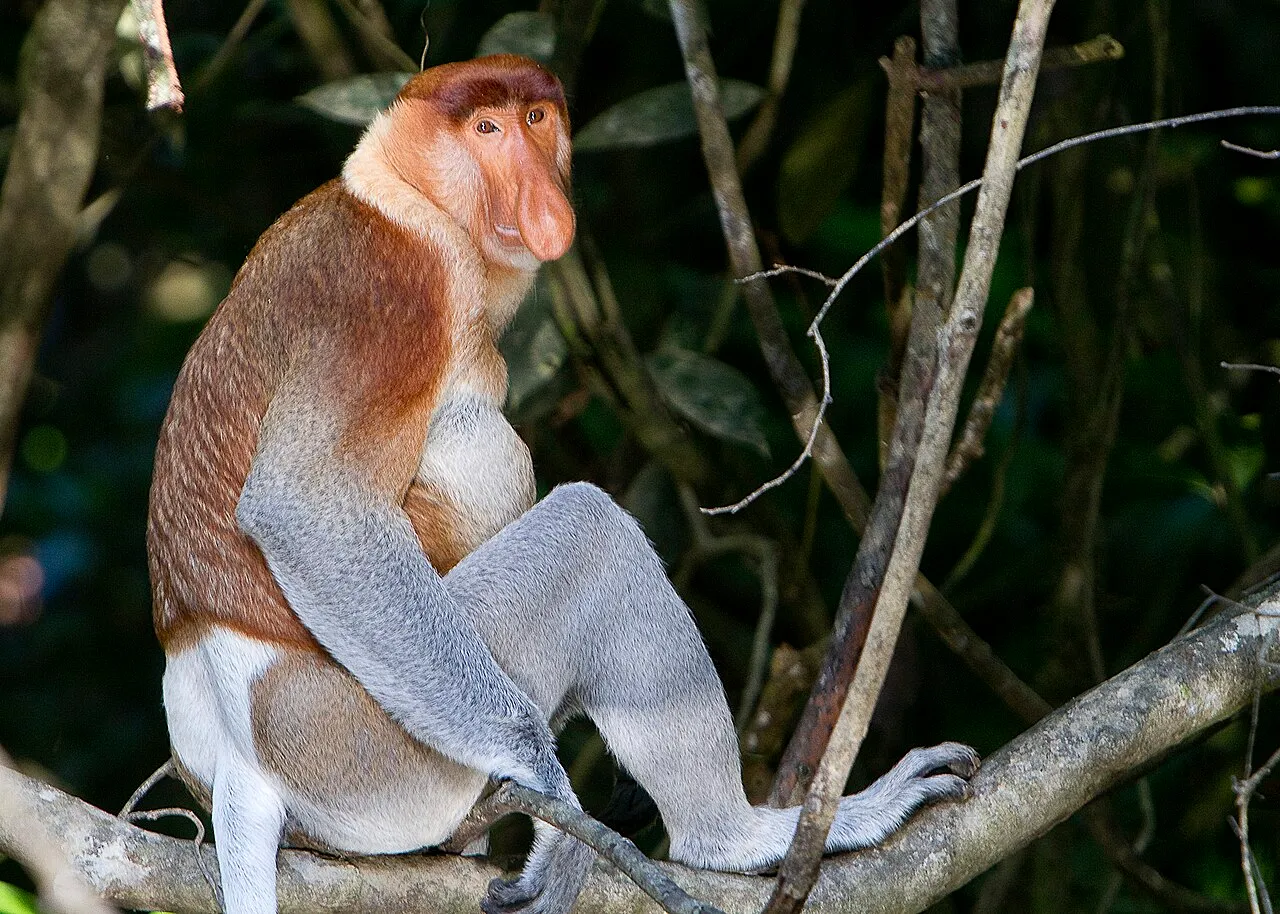
The proboscis monkey, Nasalis larvatus, is a colobine monkey found only on the island of Borneo, in Brunei, Indonesian Kalimantan and Malaysian Sabah and Sarawak. It lives mainly in mangrove and riverine forest1, almost always near water, and is best known for the adult male’s large, pendulous nose.
What does a Proboscis Monkey look like?
The feature that gives the species its name is the male’s nose, which can exceed 10 cm in length and often hangs lower than the mouth; it is thought to enhance the male’s vocal calls through resonance. Females have a much smaller nose1 by comparison. Both sexes have a characteristic protruding, pot-bellied abdomen2.
Adults are males 73–76 cm and females 61–64 cm in head-body length, excluding the tail. Males weigh 16–22 kg and females 7–12 kg, making this one of the more sexually dimorphic colobines. The back is bright orange, reddish brown, yellowish brown or brick-red, with light-gray, yellowish or light-orange underparts, and the arms, legs and tail are grey. Males additionally carry a dark brown mane on the back and have a black scrotum and red penis, making the sexes coloured differently as well as sized differently. Infants are born with a blue face that darkens to grey1 by about 2.5 months and turns cream-coloured, as in adults, by about 8.5 months. The fingers and several toes are webbed2, an adaptation for swimming.
Where do Proboscis Monkeys live?
The species is endemic to Borneo, found in Brunei, Indonesian Kalimantan, and Malaysian Sabah and Sarawak. It keeps mainly to coastal and riverine areas: mangrove forest along rivers and estuaries, swamp forest and lowland rainforest, almost always close to water1. Most proboscis monkeys live outside protected reserves2, in habitat that is largely threatened or already disturbed.
What do Proboscis Monkeys eat?
The diet is mainly young leaves and shoots, together with unripe fruit and seeds of mangrove and riverine trees, with invertebrates eaten only occasionally. The balance shifts through the year: Animal Diversity Web records a diet more fruit-focused from January to May1 and more foliage-focused from June to December.
How do Proboscis Monkeys live?
Proboscis monkeys are diurnal, feeding then moving inland to rest, with feeding peaks in the morning and at dusk before the group returns to riverside trees for the night. The basic social unit is a one-male group of one adult male with 2–7 females and their young1; several such groups come together into sleeping bands that can reach about 60 or more individuals2, though they do not groom or socialise across group boundaries at these gathering sites.
Movement combines quadrupedal walking, leaping and semi-brachiation in the trees. The species is an unusually capable swimmer for a primate: it can leap from high branches straight into the water2 and swim up to 20 m while fully submerged. Vocal communication includes growls, made by males to calm the group; honks, also from males, as a threat or predator warning; and shrieks or screams from either sex during agitation or conflict. Social grooming bouts typically last 1 to 5 minutes1.
How do Proboscis Monkeys reproduce and how long do they live?
Gestation lasts about 166 days, with Primate Info Net noting that some estimates run slightly over 200 days. Mating is not confined to one short season, occurring from February to November, and in some populations births peak between March and May, near the end of the rainy season2. A single infant is born at a time, and it is nursed until about 7 months of age, though it stays close to its mother for over a year afterwards. Newborns are altricial and must be carried by the mother until they can walk on their own1.
Estimates of age at sexual maturity differ: Animal Diversity Web gives about 4 years for females and about 7 years for males, while Primate Info Net gives females maturing around 5 years2. Lifespan in the wild is unknown; in captivity, individuals have lived up to about 23 years1, with females averaging about 20 years and males about 21.
Is the Proboscis Monkey endangered?
The IUCN lists the proboscis monkey as Endangered3, under Red List version 2022.2. Animal Diversity Web records an estimated 50% decline in the population projected over 10 years, and the species is listed on CITES Appendix I. The principal threat is destruction of mangrove and coastal forest, driven by agriculture, oil-palm plantations, mining and logging; Primate Info Net notes that most proboscis monkey habitat is already disturbed or under threat. The species is also persecuted as a crop raider and sometimes poisoned, and in some areas it is hunted for food or recreation, or taken as bait for lizards, snakes and crocodiles, although local Muslim communities in parts of its range avoid hunting it for religious reasons. Boat traffic on rivers disturbs river-crossing behaviour and is linked to declines in population density and group size2, and documented predators include leopards and crocodiles1.
Similar species
- Silvered langur (Trachypithecus cristatus): a smaller colobine sharing the same coastal and riverine forests of Borneo. Adults weigh only about 6.2 kg (females) to 7.1 kg (males), far less than a proboscis monkey, and lack the large nose, instead showing a grey to brownish-grey coat flecked with grey-white “silvered” hairs4 and a tail longer than the body.
- Long-tailed macaque (Macaca fascicularis): also found alongside proboscis monkeys in Bornean riverside forest, but easily told apart by its flat, catarrhine nose rather than an enlarged one, grey-brown to reddish-brown coat, and a tail of 50–60 cm5 that is notably long relative to its smaller body.