Contents
The green monkey, Chlorocebus sabaeus, also called the Western green monkey or sabaeus monkey, is native to West Africa, where it ranges from Senegal to the White Volta River in Ghana. It is known for distinct alarm calls for different predators, and advances in HIV/AIDS research can be directly connected to experiments on green monkeys2. Green monkeys and five closely related species1 were formerly considered subspecies of Cercopithecus aethiops, the “vervet monkeys”, until modern analysis reclassified them as separate species in the genus Chlorocebus.
What does a green monkey look like?
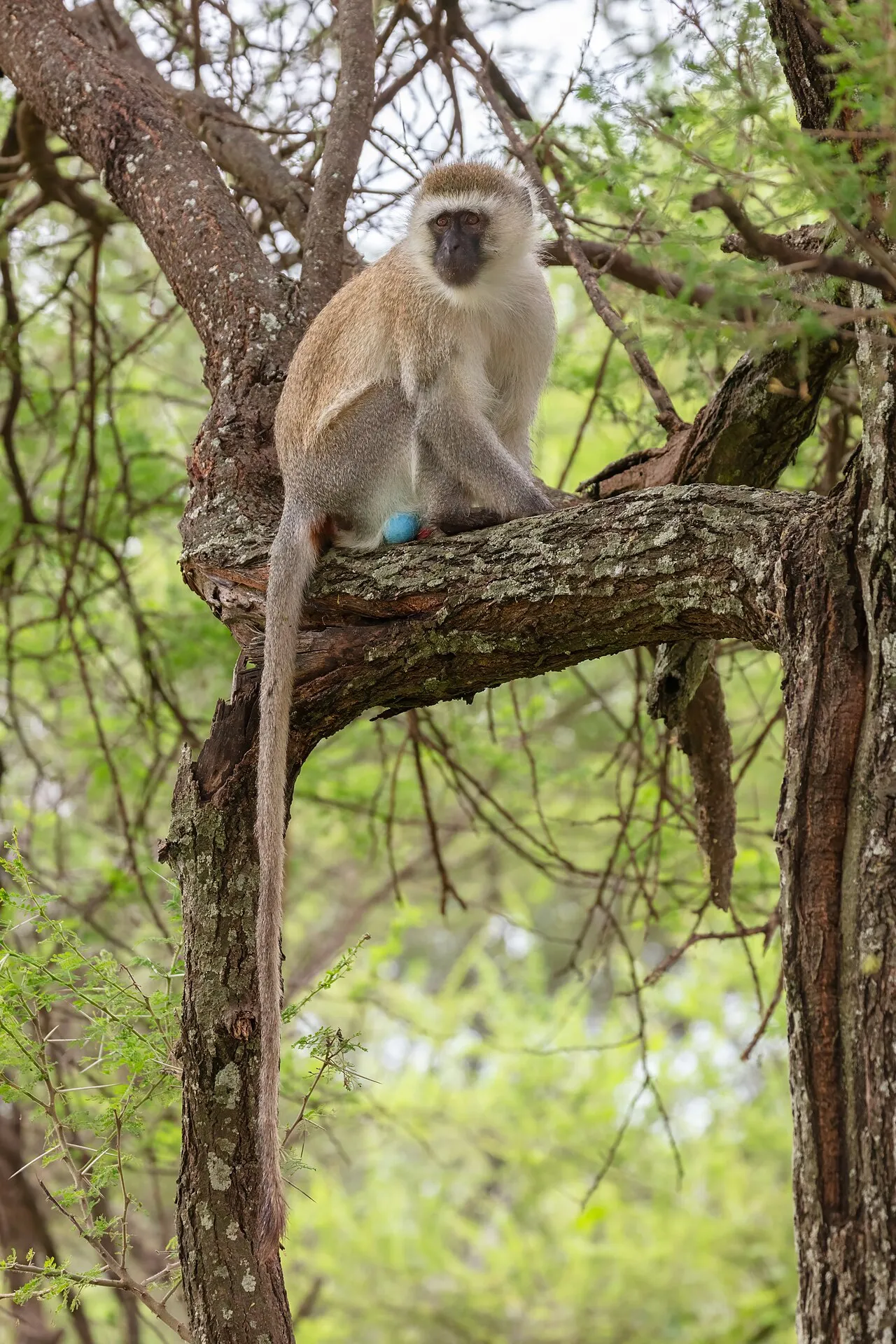
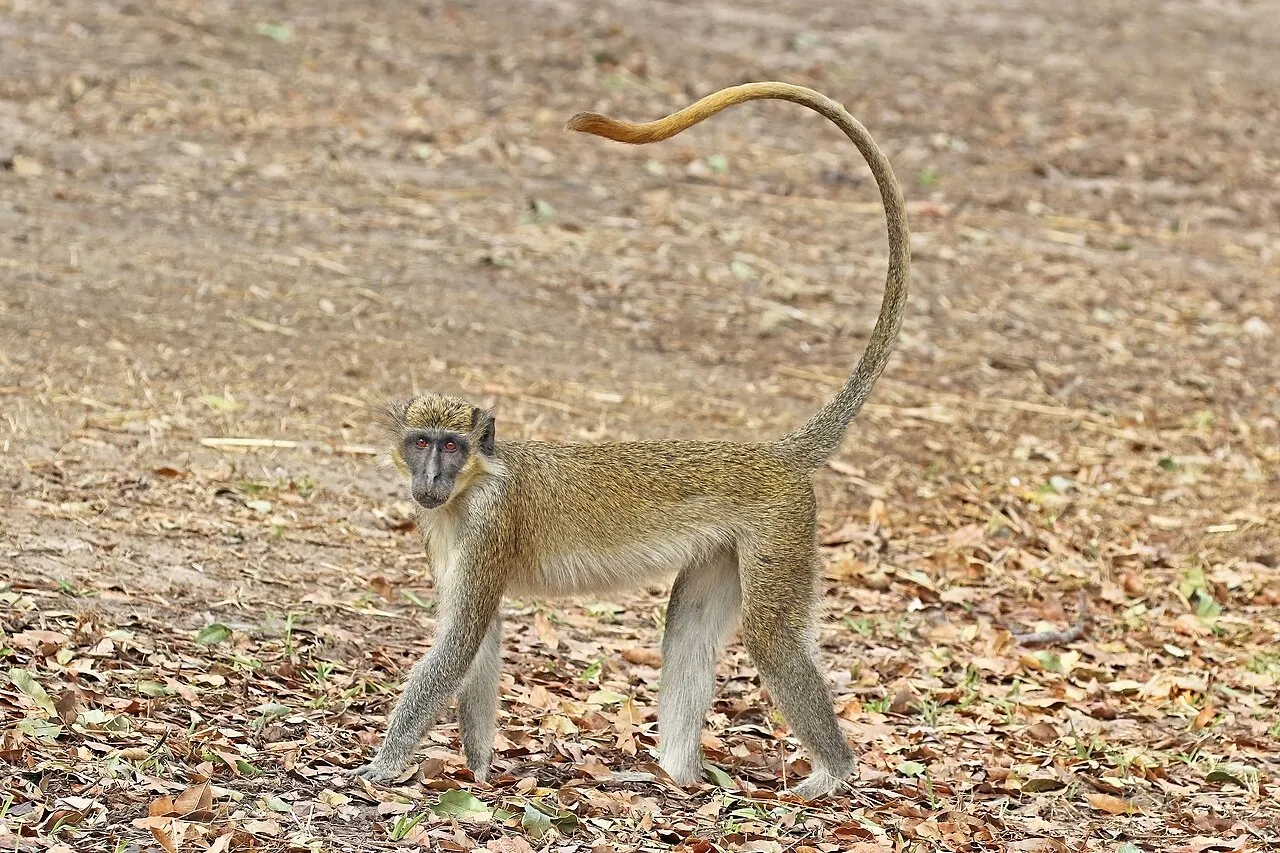
The name comes from the bright golden-green fur on the crown, the back of the head and neck and the upper body. The face and ears are black, framed by lemon-yellow whiskers that can be orange-ish in some populations. The eyes are red-brown with pale yellowish brows, the lower limbs, hands and feet are light grey, and the belly and chest are off-white. The long greyish tail has a pale yellow base and a golden-yellow tip. Infants are born with dark fur and pale faces1.
Males are larger than females. Animal Diversity Web gives males 4 to 8 kg2 and females normally 3.5 to 5 kg, while the New England Primate Conservancy gives averages of 5.1 kg for males and 3.5 kg for females. Head and body measure 42 to 60 cm in males and 30 to 50 cm in females. The tail is often longer than the body, at 46 to 76 cm in males and 41 to 66 cm in females. The size difference between the sexes gets smaller going from north to south1 of the range.
Males have a blue scrotum and a red penis surrounded by white and yellow-orange hairs, a contrast they use as a visual signal of dominance. Dominant males have brighter blue scrotal skin1. Green monkeys almost always travel quadrupedally2 on the ground or in tree canopies.
Where do green monkeys live?
The native range lies south of the Sahara Desert, with populations in Côte d’Ivoire, Ghana, Liberia, Burkina Faso, Guinea, Guinea-Bissau, Mali, Mauritania, Senegal, Sierra Leone and The Gambia. It covers 1,000,000 km², from the Atlantic at Dakar in the west to the Nakambé and Volta River system in Burkina Faso and Ghana in the east. Green monkeys also live on the Bijagos archipelago1 in Guinea-Bissau.
Green monkeys taken as pets by European explorers founded wild populations on Cape Verde, Barbados and Saint Kitts and Nevis. Animal Diversity Web links the Caribbean introduction to slave trading in the 1600s2. In Florida, green monkeys escaped around 1947–19481 from the Dania Chimpanzee Farm, and a group of 12 to 15 that evaded recapture founded a feral population in the mangrove swamps around Dania Beach.
In West Africa green monkeys live in riverine woodlands, savannas, mangrove forests, plantations and orchards, and in mosaics of savanna and forest, from sea level up to 1,000 m1. Animal Diversity Web places them at the edges of forests that border woody grasslands, crossing savannas between forest edges and avoiding the interior of dense, wet forests. In the Caribbean they occupy mangrove swamps, agricultural land and urban settings2.
What do green monkeys eat?
Green monkeys have a varied and flexible omnivorous diet. They prefer fruits, young leaves, seeds and flowers, and add buds, young twigs, stems, bark and gum, even the thorns of the red acacia. Animal Diversity Web names wild bananas, papayas and mangos2 among the common fruits. Prey makes up almost half of their diet1: insects and larvae, bird eggs, birds such as turtledoves, lizards, and small mammals such as Nile rats and young hares.
When food is scarce in the dry season, they dig out West African marbled lungfishes resting in their underground burrows. In mangrove swamps they eat the aerial roots of red mangrove trees1 and catch fiddler crabs. In the wild they commonly use a mouth pouch to store and carry food2 as they find it.
How do green monkeys live?
Green monkeys are diurnal and semi-terrestrial, spending 28–61% of their time on the ground and 28–75% in trees, depending on the habitat. In trees they mostly stay between 0 and 10 m. They swim readily up to 100 m, and mothers swim while carrying their infants. Usually, green monkeys spend ~24% feeding, ~33% travelling and ~34% resting, with the rest on social activity. Troops usually move 2 to 8 km a day1, and up to 11 km in the dry season in search of water.
They live in groups with multiple males and females, each usually with a dominant male who defends the territory. Where annual rainfall is above 50 cm, troops hold under 36 individuals, sometimes as few as 4–9, on home ranges of 15–30 ha. Where it is below 50 cm, a troop can have as many as 174 individuals on a range of up to 140 ha. Animal Diversity Web gives a total group number of 7 to 802. Females typically remain in their natal group for life, while males leave at puberty and keep moving between troops through adulthood. At a large food source, such as a jujube orchard, several troops totalling up to 300 individuals1 can forage together without aggression.
When a leopard alarm call sounds, the monkeys run high into the trees. At a snake alarm, some may stand upright to search for the snake and mob it. As of 2026, green monkeys on Barbados, separated from their predators for ~350 years, had lost predator-specific alarm calls, yet still fled into trees when they heard recorded leopard alarm calls of West African green monkeys. Dominant adult males bark loudly at dawn and sunset to advertise the troop’s location and territory, and a moving troop keeps track of its members with repetitive “cohesion grunts”1.
How do green monkeys reproduce and how long do they live?
Animal Diversity Web describes green monkeys as seasonal breeders, breeding between April and June. The New England Primate Conservancy reports many more copulations in December and January, timing births between April and July. Gestation lasts 163 to 165 days, and females usually produce one offspring a year. Infants nurse until they are 5 to 6 months of age, while Animal Diversity Web gives a weaning age of 12 to 24 months. Females mature at 2 years and males at 5 according to Animal Diversity Web; the New England Primate Conservancy says females usually mature at 3 to 4 years. Infant mortality is high, with a loss of about 57% of all newborns2. Females of different troops guard their young in day-nurseries in large trees1, where 2 or 3 adult females supervise up to 15 young.
The lifespan of green monkeys has not been well studied. In captivity it ranges from 11 to 13 years2, which Animal Diversity Web assumes is the upper limit in the wild. The New England Primate Conservancy says wild green monkeys are estimated to live ~27 years1.
Is the green monkey endangered?
The IUCN lists the green monkey as Least Concern, under Red List version 2022.23. Populations were declining across the range, but the total decline had not exceeded 30% over 36 years, from 1984 to 2020. As of 2026, green monkeys were losing habitat to mining, agriculture, logging and wood harvesting. They were killed for bushmeat, captured for trade as exotic pets, and routinely killed to protect agricultural yields. As hunting pressure increased, troops became quieter and dispersed into different trees. As of 2026, green monkeys were also trapped in the Caribbean every year1 and imported by research and testing laboratories in the United States and Canada.
The green monkey is listed in Appendix II of CITES. Protected areas where it lives include Niokolo-Koba and Saloum Delta national parks1 in Senegal, Comoé National Park in Côte d’Ivoire and River Gambia National Park in The Gambia.
Similar species
- Vervet monkey (Chlorocebus pygerythrus): its face is black, ringed in white by white cheek whiskers and brow fur. Similar Chlorocebus species typically lack its black hands, feet and tail tip4. A green monkey has pale yellowish brows, unlike the much whiter, distinct brow-ridge1 of closely related species.
- Tantalus monkey (Chlorocebus tantalus): ranges from the Volta River in Ghana to the White Nile in Sudan. At the Volta its range overlaps the green monkey’s, and the two might occasionally mate and produce hybrids1. A tantalus monkey’s face, hands and feet have bare, black skin5, and its males have a bright blue scrotum surrounded by orange hairs.