Contents
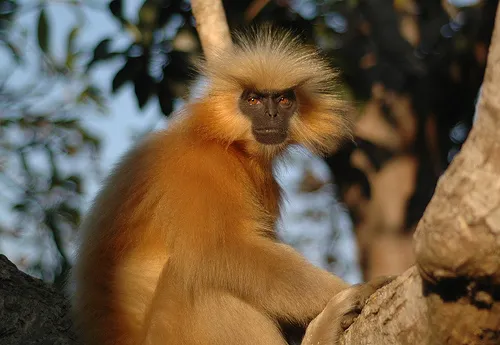
The golden langur, Trachypithecus geei, is an Old World monkey whose range is limited to Assam, India and neighboring Bhutan. It is named for the colour of its fur, which ranges from dark golden to creamy buff, set off by a black, hairless face with a long pale beard. The scientific name comes from the man who discovered them, Gee, and the monkey was first discovered in 19561, when it was placed in the genus Presbytis.
What does a golden langur look like?
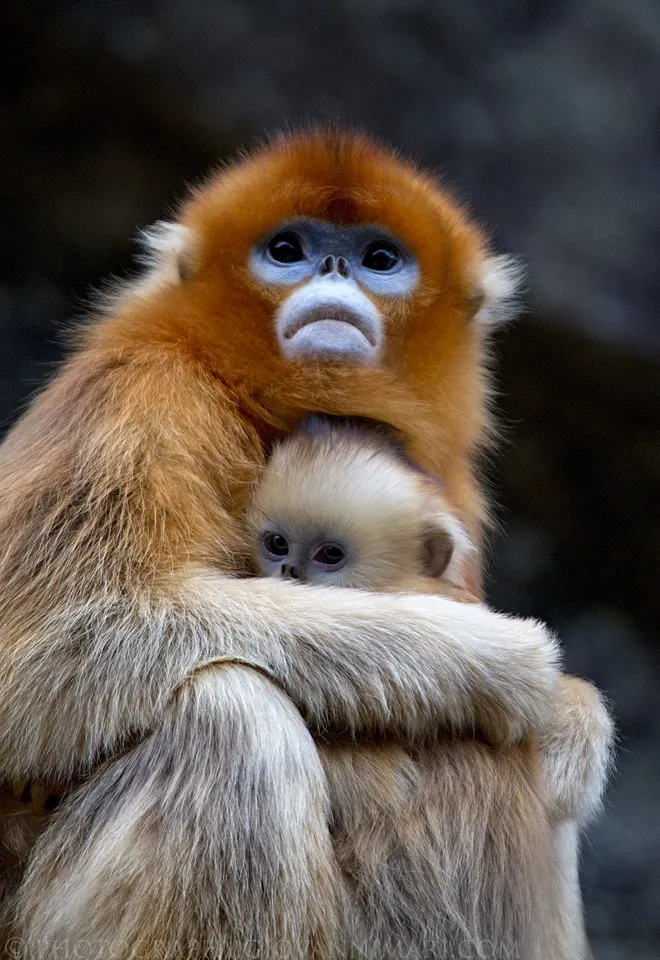
The golden langur has a slim build, with long limbs and tail. Its head and body measure 50 to 75 cm, and the tail adds 70 to 100 cm, ending in a tassel. Animal Diversity Web gives an average mass of 8,100 g1; AnAge lists the same adult weight of 8,100 g2. Fleagle (1999) gives 10.8 kg for adult males and 9.5 kg for adult females3.
The fur is a slightly darker red on the top and sides and lighter underneath. It changes with the seasons: dark golden chestnut in the winter and more cream-coloured in summer. Young golden langurs are almost pure white. Golden langurs in the south tend to be more uniform in color and smaller1 than those in the north.
Males tend to be slightly larger than females1, and the tail is notably larger in males. Adult males have a cream to golden coat with darker flanks, while females and juveniles are lighter. Two subspecies are recognised: T. g. geei and T. g. bhutanensis3, the latter in the northern part of the range in Bhutan.
Where do golden langurs live?
Golden langurs live in a region bounded by four geographical landmarks1: the foothills of Bhutan to the north, the Manas River to the east, the Sankosh River to the west and the Brahmaputra River to the south. The area within these limits is approximately 30,000 square kilometres3, much of it unsuitable habitat.
The habitat is moist evergreen and tropical deciduous forests, as well as some riverine areas and savannas. The monkeys live in the upper canopy of sub-tropical forests in the south and in more temperate forests in the north. They are found from close to sea level up to 3000 m at the foothills of Bhutan. As of 2004, four national parks and wildlife sanctuaries1 covered most of the area where golden langurs are found in Bhutan; in Assam they lived in two wildlife sanctuaries and in fragmented reserve forests.
What do golden langurs eat?
Golden langurs are both folivores and frugivores. They eat ripe and unripe fruits, young and mature leaves, leaf buds, flower buds, seeds, twigs and flowers, and mostly prefer to eat young leaves. The most popular plants are Ficus racemosa, Salmalia malabarica and Adenanthera peuonina. Like other members of the subfamily Colobinae, they have a sacculated stomach1, made up of compartments that help break down the cellulose in leaves.
How do golden langurs live?
Golden langurs live in groups of 4 to 40 members, with an average group size of 8. The adult sex ratio was 2.3 females to every male3, although most groups had only one adult male. Little was known about the social structure in 2004, but social grooming is a very important group activity1 that strengthens the bonds between group members.
The species is diurnal and mostly active in the early morning and afternoon, when it feeds. Golden langurs spend most of their time in the tree canopy and move by leaping from branches, pushing off with the hind limbs and landing on all four limbs. They may also walk on all fours when they descend and on larger branches. Each group tends to stay in the same place1 and does not move far from home.
Golden langurs are a shy species that avoids humans, which makes many of their behaviours hard to observe. Vocal communication exists, including loud “whooping” noises heard from the males1.
How do golden langurs reproduce and how long do they live?
As of 2004, golden langurs had been studied relatively little, and little was known about their reproduction. Births occur almost year-round, with a possible peak of a few months that matches changes in climate and vegetation. A female gives birth to a single offspring at a time. The breeding interval was unknown in 2004. Parental care had not been observed in this species by 2004; it is presumed to be similar to that of Hanuman langurs1, where the mother and other females provide all the care for the young.
As of 2004, little was known about lifespan in the wild, due to their rarity and fairly recent discovery1. AnAge (build 15, 2023) has not established a maximum longevity, but records that one specimen lived 15.3 years in captivity2.
Is the golden langur endangered?
The golden langur is listed as Endangered4 on the IUCN Red List, which first listed it as endangered in 1976. In 2003 the IUCN Red List considered it endangered, and it was listed as Appendix I on the CITES website. The main reasons for its low numbers are its localized habitat and the rapid loss of this habitat through deforestation. An estimated 50% of their habitat was lost from India in a span of 10 to 12 years, and about 4,500 golden langurs remained in 19981 in Assam and Bhutan. In India alone, the count grew from 6,000 in 2008–09 to 7,396 by 2020–213.
As of 2004, only approximately 95 square km of their habitat1 in India was protected, in the Manas and Chakrasilla wildlife sanctuaries. The species is listed in Schedule I of India’s Wildlife Protection Act, 1972 and of Bhutan’s Forest and Nature Conservation Act, 1995. In Assam’s Bongaigaon district, where a fruit-tree planting project began in 2019, several golden langurs have died3 from electrocution and in road accidents while looking for food beyond the reserve forests.
Similar species
- Capped langur (Trachypithecus pileatus): a closely related species found in northeast India, Bhutan, Bangladesh and Myanmar5. In Bhutan the two species have hybridised3.
- Hanuman langur (Semnopithecus entellus): has brownish gray fur with white fur underneath6 and a white-tipped tail, unlike the golden langur’s golden to cream coat. Hanuman langurs are not afraid to live among humans1, while golden langurs avoid people.