Contents
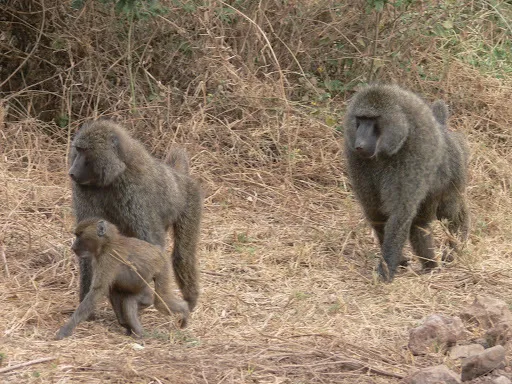
The olive baboon, Papio anubis, also called the anubis baboon, is a monkey found across 25 countries throughout equatorial Africa, with the most expansive range of any baboon species. It is the most broadly distributed baboon species2, ranging through most of central sub-Saharan Africa. Olive baboons live in troops of 15 to 150 individuals3, with several adult males, many adult females and their offspring. The scientific name comes from the species’ striking similarity to the Egyptian god Anubis1, who had the face of a dog with a long snout.
What does an olive baboon look like?
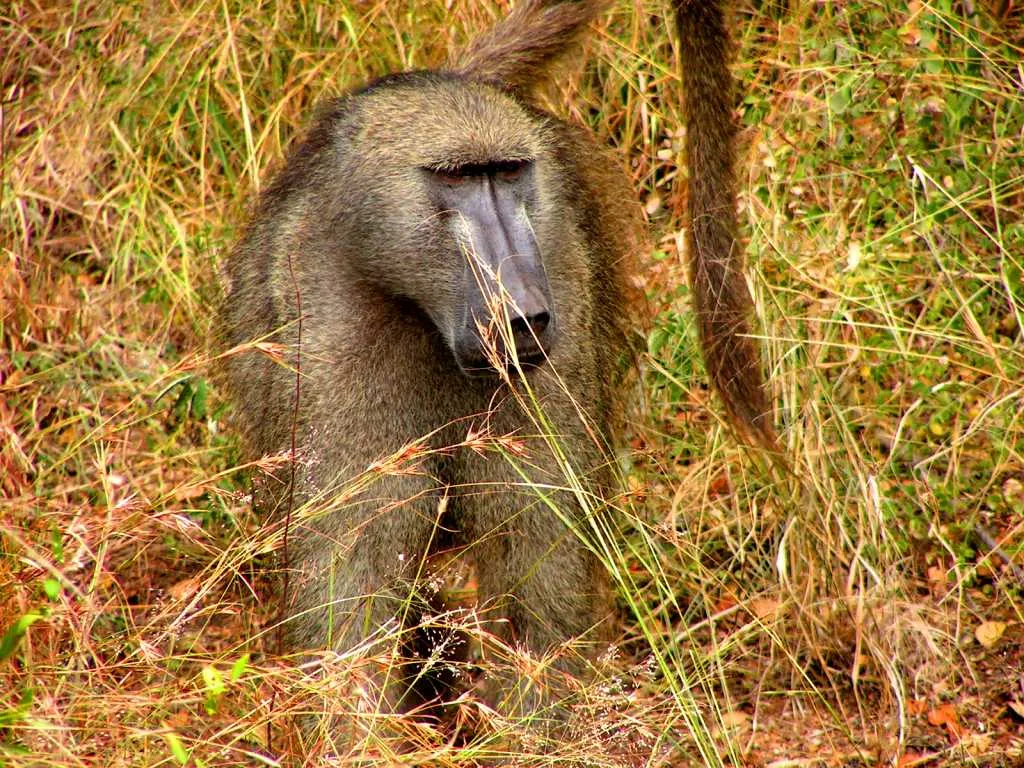
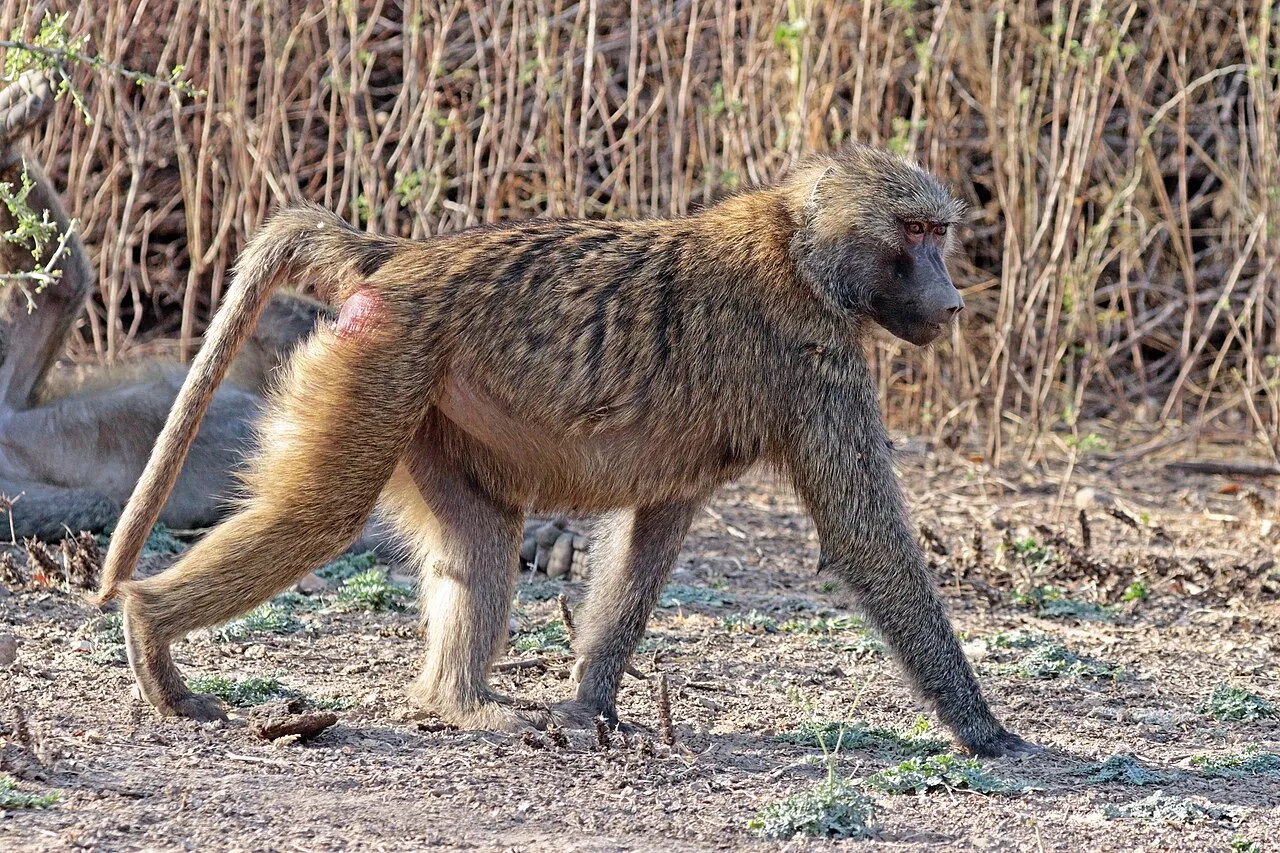
The coat is a dark, olive-gray, produced by hairs with 1 to 2 alternating pairs of black and yellow-brown rings. Adult males have long hair forming a mane from the top of the head through the shoulders, which gradually shortens down the back. Females lack a mane. The skin of the face and around the ischial callosities is dark gray to black in both sexes2. Olive baboons have long, pointed muzzles3 and, because of their quadrupedal stance and locomotion, appear quite dog-like. Like other cercopithecines, they have cheek pouches for storing food as they forage.
The tail is between 380 and 584 mm long3. It is held up and away from the rump for about a quarter of its length and then drops suddenly, giving the appearance that the tail is broken. Infants are born with black fur and pink faces1, and the black natal coat is replaced by the olive-gray by about 6 months of age2.
The sexes differ strongly: males are about twice as large as females. Wild males weigh 24 kg on average and wild females 14.7 kg (Strum 1991). Where they raid crops, males weigh around 27.4 kg and females 15.6 kg, and captive males average 29 kg and females 17 kg (Coelho 1985)3. Animal Diversity Web gives around 25 kg for males and 14 kg for females, with an average head and body length of 760 mm for males and 600 mm for females. Males have large canine teeth2, whereas the teeth of females are much smaller.
Where do olive baboons live?
From west to east, olive baboons are found in Guinea, Mali, Mauritania, Sierra Leone, Côte d’Ivoire, Burkina Faso, Ghana, Togo, Benin, Nigeria, Niger, Chad, the Central African Republic, Cameroon, Sudan, Ethiopia, Eritrea and Somalia. The range extends south into Uganda, Kenya, Tanzania, Rwanda, Burundi, the Democratic Republic of Congo and Congo. Animal Diversity Web reports isolated populations2 within the Saharan region. A group of 60 olive baboons escaped from a safari park in Spain3 in 1972 and began ranging free; until 2001 a free-ranging population could be found there, but it has since been captured and transferred to zoos.
Olive baboons inhabit savannas, tropical evergreen forests, semi-deserts, steppes, montane forests1, semi-arid woodlands and even areas near human settlements, so long as there is a water source nearby. The Wisconsin National Primate Research Center describes habitats ranging from desert to montane forest. In the Bole Valley of Ethiopia they range from the valley bottom at 1700 m to the plateau at 2300 m (Dunbar & Dunbar 1974). In Eritrea they live in lowlands below 900 m3, where riverine forest borders savanna.
What do olive baboons eat?
Olive baboons are omnivores that eat roots, tubers, corms, fruits, leaves, flowers3, buds, seeds, bark, exudates, cacti, grasses, insects, birds, bird eggs, and vertebrates up to the size of a small antelope. They find food on the ground, in the trees and underground. Troops near forests eat a heavy fruit-based diet1, while those near the savannas mainly eat seeds and grasses. During the dry season, many populations dig up roots, tubers and corms to make up for food scarcity. Baboons can subsist on grasses for extended periods2, which allows them to exploit dry habitats such as deserts, semideserts, steppes and grasslands.
Both males and females hunt. In simple hunting, one baboon pursues the prey for less than 10 minutes within 300 m of the troop; complex hunting involves more than one baboon and ranges 300 to 4000 m from the group. Thomson’s gazelles make up 33% of the prey (Strum 1983)3. Olive baboons raid farmland1, taking crops such as maize, bananas, sugarcane and beans, and have been known to eat trash or kill goats and sheep.
How do olive baboons live?
Olive baboons are diurnal1: active during the day, asleep at night. They are quadrupedal, mainly terrestrial primates, and members of a troop travel, forage and sleep together. Animal Diversity Web says an average troop may number 39 to 97 animals2, and the daily range of a troop at an average of 5,800 m. At night they prefer open cliffs with near-vertical slopes (Hamilton 1982)3; when cliffs are not available, they choose trees that protrude from the surrounding canopy.
Females almost always remain in their natal group for their entire lives, whereas males disperse in order to mate. Rank among females is passed down through the mother, so daughters rank just below their mothers. Males leave their natal group between six and nine years of age and transfer several more times over their lives. Fights between adult males occur almost daily and injuries are common. Older males, past their prime or at least 14 years of age, form coalitions to keep younger males from mating. Females also form long-lasting “friendships” with one or two males3, grooming, travelling and sleeping near them.
The most common call, given by all ages, is the “basic grunt”, heard throughout the day. The two-syllable “wa-hoo” is given in series lasting one to 20 minutes, in response to predators, in distress and at night. Olive baboons have white eyelids, made visible when they raise their eyebrows as a mild threat. Young olive baboons in Nigeria have been seen to swim and dive (Pfeyffers 1999-2000)3, presumably as play.
How do olive baboons reproduce and how long do they live?
Females cycle and give birth throughout the year (Bercovitch & Harding 1993). Mating is promiscuous: both sexes have multiple mates, and a male and a receptive female may form a consortship lasting a few minutes or up to two weeks. Gestation lasts about 180 days, after which the female gives birth to a single offspring weighing approximately 1068 g. The interbirth interval ranges from 12 to 34 months; at Gilgil it averages about two years (Smuts & Nicolson 1989)3. Weaning typically occurs around 420 days of age2.
Both sexes reach sexual maturity between four and six years3. Males do not reach full adult size until about 10 years old in the wild, and between seven and eight years in captivity. In the wild, olive baboons can live for 25 to 30 years1, but disease and injuries mean few reach their full lifespan. In captivity, the oldest individual lived to 48 years old.
Is the olive baboon endangered?
The IUCN lists the olive baboon as Least Concern4, under Red List version 2022.2. As of 2024, current data suggests its numbers are substantial and the population quite stable, but there is severe human-wildlife conflict: under the African Convention the species is listed as vermin, and thousands are killed each year by farmers and hunters. In Ethiopia, surveys reported olive baboons as the second biggest threat to agriculture. In parts of Nigeria they are hunted for bushmeat. The olive baboon is listed in Appendix II of CITES1, an agreement between governments that aims to ensure international trade in wild animals and plants does not threaten their survival.
Similar species
- Hamadryas baboon (Papio hamadryas): the two species interbreed in the Awash River Valley3 of central Ethiopia, forming a hybrid zone. The bare area of the rump is much smaller in the olive baboon2 than in the hamadryas or Guinea baboon.
- Yellow baboon (Papio cynocephalus): olive baboons hybridize with yellow baboons3 in Kenya and Tanzania, most notably in Amboseli National Park. The olive baboon’s head is flat on top2, while the yellow baboon has a prominent crest on the top of the head.
- Guinea baboon (Papio papio): its range overlaps with the olive baboon’s3 in Guinea and Mali, in the west of the olive baboon’s natural range. The Guinea baboon has a larger bare rump2 than the olive baboon.