Contents
The mandrill, Mandrillus sphinx, is a large Old World monkey of the rainforests of southwestern Cameroon, western Gabon, Equatorial Guinea and southwestern Congo1. It is best known for the vivid blue and red markings on its face and rump, and the New England Primate Conservancy calls it the largest monkey in the world2. Mandrills live in troops of varying size and feed mainly on fruit.
What does a mandrill look like?
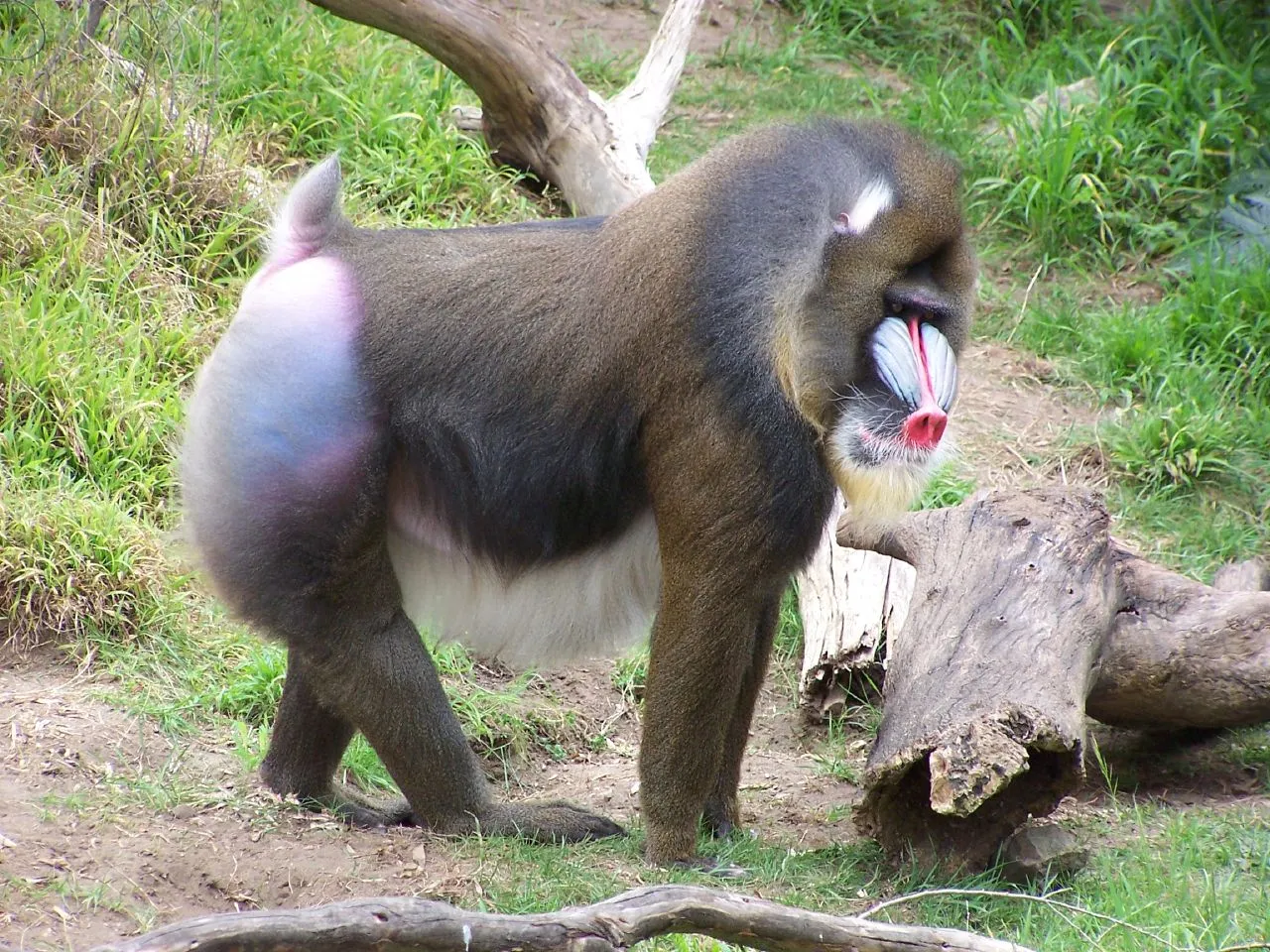
A mandrill’s pelage is olive green with paler underparts, described by the New England Primate Conservancy as an olive-gray coat. Its face carries a red stripe down the muzzle and around the nostrils, with the ridged sides of the muzzle coloured blue, a golden beard, and a rump that is brilliantly coloured blue to purple. These markings are duller in females and juveniles than in adult males1, and the New England Primate Conservancy notes that colour intensity in males tracks testosterone levels and dominance status. Females signal fertility with red swellings on their rump. Mandrills have exceptionally long arms, large canine teeth, and cheek pouches that can hold close to a full stomach load of food2.
Males greatly exceed females in both size and colour intensity. Animal Diversity Web gives males an average weight of 25 kg and up to 54 kg, against a female average of 11.5 kg; the New England Primate Conservancy gives a wider male range of 32 to 54 kg and about 12 kg for females. Head-body length runs 61 to 76 cm1 overall; the New England Primate Conservancy gives about 81 cm for males and 56 cm for females2, within that range.
Where do mandrills live?
Mandrills range across southwestern Cameroon, western Gabon, Equatorial Guinea and southwestern Congo1. The New England Primate Conservancy adds that the core of the range is Gabon, with the distribution bounded by the Sanaga, Ogooué and Ivindo rivers2.
They inhabit tropical rain forest, montane and thick secondary forest, from sea level into hilly and mountainous terrain, and also move through thick bush. Though they live mostly on the ground, mandrills shelter in the trees at night1.
What do mandrills eat?
Mandrills eat a highly varied diet of fruit, seeds, fungi, roots, insects, snails, worms, frogs, lizards, and sometimes snakes and other small vertebrates. The New England Primate Conservancy states that figs and other fruit make up to 90% of the diet, with mandrills also eating soil and clay, and feeding opportunistically on anything they can find2, including scavenged kills. While foraging, males tend to stay on the ground while females and young occupy the mid-level trees1.
How do mandrills live?
Day-to-day groups range from a few individuals up to about 50, in what Animal Diversity Web describes as a harem structure1, where a dominant male defends a group of females to whom he has exclusive mating rights. The New England Primate Conservancy instead describes multi-male, multi-female groups of roughly 40 members that can gather into much larger troops of 600 to 800 individuals2 — a different scale from the harem groups Animal Diversity Web describes, not an average of the two.
The dominant male returns immediately at any sign of danger1 and, per the New England Primate Conservancy, is responsible for leading the group in foraging and maintains his rank through threatening vocalisations and displays of strength such as lunging or charging, alongside facial expressions, postures and scent marking. Female hierarchies are matrilineal, with rank depending on family ties to dominant females, who in turn get greater access to food and high-status males. Grooming is common and helps maintain dominance hierarchies, resolve conflicts and strengthen social bonds2.
Mandrills are diurnal. They communicate with visual and acoustic signals, scents and tactile information, grunting to maintain contact in the forest where visibility is low1. The New England Primate Conservancy adds barks for warnings or aggression and screams for fear or alarm, alongside scent marking from the chest, rump and genital glands that conveys sex, hierarchical rank and fertility2.
How do mandrills reproduce and how long do they live?
Animal Diversity Web reports that mating is believed to occur between July and October, with births between December and April, while the New England Primate Conservancy describes sexual activity occurring twice each year during the female’s 32-day cycle. Gestation lasts about six months — Animal Diversity Web gives 173 days by one estimate. Births are usually single, with twins observed only in captivity; infants are born with a black natal coat and pink skin that lasts about two months. Groups may breed every two years1 depending on food availability, and infants become independent after about two years2.
Estimates of maturity differ: Animal Diversity Web puts a female’s first offspring at 4 to 8 years1, while the New England Primate Conservancy gives 4 years for females and 7 for males2.
The New England Primate Conservancy estimates a wild lifespan of about 20 years2; Animal Diversity Web has no wild figure but records a captive average of 31.7 years for females and a maximum of 46 years1, a record the New England Primate Conservancy cites as well.
Is the mandrill endangered?
The IUCN lists the mandrill as Vulnerable, under Red List version 2022.23. Animal Diversity Web describes a drastic decline in the mandrill population due to habitat destruction (Ingmarsson 1999), and notes mandrills are especially vulnerable to hunters because of their loud calls; they are hunted as food and live at very low density, poorly protected if at all1. The New England Primate Conservancy adds that rainforest is cleared for mining, farming, logging and human settlement, that mandrill meat is considered a delicacy in Africa, and that climate change is shifting the distribution of many common mandrill foods2.
The mandrill is listed on CITES Appendix I. In 2008, 36 captive-bred mandrills were released into Lékédi Park, Gabon, with stable survival and reproduction after two years, and in 2021 the Central African Forest Initiative agreed to pay Gabon $150 million for rainforest protection2.
Similar species
- Drill (Mandrillus leucophaeus): the mandrill’s only living congener. Drills have jet black faces1, lacking the mandrill’s bright facial colouring and the prominent grooves in its facial ridges; a drill’s coat is brown with a yellow tinge, and its range lies north of the mandrill’s, in Cameroon north of the Sanaga River and on Fernando Poo island4.
- Olive baboon (Papio anubis): the New England Primate Conservancy notes mandrills were once classified with baboons in the genus Papio2 before being placed in their own genus. The olive baboon’s face and build are far plainer: its pelage is dark olive-gray, its face and ischial callosities are dark gray to black in both sexes, it has a flat-topped head rather than ridged facial markings, and males carry a large anterior mane5 that mandrills lack.