Contents
The hamadryas baboon, Papio hamadryas, is an Old World monkey native to the Horn of Africa and southwestern Arabia. It is famous for its complex, multi-level social system, and it is the only baboon species in which males maintain a harem. Ancient Egyptians deified it1 and considered it an avatar of Thoth, the god of learning2.
What does a hamadryas baboon look like?
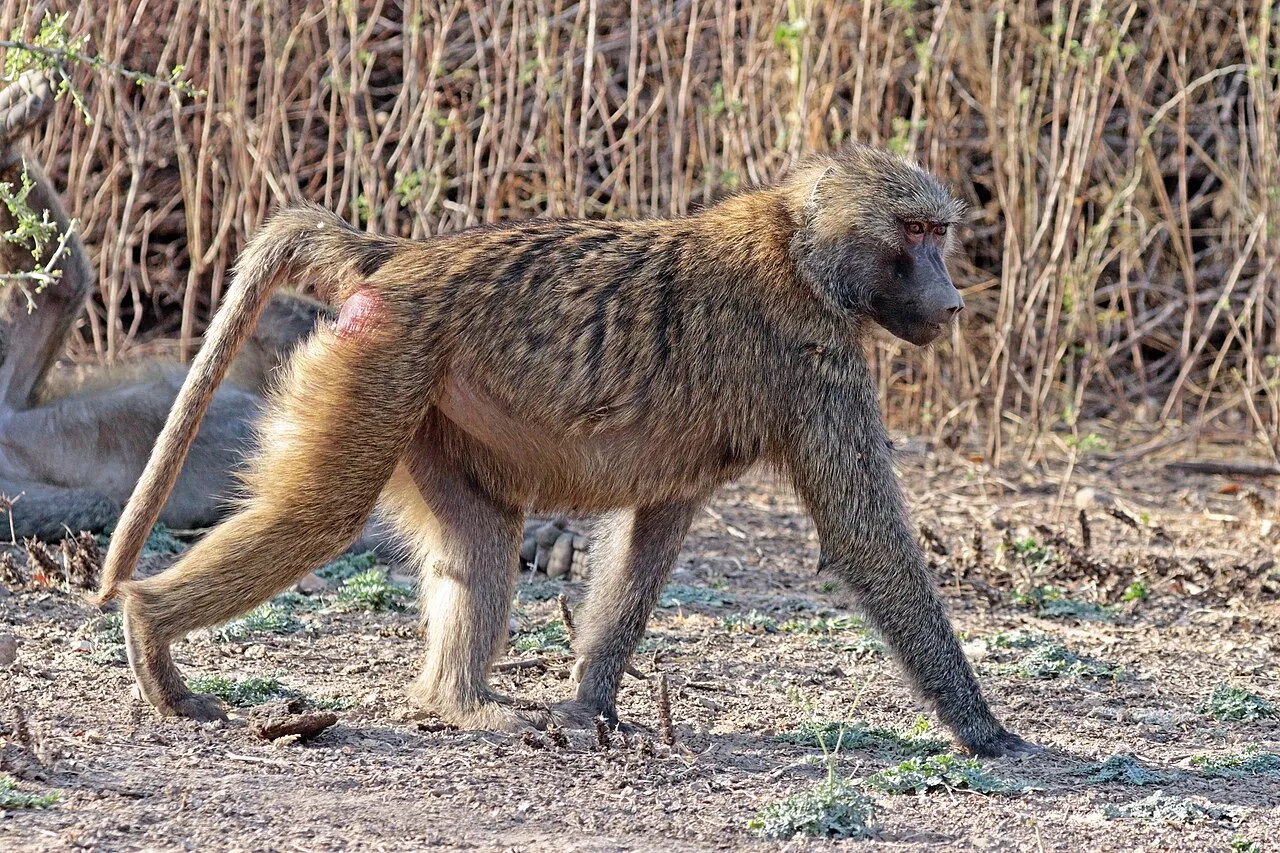
Hamadryas baboons are highly sexually dimorphic in size and pelage. Males may measure up to 80 cm and weigh 20 to 30 kg4, while females weigh 10 to 15 kg and have a body length of 40 to 45 cm. Animal Diversity Web puts adult males at around 21.5 kg and females around 9.4 kg, and the San Diego Zoo Wildlife Alliance gives males 16 to 20 kg1 and females 8 to 14 kg. The head and body length has been reported as 610 to 762 mm3, with the tail adding a further 382 to 610 mm.
The male’s coat is basically grayish-brown, with lighter cheek hairs that grade into a very pronounced, bushy, silver-colored mane; females are a plain olive-brown. The male’s mane covers the head and shoulders and reaches all the way to the hips, while females lack this mane and have much shorter hair. In both sexes the skin around the ischial callosities is pink or bright red; males have skin of a similar color on the muzzle and face, whereas females have a muted, grayish-brown face. Males also have larger canine teeth2; their muzzles have cheek pouches that can store food temporarily. The tail is long and curved, with an arch at the base. The natal coat is black3 and is replaced by approximately six months of age with an olive-brown coat like that of an adult female.
The male’s mantle of hair, reaching to the waist, distinguishes this species from other baboons in its range1.
Where do hamadryas baboons live?
In Africa the species is found around the southern Red Sea, in Ethiopia, Somalia and Eritrea, and it also occurs in Saudi Arabia and Yemen. Its range extends to Djibouti4, and in Arabia it is native to the Sarawat Mountains; it is locally extinct in Egypt. The San Diego Zoo Wildlife Alliance places it principally in Ethiopia1. The Arabian populations often live in close association with humans, and, although considered endemic to the region, they were probably introduced there accidentally3 at some point during the height of the ancient Egyptian Empire.
Its habitat is subdesert, arid brushland, steppe, plain and savannah1, in areas with vertical cliff faces on which it sleeps. The availability of sleeping sites appears to be the principal limitation3 on its range. Hamadryas baboons are relatively more tolerant of low-water conditions and can be found more than 6 km away from rivers2.
What do hamadryas baboons eat?
The hamadryas baboon is omnivorous3. Its known foods include fruits, tree gums, insects, eggs, acacia seeds and flowers, grass seeds, grass, rhizomes, corms, roots, tubers and small vertebrates. The San Diego Zoo Wildlife Alliance calls it primarily vegetarian1: it eats seeds, roots, berries, leaves and flowers, raids agricultural lands, opportunistically takes insects and occasionally preys on hare or dik-dik antelope.
It feeds on fruit from acacia species, and where it lives close to cities it supplements its diet by foraging at garbage dumps. When locusts swarm, hamadryas baboons and almost every animal in the area feed on the locusts2. During the dry season it eats the leaves of Dobera glabra and sisal4. Baboons can subsist on grasses for extended periods3, which allows them to exploit deserts, semideserts, steppes and grasslands.
How do hamadryas baboons live?
Like other baboons, the hamadryas baboon is diurnal and quadrupedal2, and it is a mainly terrestrial primate. Its basic social unit is the one-male unit, in which a leader male aggressively herds and controls from one to nine females and their offspring; another account gives up to 10 females4. A single unit may hold 2 to 23 animals, 7.3 on average3. There may also be a subordinate “follower” male, thought usually to be related to the leader.
Two to three units form a clan, whose males are thought to be close genetic relatives. Clans form bands: two or three clans per band in one account, and two to four clans, up to 400 individuals4 in another, while the New England Primate Conservancy gives bands of 9 to more than 200 individuals2. Troops are aggregations of baboons that use the same sleeping cliffs or rocks3, and it is unlikely that the troop has any social significance to the animals themselves.
Aggression is generally seen in male leaders, who threaten and bite females that stray from the unit or get close to other males. In other baboons, males transfer from their natal groups into other troops, but male hamadryas baboons remain in their natal clans and usually their natal bands. Male leaders begin each day by “coordinating” on the water hole at which the band will reunite at midday: a leader takes several steps in the direction of a particular water hole, and when a majority of leaders agree, the daily foraging march begins. Researchers have observed that agreeing on a travel direction can take the baboons over an hour2. The daily range varies from 6.5 to 19.6 km3, and the maximum home range is approximately 40 km².
Adult males give a two-phase bark, or “wahoo” call, toward feline predators or other males. All hamadryas baboons except infants make rhythmic grunts when approaching another animal, and all except adult males give a shrill bark to indicate alarm. Most social grooming is performed by females and is directed toward the unit leader. Tool use has been recorded mostly in captive individuals2. Known predators are leopards and Verreaux’s eagles3.
How do hamadryas baboons reproduce and how long do they live?
Hamadryas baboons breed aseasonally, although Kummer (1968) did report a peak of births in May/June and November/December. Gestation lasts about 172 days, after which the female gives birth to a single offspring weighing from 600 to 900 g. Females have an average interbirth interval of 24 months, with some as short as 12 months and some as long as 36 months. The average length of lactation is 239 days3, and lactation can last from 6 to 15 months.
Puberty occurs between 4.8 and 6.8 years in males and around 4.3 years in females. Males reach full size around 10.3 years of age, and females reach adult size around 6.1 years. The male’s silver mane, white cheeks and pink hindquarters do not develop until after full adult size is reached. A male may also establish a unit by “adopting” a juvenile or subadult female, grooming her and carrying her if necessary, and he will breed with her when she reaches reproductive maturity. Females can experience deceptive estrous cycles3 when a new male takes control of the unit, which may be an adaptive behavior with an anti-infanticidal effect.
One male hamadryas baboon lived 37.5 years in captivity, and AnAge gives a wild record longevity of 27 years. Typical life expectancy in managed care is about 26 years1. Females appear to undergo menopause at about age 265.
Is the hamadryas baboon endangered?
The IUCN lists the hamadryas baboon as Least Concern6, under Red List version 2022.2. Citing the IUCN’s 2016 assessment1, the San Diego Zoo Wildlife Alliance described it as widespread and abundant, with no major range-wide threats and wild populations stable or increasing. Its current distribution is smaller than its historical range: it used to be abundant in Egypt but is no longer found there. That is likely due to agricultural expansion, hunting for bushmeat2 and farmers killing baboons that come close to their farms. In its 2004 account3, Animal Diversity Web named habitat loss, harvesting for food and for research, and outright persecution as threats.
In Saudi Arabia, people sometimes feed wild hamadryas baboons2, which can make them lose their fear of humans. The species is listed on CITES Appendix II1. It occurs in the Harar Wildlife Sanctuary4, the proposed Yangudi Rassa National Park and a number of wildlife reserves in the lower Awash valley and in northern Eritrea.
Similar species
- Anubis baboon (Papio anubis): the most broadly distributed baboon species, ranging through most of central sub-Saharan Africa. It hybridizes with the hamadryas baboon along the Awash river valley in Ethiopia. Its face and the skin around the ischial callosities are dark gray to black in both sexes7, and its bare rump is much smaller than a hamadryas baboon’s. Male anubis baboons tend to herd females only when they are in estrus3.
- Gelada (Theropithecus gelada): found only in the highlands of Ethiopia and Eritrea. Both sexes have short rostrums and wide nostrils8, short brown fur and a hairless patch on the chest, usually triangular in shape and outlined by white hairs.