Contents
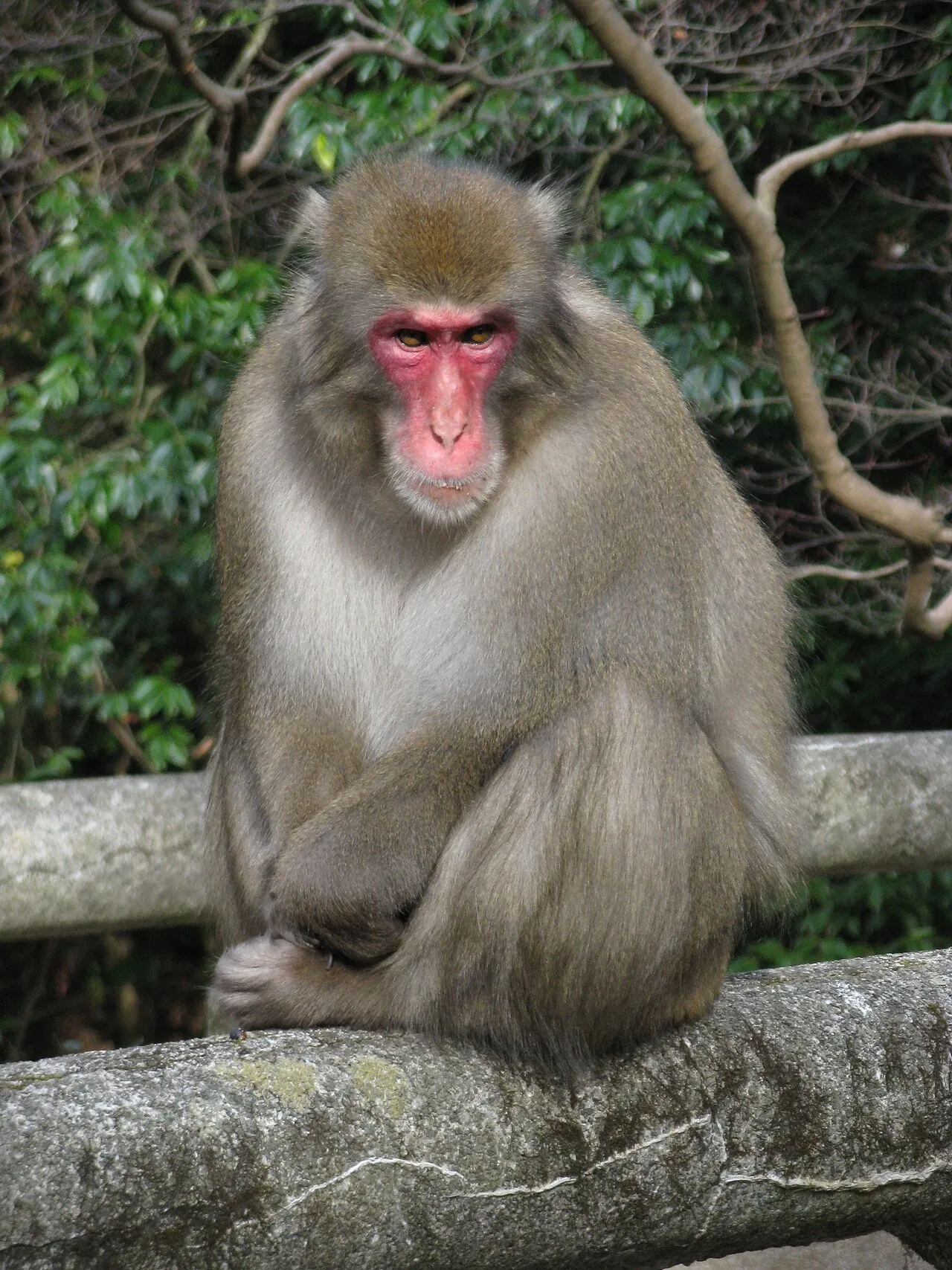
The Japanese macaque, Macaca fuscata, is a monkey native to Honshu, Shikoku and Kyushu1 and smaller surrounding islands, including Yakushima. Its northernmost population, on Honshu’s Shimokita peninsula, is the northernmost wild non-human primate population in the world2. The species is best known as the “snow monkey” for soaking in hot springs in winter3 at sites such as Shiga Heights.
What does a Japanese macaque look like?
A Japanese macaque has thick brown to yellowish-brown or grey-brown fur and a bare pinkish-red face and rump, with visible blood vessels beneath the skin of the face. Its tail is a short stump no more than about 10 cm long. Fur thickness increases with latitude: the New England Primate Conservancy reports that it lets northern populations survive temperatures as low as -20°C2. Males average 11.3 kg and 57 cm in head-body length, females 8.4 kg and 52.3 cm; Animal Diversity Web notes that northern populations run heavier than southern ones1, tracking the colder climate.
During the breeding season adults redden further: females develop a scarlet face and anogenital region3, and males a deep red face with exposed genitals.
Where do Japanese macaques live?
Besides the main Japanese islands, a troop moved from Kyoto to a ranch near Laredo, Texas in the early 1970s and still lives there today4. The species occupies a wide elevational and climatic range, from warm evergreen broadleaf forest in the south to cool deciduous and coniferous forest in snowy northern mountains, at elevations from sea level to about 3,180 m, though groups generally move below 1,800 m in winter1. On Yakushima, rainfall averages about 3,000 mm a year at 20°C, while the northern Kinkazan site averages 1,500 mm at 11°C; northern snow depths can reach 2 to 3 metres3.
What do Japanese macaques eat?
Japanese macaques are omnivorous generalists, recorded eating over 213 plant species3 — buds, leaves, fruit, flowers, seeds and nuts — plus insects, fungi, bird eggs, and, in some populations, crabs and fish. Diet shifts with the seasons: Animal Diversity Web reports fruit predominating in summer and late fall, with a shift toward flowers and nectar in spring and winter1, when fibrous mature leaves become the main fallback food. Some populations near human settlements raid crops, and macaques in the Japanese Alps have been seen overturning rocks to catch fish in shallow water2.
Several provisioned troops are known for washing sand off sweet potatoes before eating them, a learned behaviour passed on by social transmission3.
How do Japanese macaques live?
Japanese macaques live in multi-male, multi-female troops of 10 to 161 individuals, averaging about 41. The society is matrilineal: females stay in their natal group for life, while males emigrate around sexual maturity, sometimes travelling more than 100 km to join a new troop3. Both sexes have a clear dominance hierarchy; a female’s rank is inherited by her offspring2, and an alpha male’s position depends partly on his ties to high-ranking females.
The species is diurnal and mostly quadrupedal1, moving on the ground more than in the trees, though females climb more than males. Over half of their vocalisations are peaceful or calm “coo” calls used to keep the group in contact3, alongside facial expressions such as ear-flattening and lip-smacking. Besides hot-spring bathing and potato-washing, troops have been seen making and throwing snowballs2.
How do Japanese macaques reproduce and how long do they live?
Mating is seasonal, running roughly from autumn to early spring, with births concentrated between March and September. Females reach sexual maturity around 3.5 years, males around 4.5. Gestation lasts about 5.5 to 6 months, and twins are rare, occurring in about 1 of every 488 births1. Weaning is usually complete between 6 and 18 months, and infant mortality in the first year averages about 28%3.
In the wild, males have been recorded living to 28 years and females to 32, though Primate Info Net puts the average wild female lifespan at only about 6.3 years3, reflecting high infant and juvenile mortality, not a typical adult lifespan. In captivity, males have been recorded living to an average of 27 years1.
Is the Japanese macaque endangered?
The IUCN lists the Japanese macaque as Least Concern as of its 2022 Red List assessment5. Even so, it is killed as a crop pest: Primate Info Net reports that farmers and foresters killed more than 10,000 macaques in 1998 alone, roughly a tenth of the estimated wild population at the time, and the species was reported as third among crop-raiding mammals in Japan, behind wild boar and deer. Habitat is also lost to conversion of forest to lumber plantations. The species has been protected from hunting under Japanese law since 1947 and is listed on CITES Appendix II2; Yakushima Island, home to a distinct subspecies, became a UNESCO World Heritage Site in 19933.
Similar species
- Rhesus macaque (Macaca mulatta): native to mainland Asia, from western Afghanistan through India to northern Thailand, not Japan. It carries a long tail of 19 to 32 cm6, against the Japanese macaque’s short stump, and its red face and buttocks sit on grizzled-brown, not yellowish-brown, fur.
- Formosan rock macaque (Macaca cyclopis): found only in the mountains of Taiwan. Its coat runs dark grey in winter and olive-drab in summer, and its tail, at 26 to 46 cm7, is far longer than the Japanese macaque’s.