Contents
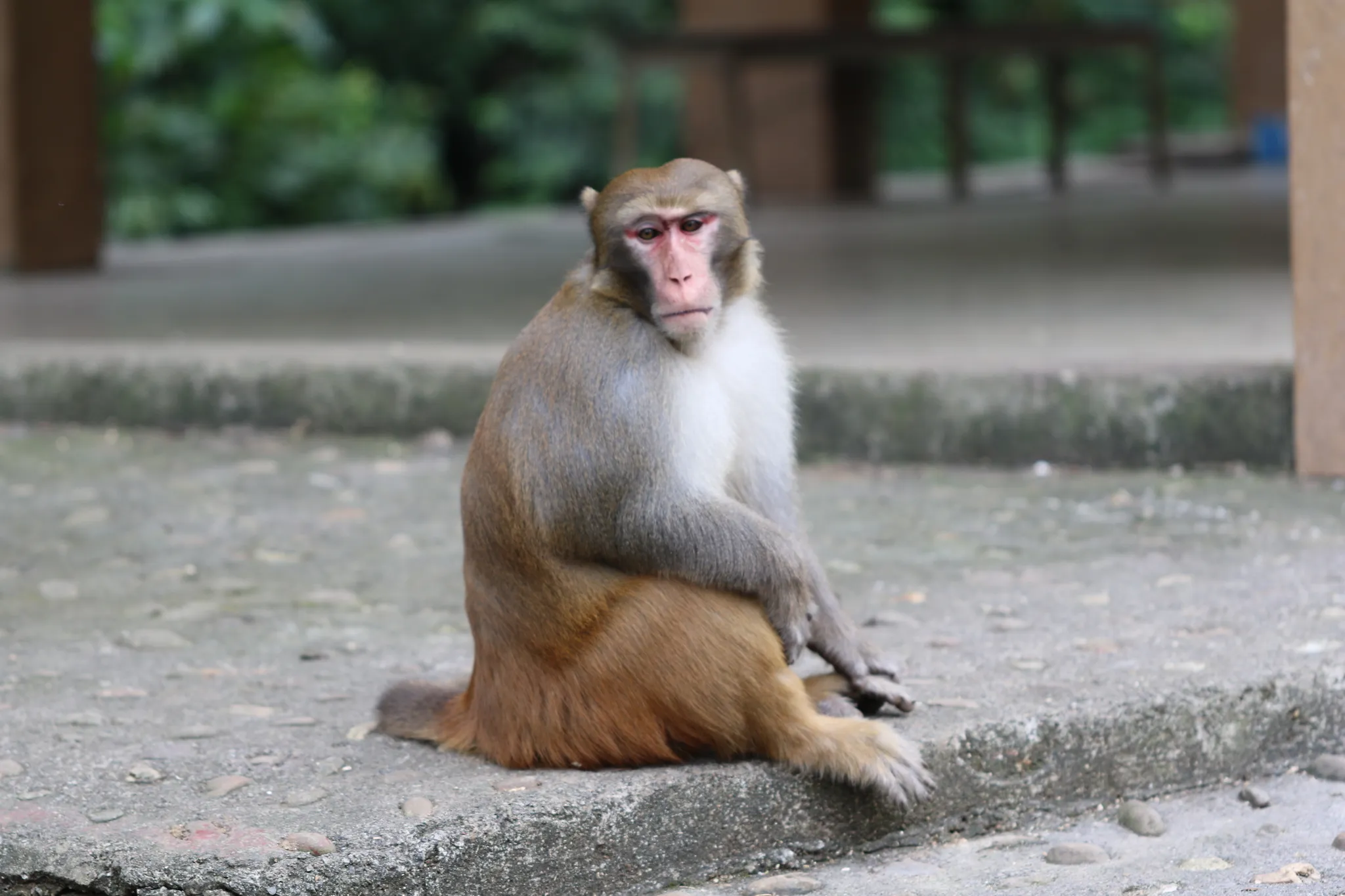
The rhesus macaque, Macaca mulatta, is a monkey native to western Afghanistan through India to northern Thailand, with populations also in Bangladesh, Bhutan, Burma, China, Laos, Nepal, Pakistan and Vietnam2. It is best known for its grizzled-brown fur and bare red face and buttocks, and for how readily it lives alongside people, from Himalayan forests to the streets of northern Indian cities. The Rh blood factor, a protein found in human blood, takes its name from this species1, after researchers first identified it on the red blood cells of rhesus monkeys in 1940.
What does a rhesus macaque look like?
A rhesus macaque has grizzled-brown fur on the back and lighter fur on the underside, described elsewhere as dusty brown to auburn. Its face and rump carry little to no fur and show a reddish-pink colour. The tail adds a further 19 to 32 cm, averaging 208 to 229 mm and shorter than the body itself. Head-body length runs 45 to 64 cm1, with males averaging about 53 cm and females about 47 cm2.
Males are notably heavier than females: Animal Diversity Web puts the male range at 6.5 to 12 kg, while Primate Info Net gives a male average of 7.7 kg; females average 5.5 kg1 by Animal Diversity Web’s figure, or 5.34 kg by Primate Info Net’s. The species is a skilled swimmer, with infants able to swim within two days of birth2.
Where do rhesus macaques live?
Rhesus macaques range across western Afghanistan, through India, to northern Thailand, and were historically abundant in southern China and Tibet too, where Animal Diversity Web says humans have caused a drastic decline over the last sixty years1. A free-ranging colony introduced to Cayo Santiago, Puerto Rico in 19382 has been studied continuously for decades.
The species occupies habitat from flatlands to Himalayan elevations of about 3,000 m, including semidesert, deciduous and bamboo forest, and mangrove swamp. It tolerates temperature extremes, from hot deserts to subzero winters. In northern India, close to half the population lives in villages, towns and cities2, including temples and railway stations, and when relocated, urban-adapted animals seek out similar built environments1.
What do rhesus macaques eat?
The diet is omnivorous and varies with season and location, including roots, herbs, fruit, insects, crops and small animals, as well as flowers, seeds, gums, grass, bark and insects2, down to mushrooms, bird eggs, shellfish and fish. Mountain populations shift from summer clovers to winter pine needles and oak leaves1 once snow covers the ground, without a rise in mortality despite the lower-quality food.
Human food makes up a large share of the diet in some places: Primate Info Net reports that up to 93% of the diet can come from human sources, direct handouts or raided crops and rubbish, and temple populations are commonly fed bread, bananas, peanuts, seeds, fruit and vegetables2 by visitors.
How do rhesus macaques live?
Animal Diversity Web puts groups at up to two hundred individuals, splitting once they reach 80 to 100 members; Primate Info Net instead gives a typical average of 10 to 80 individuals, regardless of habitat type2. A group generally contains several unrelated males and closely related females; all-male groups also occur1.
Females stay in their natal group for life and rank by matrilineal kinship, each female outranking her older sisters, a pattern of female philopatry and male dispersal in which males emigrate at the start of the breeding season. Female rank stays stable for life and passes to her daughters, while a male’s dominance depends on social and aggressive skill as he matures and is far less stable: a dominant male typically holds his rank for about two years before being displaced2. Females usually live in harmony and rarely fight violently with each other, and groups are not territorial: their ranges overlap, and confrontations between groups are rare1.
Rhesus macaques are diurnal, both arboreal and terrestrial, and communicate through body postures and facial expressions, grooming and play, vocal calls, and scent1. Vocalisations include coos and grunts during group movement and affiliative contact, warbles and chirps on finding rare, high-quality food, and a shrill bark as the most common alarm call2 in threatening situations.
How do rhesus macaques reproduce and how long do they live?
Both sexes mate multiple times with multiple partners in a season in this promiscuous mating system, and females enter the female cycle every 29 days, with 8 to 11 days of receptivity in which ovulation falls roughly at the midpoint. Where seasons vary strongly, cold-climate populations mate in autumn for spring births; Primate Info Net places most mating at Cayo Santiago between July and December, while elsewhere mating runs from October through December, with births timed to the rainy season’s end, when food is most abundant. Primate Info Net puts gestation at 164 days2, close to Animal Diversity Web’s figure of around 165 days, roughly 5.5 months, and females almost always bear a single infant, weighing 400 to 500 g at birth1.
Newborns cling to the mother’s underside, switching to riding on her back after about two weeks, and weaning is usually complete by the time the next sibling is born, around 12 months. Under good conditions a female can produce one offspring a year, though Primate Info Net gives a wider typical birth interval of 12 to 24 months. Females reach sexual maturity at about 2.5 to 3 years, males at 4.5 to 7 years1, though males do not reach adult body size until about 8 years2.
Wild rhesus macaques live to 25 to 30 years, with a maximum documented wild lifespan of 30 years. In captivity, Animal Diversity Web gives an average of 23 to 36 years1, while Primate Info Net reports individuals living up to 40 years2.
Is the rhesus macaque endangered?
The IUCN lists the rhesus macaque as Least Concern as of its 2022 Red List assessment3. The Indian population fell sharply during decades of export for research: Primate Info Net reports that often 50,000 juveniles a year were trapped and shipped from India in the 1960s, and by the time exports were regulated in 1977 the Indian population had fallen by 90%. Since the export ban and the growth of captive breeding colonies, the Indian population has more than doubled since the 1970s, and in China the species remains widespread and thriving2.
Where rhesus macaques live close to people, conflict is now the larger pressure: in one surveyed region of India, over 95% of residents reported feeling harassed by bites, theft of household items or other causes, and traditional Hindu reverence for the species is eroding as competition for resources grows2. The species is listed on CITES Appendix II1.
Similar species
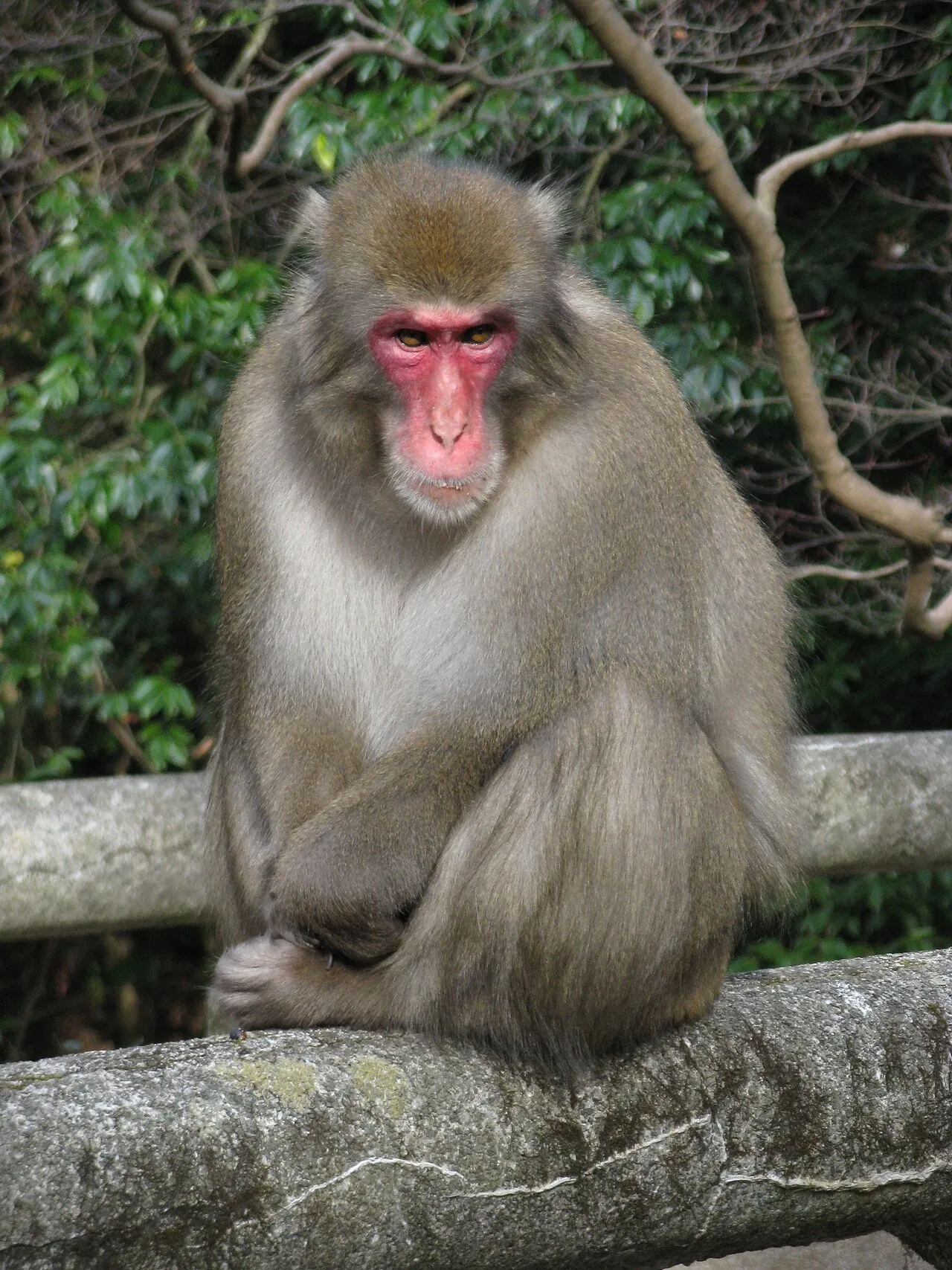
- Japanese macaque (Macaca fuscata): found only in Japan, not on mainland Asia. It carries a short, stumpy tail, against the rhesus macaque’s longer tail, and its fur runs shades of brown and grey to yellowish-brown4 rather than grizzled-brown.
- Crab-eating macaque (Macaca fascicularis): found in Southeast Asia, from Burma east through the Philippines and south into Indonesia, outside the rhesus macaque’s range. It carries a far longer, 50 to 60 cm tail, close to or exceeding its own body length, against the rhesus macaque’s shorter tail, and its coat runs grey-brown to reddish-brown5 without the rhesus macaque’s bare red face.