Contents
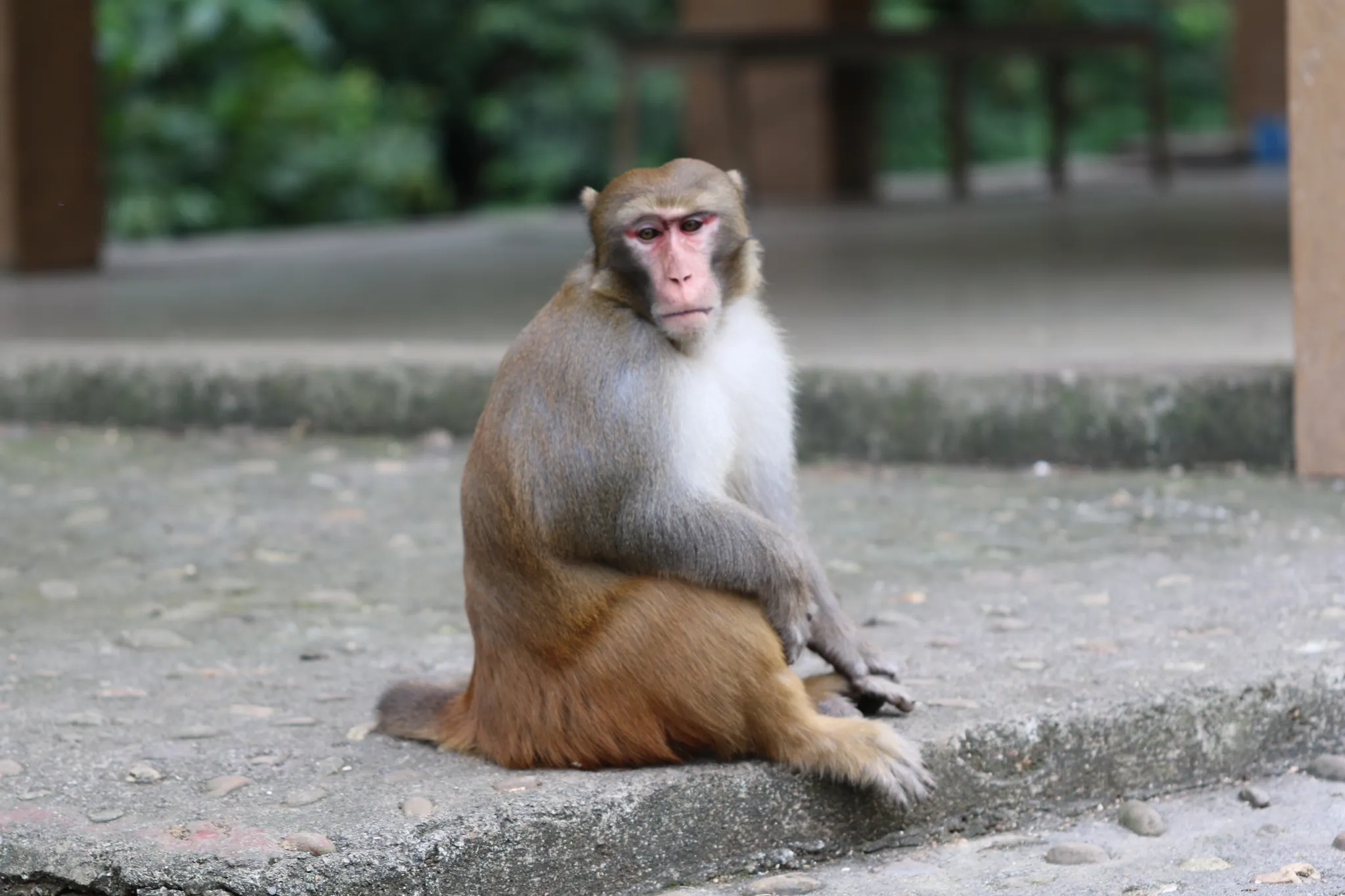
The Tibetan macaque, Macaca thibetana, is a monkey that lives in eastern Tibet, east to Guangdong and north to Shaanxi in China, and a few populations have also been spotted in northeastern India. It is the largest macaque in existence, and it also goes by the names Chinese stump-tailed macaque, Père David’s macaque, Milne-Edwards’ macaque and red-faced monkey. Four subspecies1 are officially recognised, among them the Huangshan macaque of southern Anhui.
What does a Tibetan macaque look like?
Males measure 61 to 71 cm on average, while females are typically 49 to 63 cm long. Adult males can weigh up to 18.3 kg1, whereas adult females weigh around 12.8 kg.
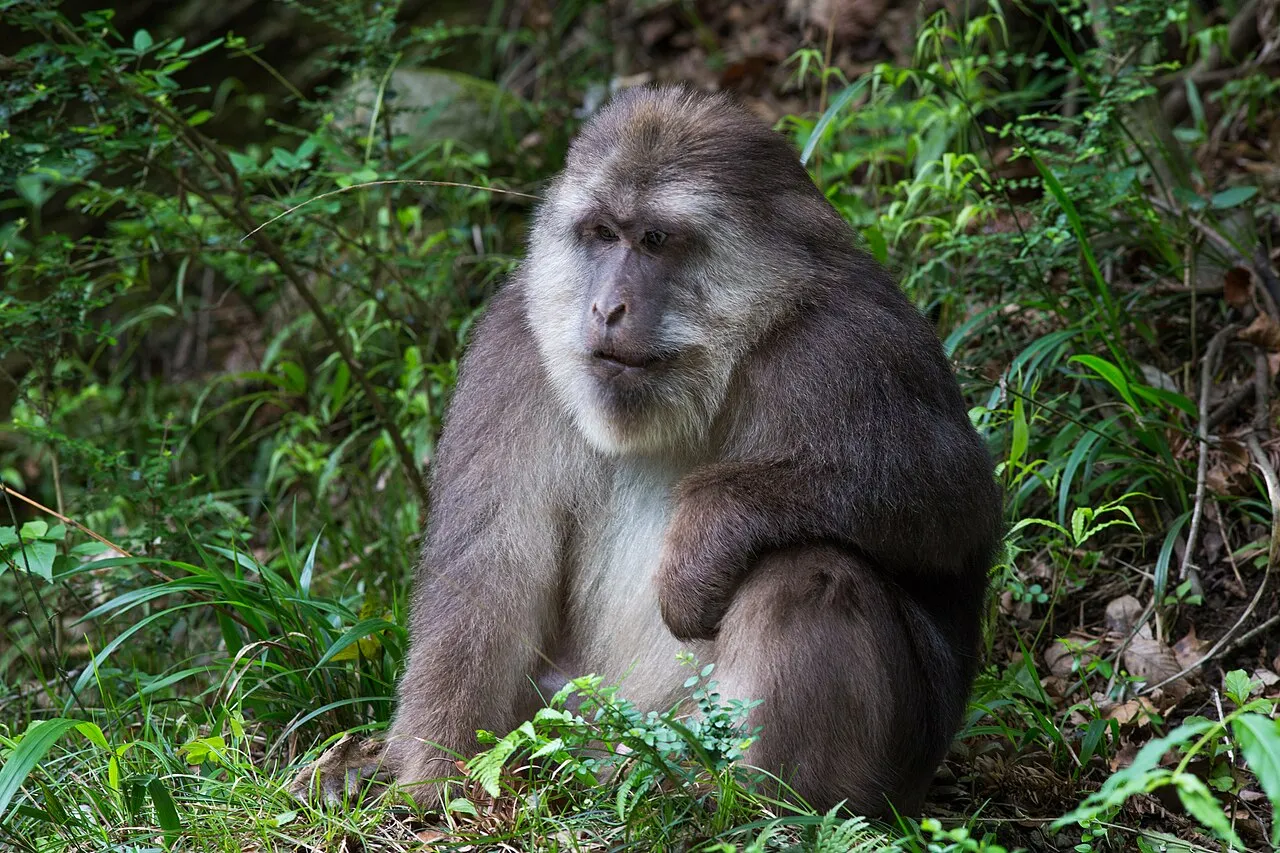
Thick brown fur covers the body, dark chocolate brown over the head, back, arms and legs, sometimes close to black. Light blond hair brightens the face and matches the belly. Most females have red skin around their eyes, and similar skin on the muzzle, while males have pink or brownish skin around the eyes and muzzle. The nose lies flat on a hairless muzzle. The build is stocky, with strong limbs, and both sexes have very short tails, 2 to 3 inches (7.5 cm) long. Males between ten and fifteen years old have darker brown fur and more facial hair, and they are larger. Infants have lighter fur that changes around the age of two1.
Where do Tibetan macaques live?
The range runs from eastern Tibet east to Guangdong and north to Shaanxi province in China, with a few populations in northeastern India. Each subspecies holds its own part of it: M. t. thibetana lives in northern and western Sichuan1 and southwestern Shaanxi, M. t. pullus in Fujian, eastern Jiangxi, southern Zhejiang, northern Guangdong and Zhangjiajie in Hunan, M. t. guizhouensis in Guizhou, northeastern Yunnan and western Hunan, and M. t. huangshanensis in southern Anhui.
Tibetan macaques live in subtropical evergreen and leaf-shedding forests and in low woods and bushy areas, at 300 to 2,100 m, although they can often be found higher up, in rocky terrain. At these elevations they must withstand freezing temperatures in the winter. A home range extends over 14.13 km²1.
What do Tibetan macaques eat?
Tibetan macaques eat over a hundred plant species, and macaques that live at higher altitudes feed differently from those lower down. Fruit makes up more than 50% of the diet. They also feed on mature leaves, bamboo shoots, young leaves, flowers, stems and tender shoots, and occasionally on insects or bark1 when food is particularly scarce.
The diet is richest in summer, with a wider variety of good-quality food on offer. In winter they rely on the fatty seeds of the Masson pine and the starchy nuts of Eyrei’s chestnut, foods that are less nutritious overall. Large cheek pouches1 hidden under the furry face can store extra food when foraging.
How do Tibetan macaques live?
Tibetan macaques are diurnal, most active in mid-morning and early afternoon, and in many regions they rest at noon in the warm summer months. They are mostly ground-dwelling, and in the hottest hours they seek shade by tree trunks, roots and caves. On sunny winter days they spend several hours soaking up the sun on exposed rocks, and they retreat into caves in storms and snow. They often sleep in caves, and also in trees, shrubs and on hillsides, and they tend to sleep close to their feeding sites1.
They spend about 29% of their time foraging, almost 32% resting, almost 27% moving and 7% grooming. Males rest more than females, who move and groom significantly more1.
Groups are male-dominated: an alpha male rules over younger subordinate males, often his offspring, and several females, and his reign lasts 10 months on average. Most groups hold around fifty individuals, and they split into smaller groups when food is scarce or the troop becomes too large. Males leave their birth group when they reach sexual maturity around the age of 7, then form a new group or challenge dominant males in neighbouring groups. Females generally stay in their birth group for life1, with a dominant female and several subordinates, and they form cliques.
Aggression within the species is common, especially among males, and their fights often end in death. The species has virtually no natural predators since the large cats that used to live in these regions have been eradicated. Tibetan macaques live close to the rhesus macaque, but the two interact little1, as Tibetan macaques live at much higher altitudes.
The species uses around twelve distinct calls, grouped into clear calls and harsh calls. Coos, short harmonic calls, are used during foraging and group movements. Visual signals such as glances and pauses accompany approximately 39%1 of decisions about group movement.
How do Tibetan macaques reproduce and how long do they live?
Tibetan macaques mate all year round but mainly reproduce between July and December, with births peaking around January and April. Males reach puberty around the age of 6 or 7, and females reach sexual maturity by the age of 5. A female usually gives birth to a single baby1, although twin births happen. AnAge lists an average gestation of 170 days2 and an interval between litters of 730 days.
Infants are weaned around 12 months old. Babies are raised solely by their mothers. Adults sometimes pick up an infant and hold it between two of them in what is known as bridging1, then groom each other.
AnAge records a maximum lifespan of 27 years in captivity2, and one wild-born female lived 25.2 years there.
Is the Tibetan macaque endangered?
The IUCN Red List 2022.23 lists the Tibetan macaque as Near Threatened. Significant habitat loss has threatened the species for the last 30 years, though deforestation has been decreasing. Agriculture, logging and housing are leading threats, and trapping and hunting for meat is also a serious concern. Tourists pose a threat too, and the aggressive behaviour1 of Tibetan macaques increases significantly when humans are present.
The species is listed in Appendix II of CITES. It lives in protected areas such as the nature reserves of Sichuan1, including Wolong, and the Valley of Wild Monkeys at Huangshan.
Similar species
- Rhesus macaque (Macaca mulatta): lives close to the Tibetan macaque, which keeps to much higher altitudes1. Its tail adds an additional 19 to 32 cm to the total length, against the Tibetan macaque’s 7.5 cm stump, and its fur is grizzled-brown4.
- Stump-tailed macaque (Macaca arctoides): another short-tailed macaque, with a hairless tail of 3.2 to 69 mm. It has a hairless face with red skin that darkens in the sun, and males weigh 9.9 to 10.2 kg, against up to 18.3 kg for a Tibetan macaque male. Its range covers China, India, Burma5, Thailand, Vietnam and the Malay Peninsula.