Contents
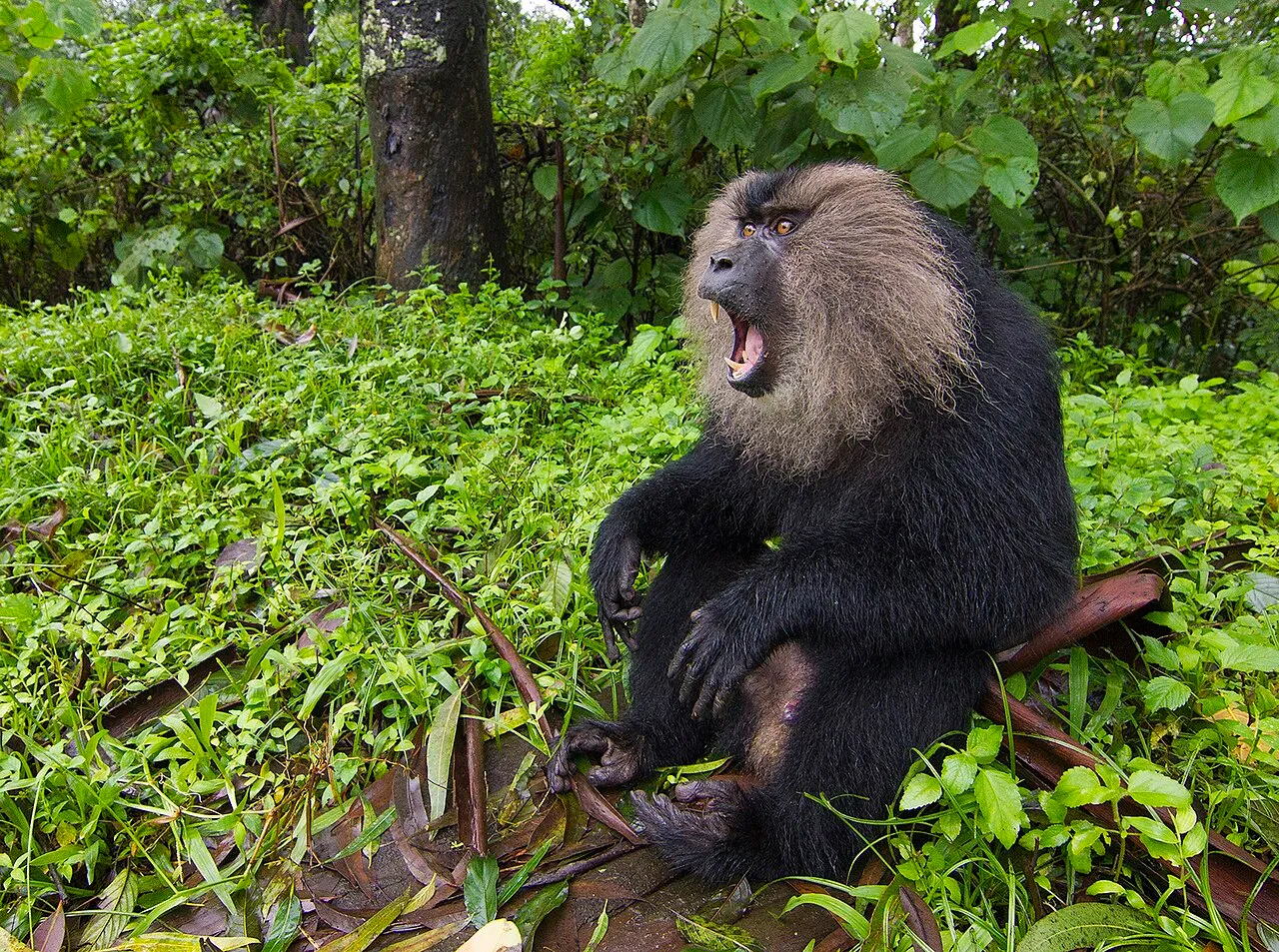
The lion-tailed macaque, Macaca silenus, is a monkey found only in India in the Western Ghats mountains. Both sexes have a grayish lion-like mane1 around a bare black face, and the thin tail ends in a tuft of black hair. The species is also called the wanderoo2, and in German “bartaffe”, or “beard ape”.
What does a lion-tailed macaque look like?
The body measures 40 to 61 cm, and the tail adds another 24 to 38 cm. Males typically weigh 5 to 10 kg1, while the smaller females weigh 3 to 6 kg. The New England Primate Conservancy puts adult females roughly 33% smaller than males, at an average of 2 to 6 kg, with a head-body length of 42 to 46 cm against 51 to 61 cm for males. It counts the lion-tailed macaque among the smaller macaque species2.
The body is covered with black fur. The ruff circles the chin, is widest around the cheeks and ends between the eyes; elsewhere the fur is glossy black. The face has close-set hazel eyes2, a broad, flat nose and long, sharp canines. Cheek pouches open beside the lower teeth and extend down the side of the neck. Infants are born with soft, black pelage1 that is replaced with adult pelage after two months.
Where do lion-tailed macaques live?
The range in the Western Ghats is bordered by the Kalakkad hills to the south and the Sirsi-Honnavara rainforests to the north, and is broken up by a low mountain pass, the Palghat gap. Populations north and south of the gap are genetically distinct2, and scientists recommend evaluating the two populations differently for conservation.
The species lives in evergreen and semi-evergreen rainforests and monsoon forests1, at elevations as great as 1,500 m. It spends most of its time 30 to 50 m off the ground2 in the upper rainforest canopy. It prefers undisturbed, old-growth evergreen forest but also lives in forest disrupted by human development.
What do lion-tailed macaques eat?
The diet consists mainly of fruit1, together with leaves, stems, flowers, buds and fungi. The most important foods through the year are fruits of the breadfruit and jackfruit genus (Artocarpus) and the fruit and flowers of wild durian (Cullenia exarillata). Near villages they also eat guava, passion fruit and coffee2.
Around 20% of feeding time goes to prey, rising to 24% in the dry season from December to May and falling to 11% in the wet season. Most prey are invertebrates such as stick insects, spiders and dragonflies; vertebrate prey includes tree frogs, birds, nestlings and bats2. Some water comes from licking dew from leaves1.
How do lion-tailed macaques live?
Lion-tailed macaques are arboreal and diurnal1. They spend more than half of the day looking for food and eating, 27% resting, 15% traveling and around 5% socializing. In disturbed areas they also spend time on the ground, and the broken canopy makes them fall out of trees 1 to 5 times per day2.
A group has 10 to 20 members1, but can have as many as 34. The New England Primate Conservancy gives 4 to 30 individuals, usually with 1 to 3 males, one of them the alpha. Females stay close to home for their entire lives, while males may change groups by aggressively taking over from another male. Home ranges can reach 500 hectares or more2, with a core of around 300 hectares usually used by one group only.
They are the only macaques in which males use calls1 to advertise their territorial boundaries. Captive animals showed 17 basic patterns of vocal communication. Silently baring the teeth signals affiliation2 with another monkey, and turning around to show the rear end signals submission.
How do lion-tailed macaques reproduce and how long do they live?
There is no specific breeding season, though most births coincide with the peak of the wet season. Gestation lasts approximately 6 months and usually produces one infant, weighing 400 to 500 g at birth. Females nurse for 12 months, and births are typically 34.3 months apart2. Females become sexually mature at 5 years and males at 8. At adolescence females generally stay in their birth group, while males leave and live in nomadic all-male groups1 until they can defend a group of females of their own.
In the wild the expected maximum lifespan is about 20 years1. In captivity the maximum is 38 years, although it is more typical for them to reach about 30.
Is the lion-tailed macaque endangered?
The IUCN lists the lion-tailed macaque as Endangered3; the New England Primate Conservancy cites the 2015 IUCN assessment. Scientists estimate 4,000 left in the wild, fewer than 2,500 of them mature. The most significant threat is habitat loss and fragmentation: forest was cleared for rice, tea, cardamom, coffee, eucalyptus and teak plantations. The species lives in a few dozen isolated subpopulations, none with more than 250 mature individuals. Low numbers and troops separated in small forest fragments also lead to inbreeding1. They have been hunted for “medicinal” uses2, occasionally for meat, and captured for the pet trade; road kills are another threat.
The species is listed in CITES Appendix I, and India’s Wildlife (Protection) Act of 1972 gives it the highest level of protection as a Schedule I species. It lives in protected areas including Silent Valley National Park2, Periyar Wildlife Sanctuary and Kudremukh National Park.
Similar species
- Bonnet macaque (Macaca radiata): endemic to southern India, where it coexists with lion-tailed macaques5 in overlapping home ranges. It has a cap-shaped whorl4 on top of the head and dark brown or yellow body fur.
- Nilgiri langur (Semnopithecus johnii): another black monkey of South India’s Nilgiri Hills, whose mane is orangey-golden brown6 and whose males weigh 9.1 to 14.8 kg.