Contents
The sooty mangabey, Cercocebus atys, is a grey Old World monkey endemic to Upper Guinea in coastal West Africa, and as of 2005 large numbers still lived in Sierra Leone, Liberia and western Ivory Coast (Santiago et al. 2005). It is a primarily terrestrial forest monkey known for a hard-object diet: its powerful jaws and large premolars let it crack hard nuts that other animals cannot eat1. The species is used in biomedical AIDS research2 and is a natural host of the simian immunodeficiency virus.
What does a sooty mangabey look like?
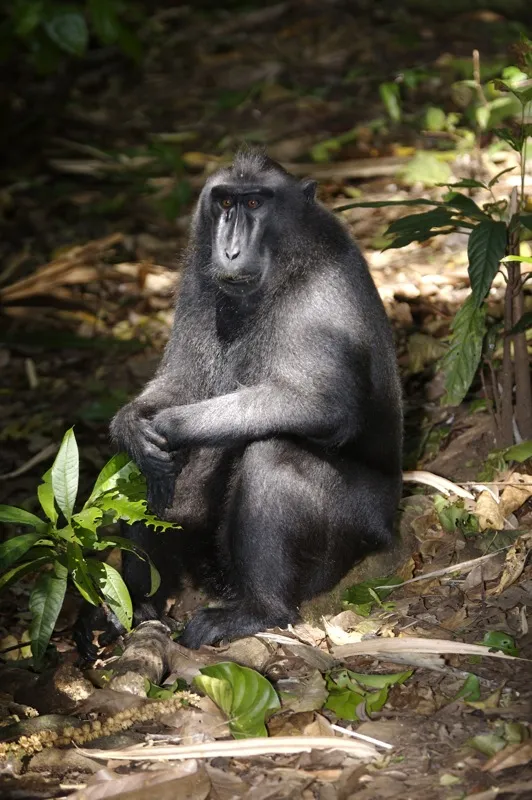
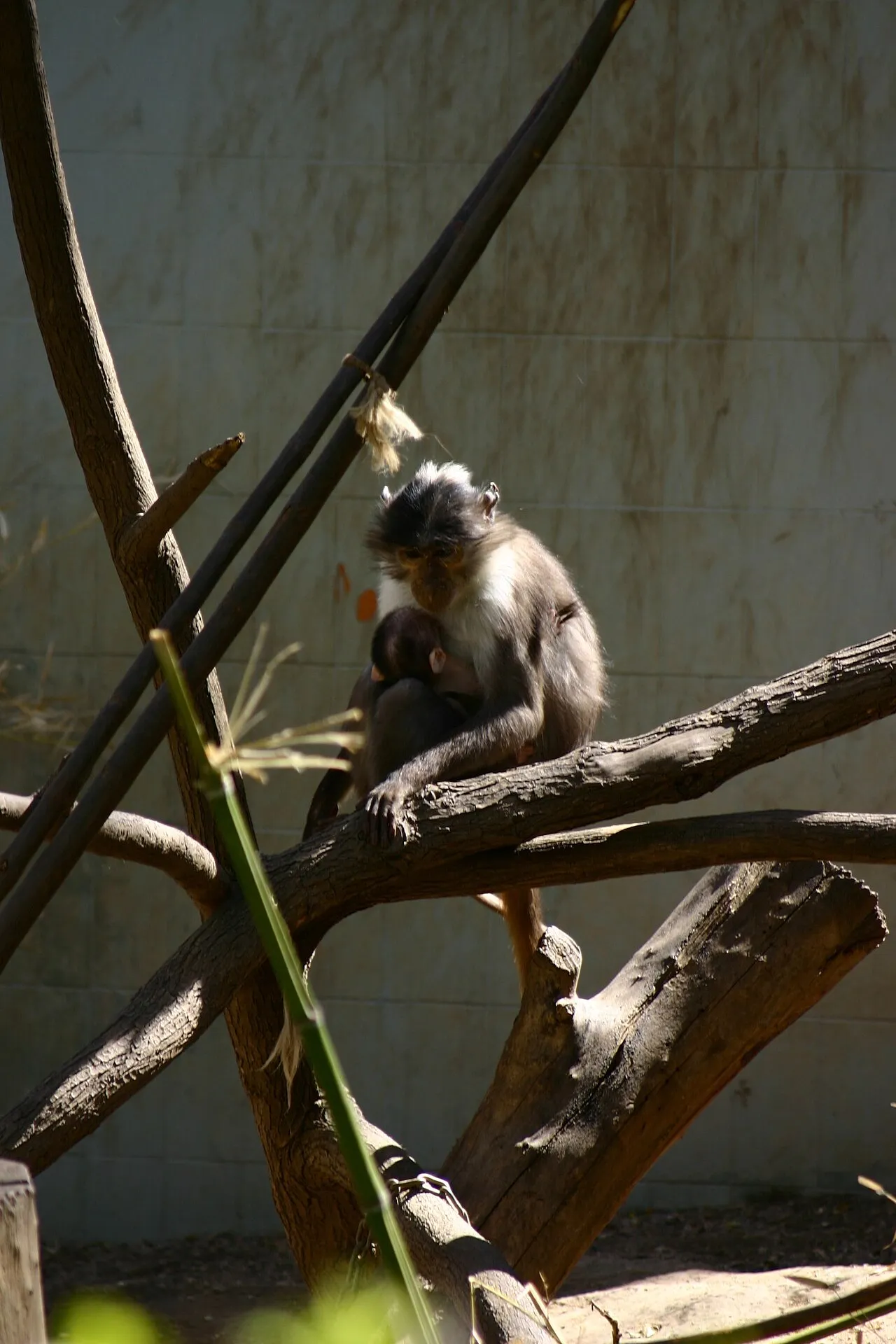
The coat is a smoky, slate-grey or brown-grey, lighter on the belly, with hands and feet slightly darker than the body. The light cheek whiskers stand out most in the eastern populations. Bare facial skin is mottled dark grey and salmon pink1, the upper eyelids are white, and the muzzle and ears are blackish. Primate Info Net describes the face as greyish-pink with a darker muzzle and ears2.
Males weigh 8.5 to 14 kg and females 5 to 9 kg, and Primate Info Net gives averages of 5.5 kg for females and 10.2 kg for males2. Head and body length is 40 to 60 cm in females, 47 to 67 cm in males, and the tail adds 40 to 80 cm in both sexes. Males are larger and heavier than females and have larger canines1; the female skull is 87% the size of the male’s.
Two subspecies are recognised. C. a. atys is smoky grey and never has a whorl or crown on the head. The white-naped mangabey, C. a. lunulatus, has a crown, a darker face, a more prominent stripe down the back and a white oval mark edged with black on the nape1.
Where do sooty mangabeys live?
The range once stretched from the Casamance River in Senegal to the Sassandra/Nzo River system1 in Ivory Coast, but by 2001 the species was mostly extinct in Senegal, Guinea-Bissau and parts of Guinea. Primate Info Net places the sooty mangabey proper west of the Nzo-Sassandra river2 and the white-naped mangabey east of it, as far as the Volta River in Ghana.
Sooty mangabeys live in primary, secondary, flooded, dry, mosaic and mangrove forests of the Guinean Forest Zone, and also in gallery forests, often near swamp and palm forests. They range from sea level up to 1,000 m1, possibly higher in the mountains of Sierra Leone. In Taï National Park in Ivory Coast the habitat is tropical moist evergreen rainforest, and the species also uses farmland; in Ghana it is most often found near Raphia palm swamps and rice farms2.
What do sooty mangabeys eat?
Animal Diversity Web describes a narrow diet of fruits and nuts, especially palm nuts, along with stems, roots, shoots and leaves of swamp plants, grass, seeds and fungi; invertebrates are another staple. The nuts of Sacoglottis gabonensis, mostly picked up from the leaf litter, can make up 25 to 80% of the diet1 depending on the season. In one study seeds made up 68% of the diet and invertebrates 26%, while other observations put plant foods at 98.7%. Sooty mangabeys also seek out frog-spawn from arboreal clutches2 around ponds.
The sexes eat differently: males tend to take more hard nuts, seeds and invertebrates, while females typically eat softer seeds and fruits. Sooty mangabeys can remember the location of fallen fruit1 and return later to retrieve it.
How do sooty mangabeys live?
Sooty mangabeys are quadrupedal, terrestrial, diurnal monkeys. Over 75% of their movement takes place on the ground, and they climb mainly in the understory and shrub layer. They live in multi-male, multi-female groups of 15 to more than 100 individuals. Primate Info Net reports wild groups of around 100 to as many as 1202, and 20 to 48 in another study. Home ranges of 6 to 8 km²1 often overlap with those of other groups.
Females stay in their natal group, while males immigrate into other groups. Males form a linear dominance hierarchy in which the alpha male attempts to monopolize sexual partners, although sneak copulations are common. Wild groups also have a stable linear dominance hierarchy of females2. The species has one of the lowest rates of agonistic behavior1 of any Old World monkey.
The most common call is the grunt, used by both sexes. Only adult males give the long “whoop gobble”, usually in contact with other groups, and there appears to be a different alarm call1 for each predator. Predators include leopards, crowned hawk eagles, chimpanzees and humans; in Taï, red colobus and Diana monkeys expand their feeding niche when sooty mangabeys are present. Captive females groom the eyelids of their infants with carefully selected stones2, for a purpose not yet known.
How do sooty mangabeys reproduce and how long do they live?
In the wild, mating begins in May, peaks in July to August, and ends in September, although births are sometimes seen all year. Gestation averages 167 days and a single infant is born. Females usually first give birth at approximately 49 to 55 months, and births come every 13 to 16 months; in captivity the interval averages 16.6 months. The lactation period lasts 4 to 10 months1. In captivity, males usually reach sexual maturity at around 7 years2.
Average lifespan in the wild is 18 years1, and average lifespan in captivity for males is 26.8 years.
Is the sooty mangabey endangered?
The IUCN lists the sooty mangabey as Vulnerable3 in Red List version 2022.2. As of 2005, hunting for meat around the Taï forest took two times a sustainable rate, and urbanisation and large-scale logging have reduced its habitat and range. Primate Info Net, citing a 2005 study, puts the harvest at more than three times the sustainable level. As of 2012 the species was on Appendix II of CITES1. In 2008 the white-naped mangabey was in far worse shape2 than the nominate subspecies and was listed among the world’s 25 most endangered primates for 2004-2006.
Similar species
- Collared mangabey (Cercocebus torquatus): sooty mangabeys are sometimes treated as its subspecies2, but the two differ consistently and live apart. The sooty mangabey is less sexually dimorphic1, and its male skull is smaller, with a narrower, shorter face.
- White-naped mangabey (Cercocebus lunulatus): proposed as a separate species in 20121, though Primate Info Net calls it generally considered a subspecies of C. atys. It lives east of the Sassandra River2 and has a white oval mark on the nape.