Contents
The Tapanuli orangutan, Pongo tapanuliensis, is a great ape known from a single population in Batang Toru, a region of Sumatra south of Lake Toba. With fewer than 800 individuals in about 1,000 km², it is the rarest great ape2. Genetic and skull studies in 20171 found the Batang Toru orangutans to be a new species, of which fewer than 800 individuals survive3.
Before this population was discovered in 1997, it was believed that no orangutans lived south of Lake Toba. Researchers first assumed the newly found animals were Sumatran orangutans. The species description rested on an orangutan killed in a human-animal conflict, whose skull and teeth differed consistently from those of 33 other adult males, and on an analysis of 37 orangutan genomes. Model-based analyses put the deepest split in the history of living orangutans at about 3.38 million years ago3, between the Batang Toru population and the orangutans north of Lake Toba. The New England Primate Conservancy calls the Tapanuli orangutan likely the most ancient orangutan lineage1.
What does a Tapanuli orangutan look like?
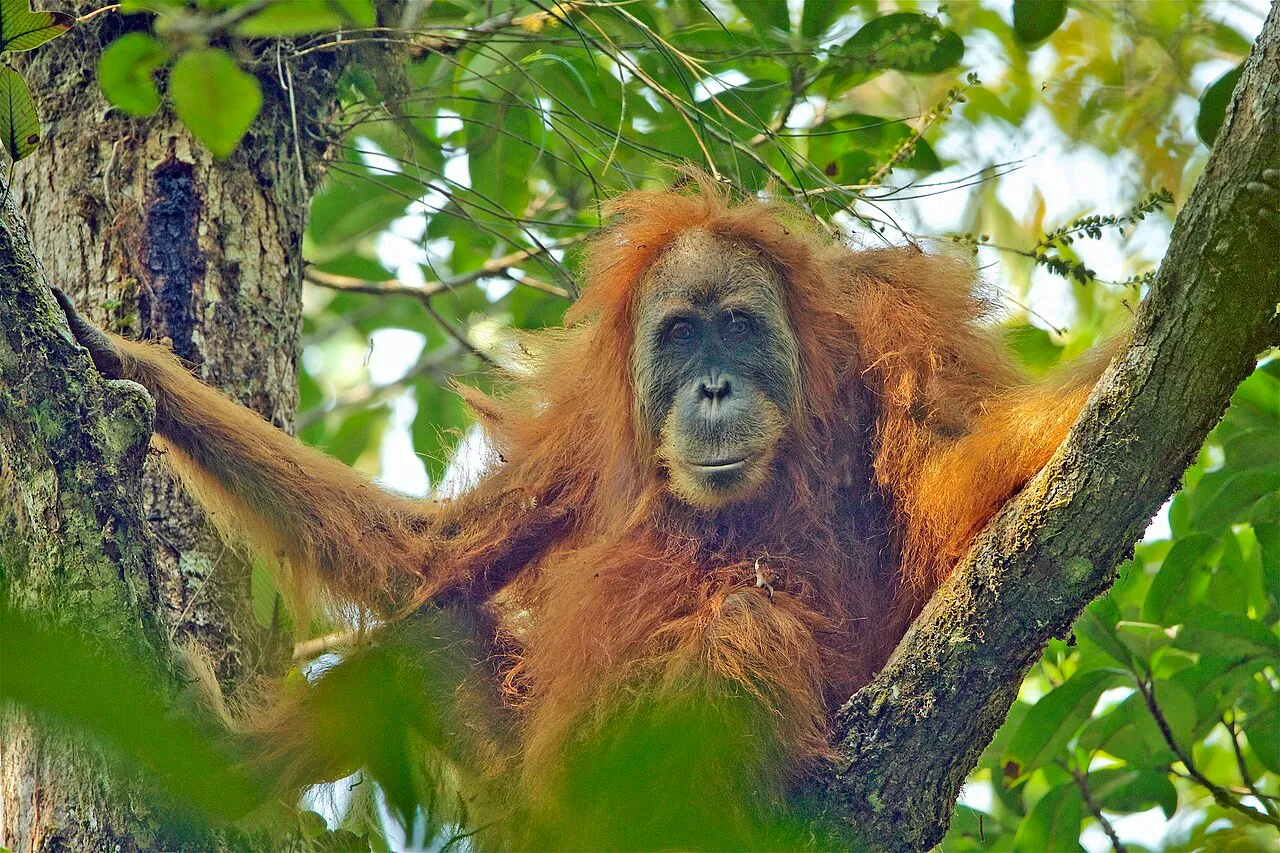
Tapanuli orangutans are approximately the same size as other orangutan species1. Males stand about 137 cm tall and weigh 70–90 kg2, females about 110 cm and 40–50 kg.
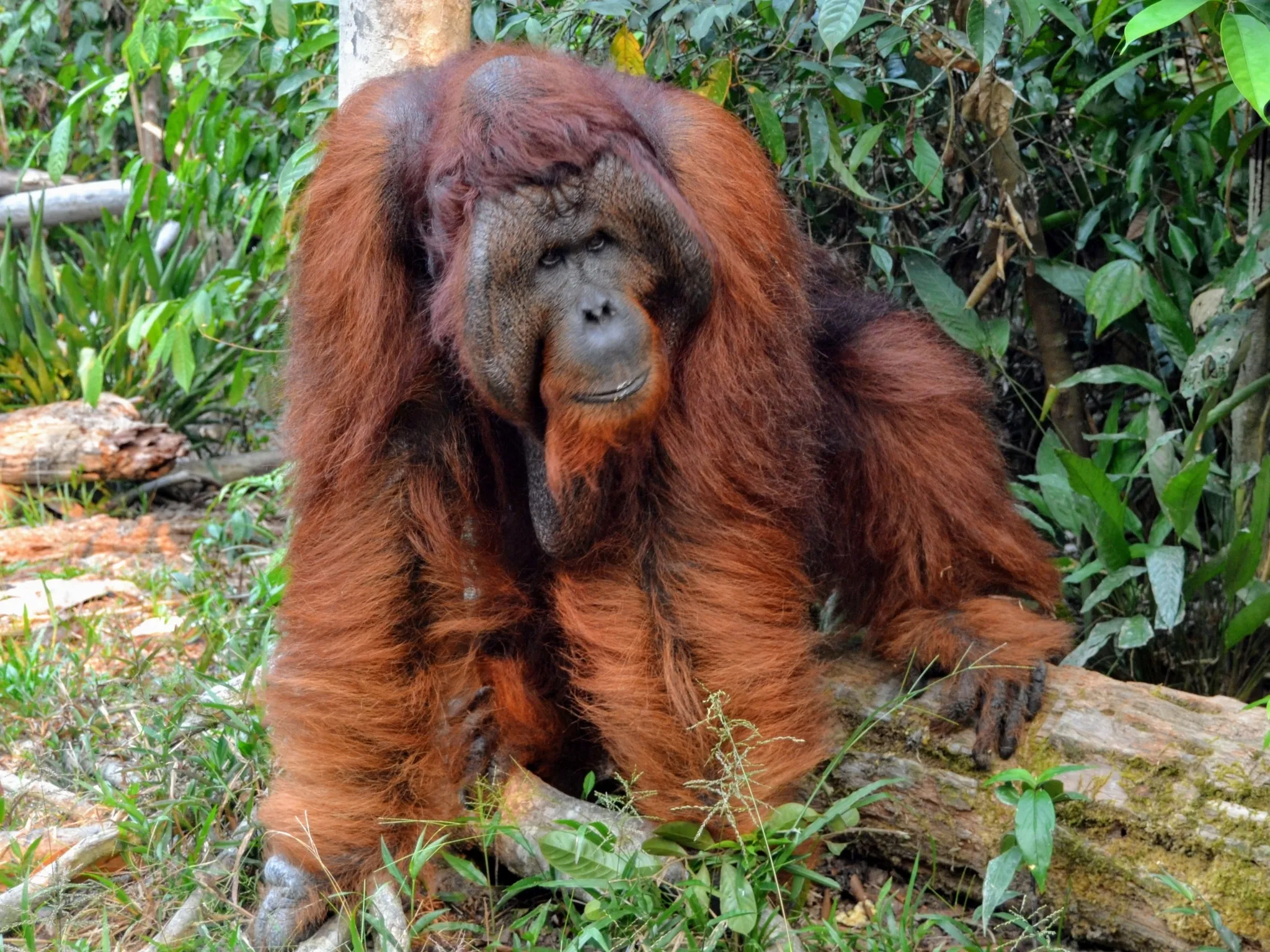
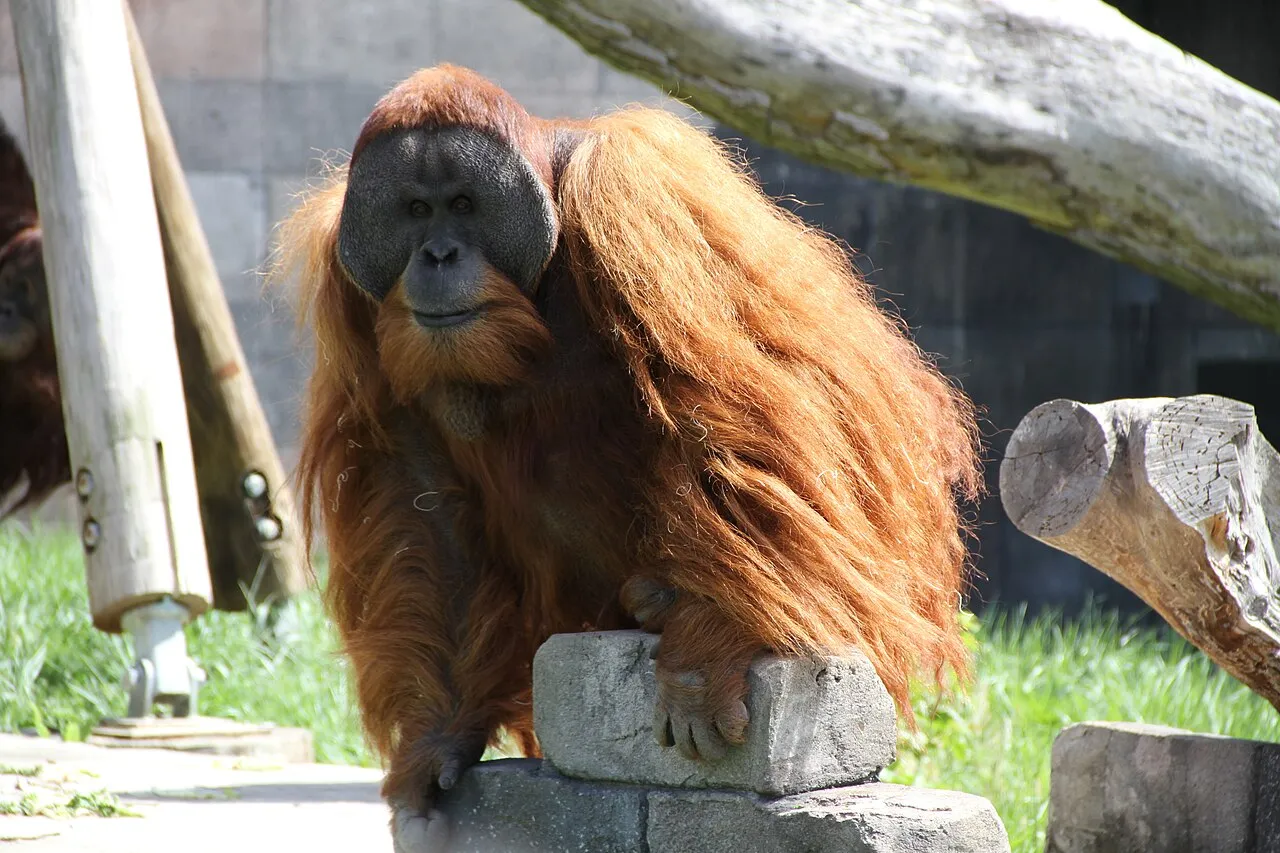
Males mature in two stages. Before the second stage, an adult male stays close to the females in size and weight. Developed, or flanged, males grow prominent cheek pads and large, pendulous sacks under their chins1, which they use to make long calls.
Like the other orangutans, the species has orange fur on its torso and limbs and exceptionally long arms and stout legs. Its fur is thicker and frizzier1 than that of the other two species, and flanged males grow a moustache and beard. Their cheek pads lie flatter and are covered with a thin layer of blonde fuzz. The species has smaller heads, and flatter and wide faces2, while in body build and fur colour it is closer to the Sumatran than to the Bornean orangutan.
Where do Tapanuli orangutans live?
A 2021 study found the whole species restricted to an area of about 1,000 km²4 of upland forest, in three declining subpopulations. That area lies in South Tapanuli, North Sumatra, south of Lake Toba, at elevations from 300 to 1,300 m. Just 100 km2 separate it from the Sumatran orangutan.
Its habitat today is the fragmented rainforests of this region’s uplands. A study of records from the early 1800s to 2009 found that the species once lived in a much larger area, across a wider range of habitat types and at lower elevations than now. As of that 2021 study, its extent of occurrence was 2.5% of the historical range in the 1890s4 and 5.0% of that in the 1940s. The New England Primate Conservancy writes that the orangutans, though better adapted for life at a lower altitude1, seem to have gradually retreated into the hills for protection from human activities.
What do Tapanuli orangutans eat?
Fruit makes up the largest percentage of any orangutan’s meals1. Orangutans also eat leaves, saplings, buds, tree bark and insects. Among the fruits orangutans eat are lychees, figs, mangos and wild durian.
The Tapanuli orangutan has dietary habits never observed in the other species: it is the only species known to eat certain types of caterpillars and pinecones1. Its diet contains unusual items such as caterpillars and conifer cones2.
How do Tapanuli orangutans live?
The species is thought to be exclusively arboreal2: scientists had not seen one descend to the ground in over 3,000 hours of observation reported in 2018, probably because of the Sumatran tigers in the area. Orangutans move through the trees by brachiation, or arm swinging1, and use their hand-like feet like an extra set of hands.
The mother and her young form the basic familial unit for orangutans, and fathers play no role in raising offspring. A flanged male has a larger range than females and unflanged males, and travels it in search of mates, giving long calls to attract females and intimidate rivals. Until he develops cheek pads, a young male either keeps to himself or socializes with other unflanged males1.
The long calls of Tapanuli males last much longer1 than those of Bornean and Sumatran orangutans, and contain more pulses given at a faster rate. Their maximum frequency is higher than that of Sumatran orangutans2.
How do Tapanuli orangutans reproduce and how long do they live?
The development of Tapanuli orangutans has not been studied in detail, and the New England Primate Conservancy gives the following figures for orangutans in general. Females overwhelmingly prefer flanged males, and a mother gives birth after 8.5 months. She usually has one infant at a time and is not sexually receptive again until it is independent. An infant depends on her completely for the first two years or so1, and stays close for at least two more.
Males reach sexual maturity between eight and fifteen years of age, but grow cheek pads and a throat sack only several years later. A female can be mature as early as twelve years of age1, but few give birth before fifteen. Tapanuli orangutans have slow reproductive rates2.
Orangutans have been known to live up to 60 years in the wild1.
Is the Tapanuli orangutan endangered?
In Red List version 2022.2 the IUCN lists the Tapanuli orangutan as Critically Endangered5. A 2021 study called it the most threatened great ape species in the world. Historical fragmentation of its forests, mostly for small-scale agriculture, together with unsustainable hunting, likely drove various populations4 to the south, east and west of the current one to extinction, before industrial-scale forest conversion began in the 1970s.
The New England Primate Conservancy lists the current threats: palm oil plantations in its estimated historical range, roads that fragment the forest, conflict with farmers over crop raiding, hunting by migrants settling along the forest edge, and the illegal pet trade. Its forests have been protected since 2017, though some companies keep limited rights: one logging company is permitted to log 300 km² of primary forest inside the current range, and gold and silver mining continues in the southwest of Batang Toru. The conservancy calls a planned hydro-electric dam, in the area where the population is densest, the biggest threat; in 2020 the Bank of China pulled out of the project. Researchers estimate that if just 1% of adults1 are killed, translocated or captured each year, the species’ extinction is inevitable.
The species is listed on CITES Appendix I. After Cyclone Senyar in December 2025, an estimated 6.2% to 10.5%2 of the fewer than 800 remaining Tapanuli orangutans were killed by floods and landslides.
Similar species
- Sumatran orangutan (Pongo abelii): lives north of Lake Toba, and the two lineages split about 3.38 million years ago3. The two are similar in body build and fur colour, but the Tapanuli orangutan has a deeper suborbital fossa, a triangular pyriform aperture2 and a more angled facial profile. Tapanuli males grow a moustache and beard that Sumatran orangutans do not1.
- Bornean orangutan (Pongo pygmaeus): the third orangutan species, designated a distinct species in 20013. A Tapanuli orangutan has thicker and frizzier fur1, and flanged males have flatter cheek pads with blonde fuzz. Tapanuli long calls last much longer and have more pulses2 than Bornean ones.