Contents
The chimpanzee, Pan troglodytes, is a great ape of equatorial Africa, ranging from Gambia in the west to Uganda in the east, roughly between 10°N and 8°S. It lives in tropical rainforest, forest-savanna mosaic and even open savanna1, and is known for tool use, cooperative hunting and a fission-fusion social life in which party membership changes by the hour. Chimpanzees and bonobos are sister species, and together they are the closest living relatives of humans.
What does a chimpanzee look like?
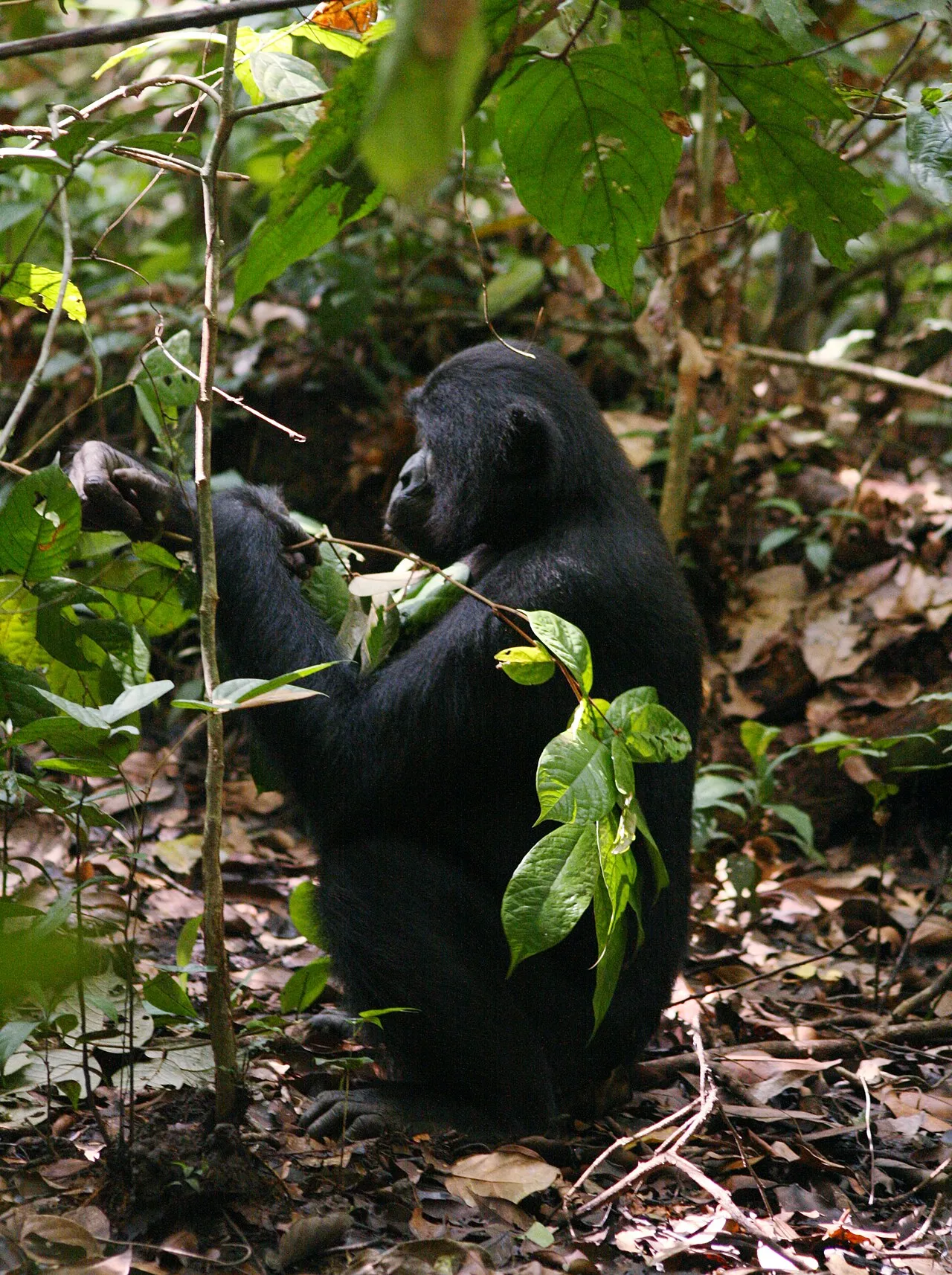
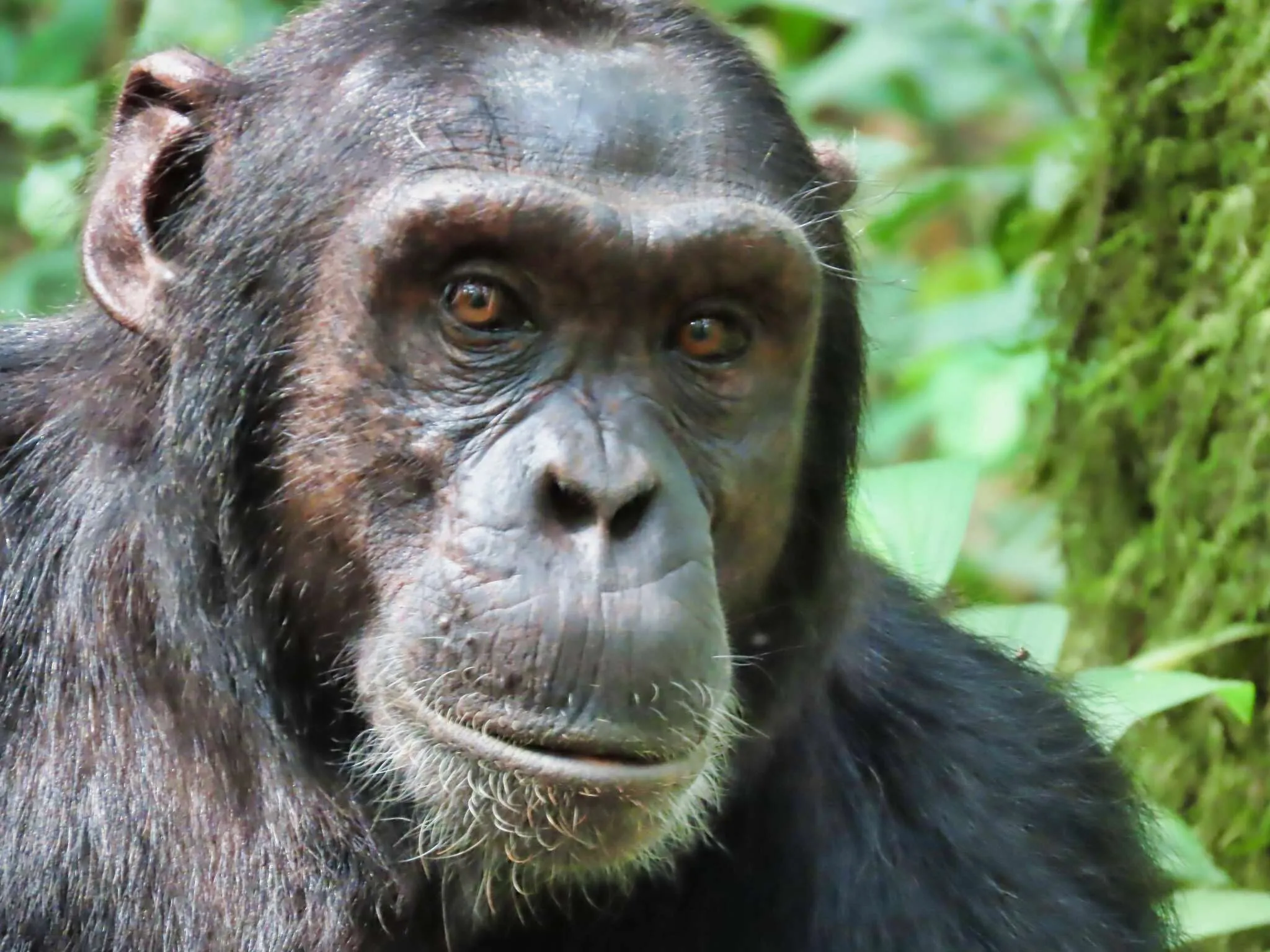
An adult chimpanzee’s face is typically black, or mottled with brown, while Primate Info Net notes infants are born with pale faces, darkening with age. Body hair is black to brown with no underfur, and many adults keep white hairs around the face that look like a beard; with age they lose head hair and the hair on the lower back grays. The ears are prominent2 and the brow ridge over the eyes is pronounced, with an arm span about 1.5 times standing height1 and legs shorter than the long arms.
Wild males weigh 34 to 70 kg, up to 80 kg in captivity, and wild females 26 to 50 kg, up to 68 kg in captivity; Primate Info Net gives a narrower wild range: males 40 to 60 kg, females 32 to 47 kg. Head-and-body length runs 64 to 93 cm, and standing height reaches 1 to 1.7 m1; Primate Info Net records both sexes averaging about 82 cm. Males are heavier than females, a sexual dimorphism Primate Info Net describes as a more robust build than the bonobo’s2, the species’ closest relative.
On the ground, chimpanzees move by knuckle-walking1, bearing their weight on the knuckles of the hands; in the trees they also swing by their arms, a form of brachiation, and Primate Info Net notes they add occasional bipedalism2 to that mix.
Where do chimpanzees live?
Chimpanzees are found across equatorial Africa from Gambia and Senegal east to Uganda and western Tanzania1, between about 10°N and 8°S and 15°W and 32°E, in a range split into western, central and eastern populations by the Niger and Congo river systems. The New England Primate Conservancy lists the subspecies’ countries in more detail: a western population from Senegal to Ghana, a Nigeria-Cameroon population on the Nigeria-Cameroon border, a central population across seven Central African countries from Angola to Gabon3, and an eastern population from the southeastern Central African Republic through northern DR Congo. Chimpanzees are absent from the central Congo Basin south of the Congo and Lualaba rivers, where the bonobo lives instead.
The habitat is mainly tropical rainforest, but also forest-savanna mosaic and montane forest up to 2,750 m1, and some populations live mostly in open savanna. Chimpanzees use both forest canopy and the ground, depending on the terrain and the season.
What do chimpanzees eat?
Chimpanzees rely heavily on ripe fruit and young leaves, supplemented with stems, buds, bark, pith, seeds and resins, as well as insects, small vertebrates and eggs; they sometimes eat soil associated with termite mounds. Primate Info Net describes about half of the day spent feeding2, with Animal Diversity Web placing two daily feeding peaks, one 7 to 9 in the morning and one 3:30 to 7:30 in the afternoon1.
Hunting supplies a further source of meat: the largest prey taken are bush pigs, colobus monkeys and baboons, most often young animals, and Primate Info Net notes a preference for red colobus monkeys where they occur. Males eat more meat than females, and cooperative hunting technique varies by population: Animal Diversity Web reports chimpanzees in Ivory Coast hunt more cooperatively than those in Tanzania or Uganda1. Tool use extends to feeding itself: Primate Info Net documents chimpanzees stripping sticks to extract termites or ants, cracking nuts with a stone hammer and anvil, and crumpling leaves into sponges for water in tree holes2.
How do chimpanzees live?
Chimpanzees live in a fission-fusion society in which the whole community splits into small, frequently changing parties. Party size varies by site: Primate Info Net records average parties of 5 to 8 individuals at Taï and an average of 10, ranging as high as 47 at Kibale when food is abundant2. Males are more social than females and travel in larger parties, covering an average of 4.9 km a day against 3.0 km for females1, who more often travel alone or with dependent offspring.
Dominance is organised in a mostly linear hierarchy with an alpha male at the top, who may take meat from subordinates or displace them at food sites; adult males spend much time together and groom one another about four times as often as females do. Chimpanzees are largely diurnal. Communication combines vocal signals, such as the pant-hoot used for individual identification and the pant-grunt directed at dominant animals2; visual signals, such as arm-raising, ground-slapping and a direct stare as threats; and tactile contact, such as social grooming, which reassures distressed individuals1 and appeases aggression.
How do chimpanzees reproduce and how long do they live?
Mating is polygynandrous: both sexes mate with multiple partners, though a male may also monopolise a female through a consortship, a pair bond that can last up to three months. Gestation lasts 202 to 260 days, with a mean of 230 days, and a single infant is born weighing about 2 kg; twins are rare. Infants are carried against the mother’s body for the first three to six months and continue to ride on her until weaning at 3.5 to 4.5 years; the interval between births typically runs 3 to 6 years, which Primate Info Net gives as 3 to 5 years. Both sexes enter puberty around age 7, but a female does not usually have her first infant until 14.5 to 15 years on average at some sites1, while Primate Info Net gives males’ social maturity as 16 years or older and a female’s first estrus at 102.
On lifespan, the sources disagree. Animal Diversity Web reports 40 to 60 years, both wild and captive1, while Primate Info Net gives a narrower wild range, 40 to 45 years, with captive individuals reaching up to 602.
Is the chimpanzee endangered?
The IUCN lists the chimpanzee as Endangered, under Red List version 2022.24; the New England Primate Conservancy notes that, rated separately by subspecies, the western population is Critically Endangered3 while the central, eastern and Nigeria-Cameroon populations are rated Endangered. Animal Diversity Web names the main threats as human expansion into rainforest and mixed-forest habitat, and hunting for bushmeat; disease is a further risk, with respiratory illness more common in the rainy season and a 1966 polio epidemic that devastated the chimpanzees of Gombe Stream National Park. The species is listed on CITES Appendix I1.
Similar species
- Bonobo (Pan paniscus): the sister species, confined to the forests south of the Congo and Lualaba rivers, where chimpanzees are absent. Primate Info Net describes the chimpanzee as having a more robust build and greater sexual dimorphism2 than its smaller-bodied relative.
- Western gorilla (Gorilla gorilla): a much larger forest ape sharing parts of the chimpanzee’s central African range; wild male western gorillas average around 180 kg5, well above even the heaviest captive male chimpanzee, and older males develop a grey “silverback” saddle on the back and rump that chimpanzees never grow.