Contents
The bonobo, Pan paniscus, is a great ape found only in the central Democratic Republic of the Congo, in the Congo Basin south of the Congo River. Bonobos and chimpanzees are sister species and together they are the closest relatives of humans. In bonobo society most females can dominate males, and both sexes use sexual behaviour to ease tension. The species was first described in 1929 as a subspecies of the chimpanzee and was reclassified as a separate species four years later.
What does a bonobo look like?
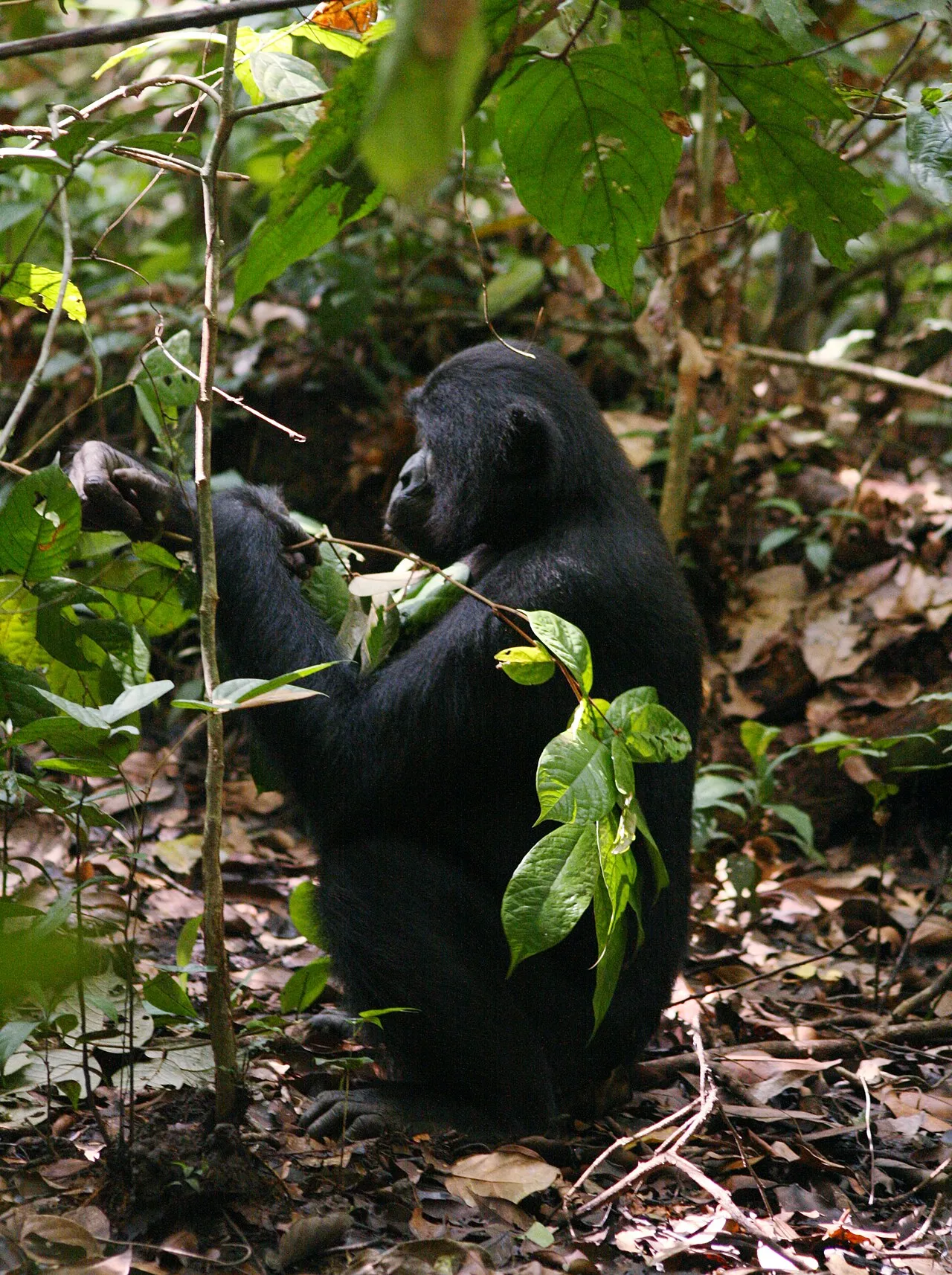
A bonobo has a black face, ears, palms and soles, and its black body hair is long and fine. Many adults keep the white rump tuft that infants have. The hair on top of the head looks parted down the middle, and the side-whiskers are long and thick.
The older name “pygmy chimpanzee” misleads. In overall size bonobos are not smaller than chimpanzees; the proportions differ, with shorter upper limbs and longer lower limbs. Males weigh 37 to 61 kg, 45 kg on average, and females 27 to 38 kg, 33.2 kg on average. The San Diego Zoo Wildlife Alliance gives 39 kg for males and 31 kg for females, with a whole-body length of 70 to 80 cm for both sexes. Average height is 119 cm for males and 111 cm for females. Males are around 30% heavier than females, yet bonobos are less sexually dimorphic than many primates, and the skeletons of the two sexes are nearly the same size.
Bonobos are primarily knuckle-walkers. At times they walk on two legs, and they do so more often than chimpanzees.
Where do bonobos live?
Bonobos live in the forests of the Congo Basin, south of the arc formed by the Congo River and its headwater, the Lualaba, and north of the Kasai River. The range is discontinuous: small populations are separated by rivers, and the species is absent or rare in many areas. The potential range is estimated at about 500,000 km².
The habitat is lowland rainforest, both primary and secondary. Bonobos also live in mosaic forest with savannas, and they enter swamp forests, where they wade in waist-deep streams. They forage in every vegetation type, while sleeping occurs in forested areas. Night nests are made in the trees at or near the last feeding site, at an average height of 7 to 15 m.
What do bonobos eat?
Fruit makes up the largest portion of the diet, and when it is plentiful it accounts for over 50%. Other important plant foods are pith, leaves, leaf stalks, seeds and flowers, and bonobos also eat honey, eggs, soil, mushrooms and insect larvae. Animal foods are only a small part of the diet: beetles, bees, earthworms and millipedes, and occasionally small mammals. Wild bonobos have been directly observed eating flying squirrels, duikers and bats.
Bonobos find most of their food in the trees, at a height of 25 to 40 m. At the Wamba study site total feeding time does not exceed 30%, against 46 to 60% for chimpanzees at Gombe. Food sharing is common.
How do bonobos live?
Bonobos are largely diurnal. At Wamba they rise between 5 and 6 in the morning and feed at once, travel on the ground to the next food trees after a rest, and settle for the night between 18:30 and 19:30. They travel 1.5 to 15 km a day to forage, and 43% of the day is spent resting.
Like chimpanzees, bonobos have a fission-fusion social organisation: they move through their habitat in groups of a few individuals whose make-up changes constantly. Travelling and feeding groups typically hold 3 to 6 individuals and may have as many as 10. Larger groups gather around plentiful food and split up again as they move on. The most stable groups are those between mothers and their offspring.
Males stay in their natal group for life, whereas females leave during adolescence to join another group. Males compete for rank, which is influenced greatly by the rank of the mother. Females support each other more often than they support males, and the oldest and highest-ranking females with grown sons form the core of a group. At Wamba, males surrendered feeding positions when females appeared.
Sexual behaviour has a social function. Bonobos use sexual behaviours in non-reproductive contexts, including contact between females and mounting between males. These behaviours are observed in females particularly upon entering a new group, and at feeding sites where a large quantity of food is found. Bonobos are not entirely peaceful, but the level of violence is lower in general than in chimpanzees, and lethal aggression has not been observed.
Females have a scream, while males bark, grunt and pant-hoot. A bonobo that “peers” at another shows interest in what the other is doing, for instance when the other holds food it wants.
How do bonobos reproduce and how long do they live?
Bonobos have no marked breeding season. Gestation lasts 231 to 244 days, about 8 months, and females produce their first offspring at about 13 or 14 years. For the first three months an infant is not seen leaving its mother. Weaning comes at around 4 or 5 years, and the interval between births is 4 to 6 years; another estimate puts the average at 4.6 years. Infanticide has never been recorded in bonobos.
Little is known about how long wild bonobos live. The longest study began at Wamba in 1976, and a female that died there in 1993 was estimated to be 45 to 50 years old. In captivity, a wild-born female at Antwerp Zoo lived there for 50.1 years and could be up to 55 years old. The median life expectancy of males in managed care is 31.3 years.
Is the bonobo endangered?
The IUCN lists the bonobo as Endangered. The range has not been fully surveyed, and the minimum population is put at 15,000 to 20,000 individuals. The threats are habitat loss through slash-and-burn agriculture and commercial forestry, hunting for meat, and a bushmeat trade promoted by lumber companies. Infants are captured by killing the mother. The civil war between 1996 and 2002 and a weakened national park system hindered conservation efforts. Hunting bonobos is illegal, but poaching is still common.
Bonobos live in Salonga National Park, a national park since 1970 and a World Heritage site since 1984 that covers 33,346 km², and in the Sankuru Nature Reserve, established in 2007. The Lola ya Bonobo sanctuary near Kinshasa offers care for rescued bonobos. The species is listed on CITES Appendix I.
Similar species
- Chimpanzee (Pan troglodytes): the sister species, found from Gambia in the west to Uganda in the east, except in the region bordered by the Congo and Lualaba rivers where bonobos live. A chimpanzee’s ears stand out more from the head, and its brow ridges and muzzle are more pronounced. Chimpanzees also have lighter skin, particularly when young, where the bare skin of a bonobo is dark throughout life.
- Western gorilla (Gorilla gorilla): a much larger forest ape of equatorial Africa. Wild males average 180 kg, and the hair on the back and rump of older males grows grey.