Contents
The Sumatran orangutan, Pongo abelii, is endemic to the northern portion of the island of Sumatra1, in Indonesia, and is listed as critically endangered2. It is the largest arboreal primate3 and the largest non-human primate in Asia, and wild orangutans are almost completely arboreal except for occasional trips to the ground.
What does a Sumatran orangutan look like?
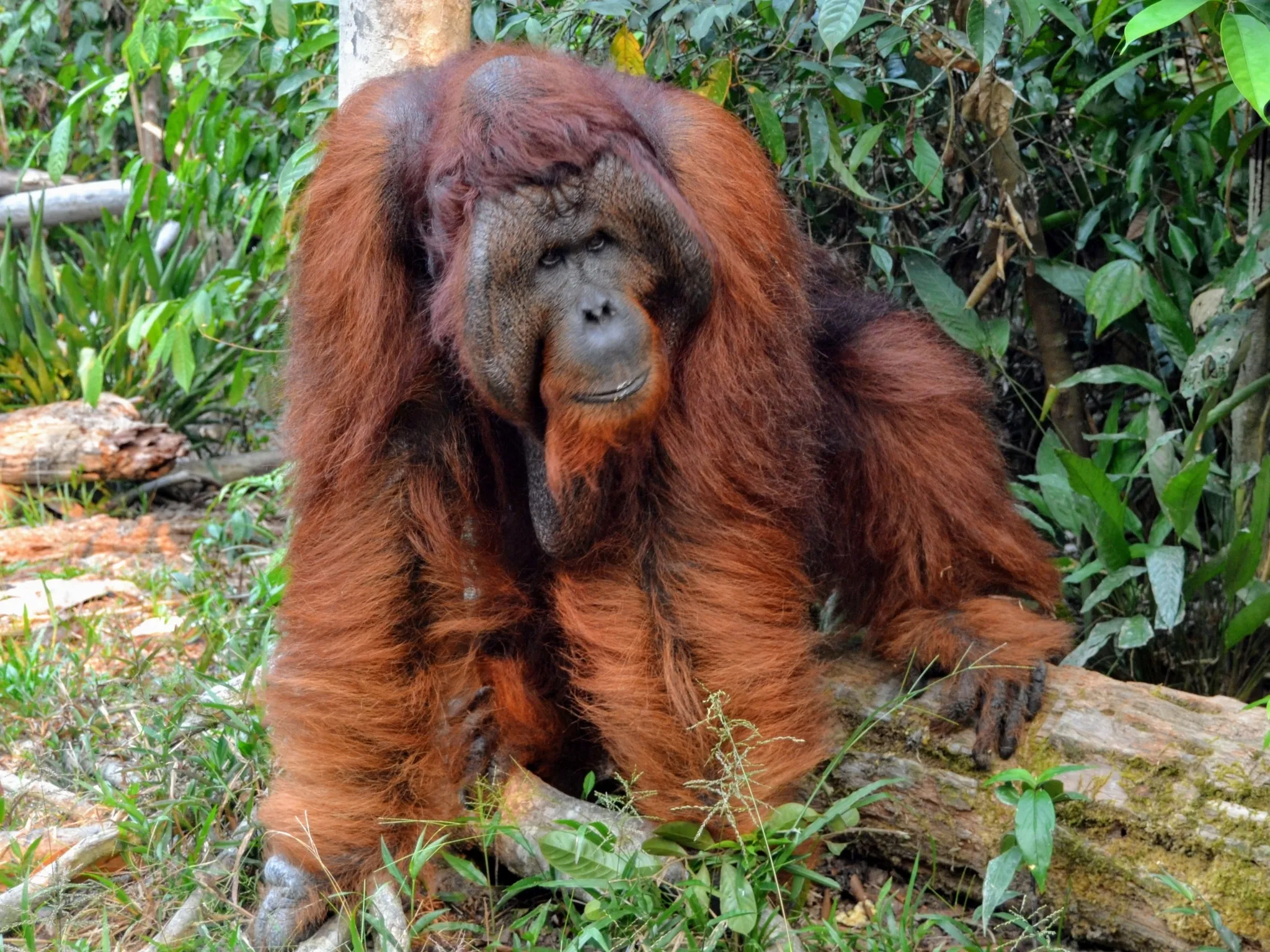
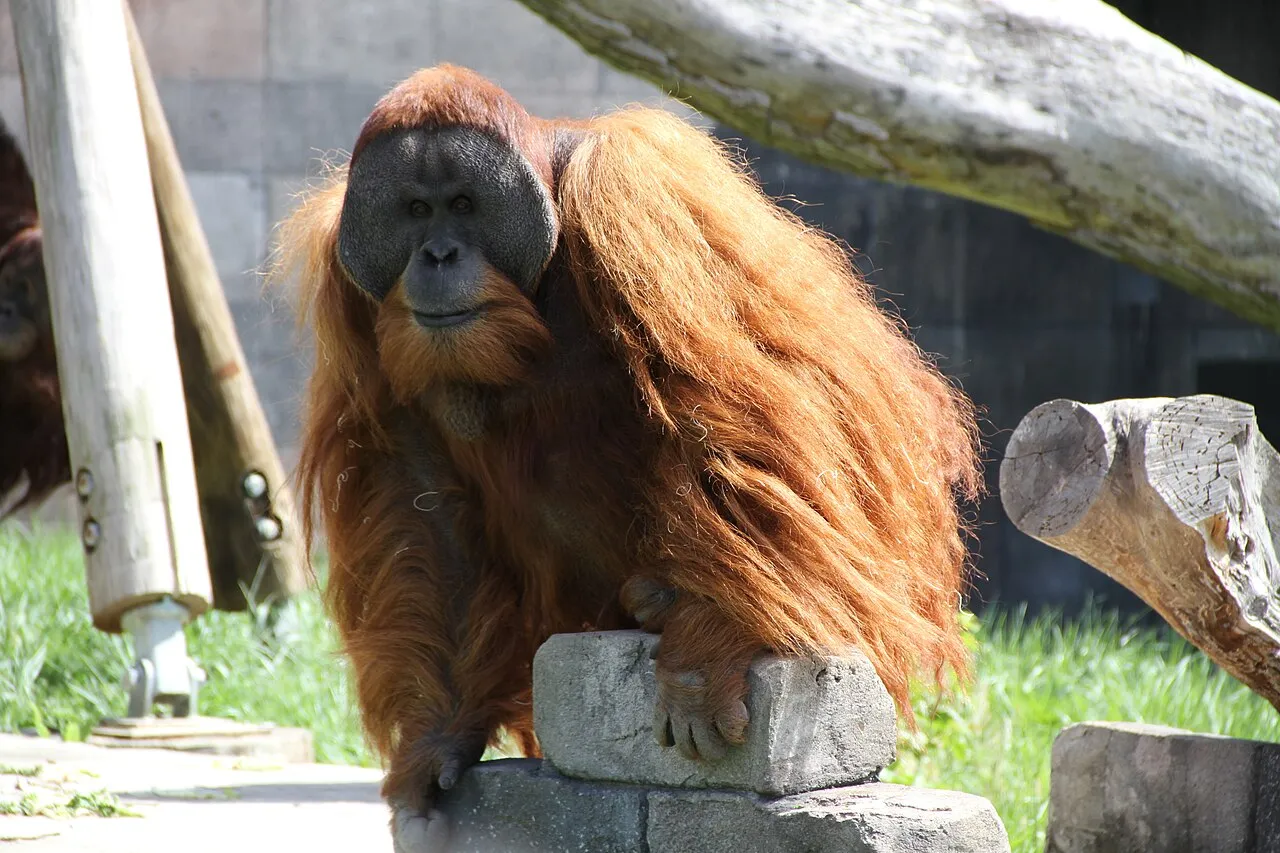
Females and unflanged males weigh 30 to 50 kg and average about 1.3 m in height, while flanged males weigh 50 to 90 kg and average 1.8 m1. The body is covered in long, fine red hair, and males have large cheek pads covered in fine white hairs. The arm span reaches 2.25 m3, and the legs are small and weak compared with the muscular arms.
Adult males come in two forms, a pattern called bimorphism: unflanged males look very similar to females and are smaller, faster and more agile, while flanged males grow wide cheek pads called flanges, longer hair and throat sacs for amplified calls. Flanges have been known to develop anywhere from 11 up to 30 years1, most commonly at about 20, and the change cannot be reversed.
Sumatran orangutans may be told apart from Bornean orangutans by longer fur, a more slender build3, white hairs on the face and groin, and long beards on both males and females, although molecular characters are considered most definitive.
Where do Sumatran orangutans live?
About 82% of Sumatran orangutans live in Aceh Province, with the remaining populations in North Sumatra Province, and about 90% live in the Leuser Ecosystem, a landscape of rainforests, rivers, lakes and peatlands covering 2.6 million hectares. Their total range is believed to be about 16,800 sq km1.
The species inhabits moist lowland forests, montane forests and peat swamps; Animal Diversity Web also lists mangrove, swamp forests and riparian forests. It prefers elevations of around 200 to 400 m, where its favourite fruiting trees grow, but can be found as high as 1,500 m. Sumatran orangutans are less tolerant of habitat disturbance1 than Bornean orangutans and highly dependent on high-quality primary forests. Fossil evidence suggests that the species once occurred throughout Sumatra and Java3.
What do Sumatran orangutans eat?
Fruit makes up about 60% of the diet, with young leaves about 25%, flowers and bark about 10%, and insects, mainly ants, termites and crickets, about 5%, plus an occasional egg. Figs are one of the most important foods3; orangutans follow the fruiting seasons of local trees, and in dry seasons, when fruit is scarce, they eat other vegetation.
Sumatran orangutans have also been documented hunting and eating slow lorises1, observed only nine times from six individuals; researchers believe this is rare and opportunistic.
How do Sumatran orangutans live?
Orangutans are among the least social primates, but Sumatran orangutans are a bit more social than Bornean orangutans and are often considered semi-solitary. Females stay with their offspring for years and may associate with other females or adolescents in loose groups, while adult males are usually aggressive or avoidant with each other. In a given area there will often be a dominant flanged male1 with a significant share of the mating opportunities.
Females range over 500 to 850 ha3 in areas that overlap with each other, and male territories have a minimum range of 2,500 ha covering up to three female territories.
The species is active during the day and builds new nests of bent branches, sticks and leaves in the trees each night. It often builds a second nest to nap in1 during the day, and has been known to add a crude roof when it rains. Young orangutans use brachiation extensively3, while older, larger ones tend to move hand over hand; exceptionally large males spend more time travelling on the ground, possibly because many trees cannot hold their weight.
Males give long calls that carry up to 1 km through the forest to claim territory, call to females and keep out intruding males, sometimes pulling down small trees and limbs to add a crashing sound. Sumatran orangutans also grunt, grumble and squeak3 when they meet, and their very flexible lips give orangutans the widest range of facial expression of all great apes.
Sumatran orangutans have the third most extensive tool repertoire among primates1, after humans and chimpanzees: they use sticks to pull insects out of crevices, large leaves as umbrellas against the rain, and rocks as hammers.
How do Sumatran orangutans reproduce and how long do they live?
Most mating occurs in the heaviest fruiting months, and breeding is most intense in mast years, when most trees of one species fruit together, every 2 to 10 years. Gestation lasts 227 to 275 days3, and a female gives birth to one young; twinning occurs rarely.
Females average 15 years of age at their first birth and 8.2 to 9.3 years between births, the longest interbirth interval of any mammal species, against 6.1 to 7.7 years for Bornean orangutans. The mother carries her baby for the first two or three years, and young nurse for about seven years on average. Females become sexually mature at about 12 years1, and males at around 14, though they do not develop a flange until about 20.
In the wild, females live 44 to 53 years and males slightly longer, 47 to 58 years, and females seem able to give birth up to 51 to 53 years old. In captivity, a female lived to 55 years at the Miami Zoo3.
Is the Sumatran orangutan endangered?
The IUCN lists the Sumatran orangutan as Critically Endangered, under Red List version 2022.22. The total population as of 2016 was believed to be about 13,800 individuals; the apparent rise from an earlier estimate of about 6,600 reflects better surveying techniques and coverage, not a true population increase. Models show a possible 81% decline from 1985 levels by 2060, and between 1985 and 2007, 60% of the species’ habitat was lost to logging, mining, agriculture, settlement and road building, and oil palm plantations have been responsible for a significant loss of habitat as well. The species’ generation time of about 25 years1 makes recovery from population loss very slow.
Sumatran orangutans are also deliberately killed by humans, sometimes to collect infants for the pet trade, as a by-product of clearing forests for oil palm plantations, or in retaliation for crop raiding. A land use plan ratified by Aceh in 20131 allows roads, hydropower, oil palm plantations and settlements in sensitive rainforest habitat.
The species is listed in Appendix I of CITES and strictly protected under Indonesian national law, which makes it illegal to capture, injure, kill, own, transport or trade one. About a quarter live in Gunung Leuser National Park1, and a reintroduction programme aims to establish two new wild populations around Bukit Tigapuluh National Park and Jantho Pine Forest Nature Reserve from confiscated orangutans, many of them former illegal pets.
Similar species
- Bornean orangutan (Pongo pygmaeus): Sumatran orangutans may be distinguished from it by longer fur, a more slender build3 and white hairs on the face and groin, and are even more arboreal1: Bornean orangutans occasionally travel on the ground, while Sumatran females virtually never do.
- Tapanuli orangutan (Pongo tapanuliensis): a single population of fewer than 800 animals in Batang Toru, south of Lake Toba on Sumatra, recognised as a new species in 2017 after genetic and morphological research. It has thicker and frizzier fur4, and flanged males have flatter cheek pads covered with a thin layer of blonde fuzz.