Contents
The Bornean orangutan, Pongo pygmaeus, is a great ape found only on the island of Borneo, shared by Indonesia, Malaysia and Brunei. It is critically endangered2. Unlike most apes it lives largely alone1, moving through the canopy.
What does a Bornean orangutan look like?
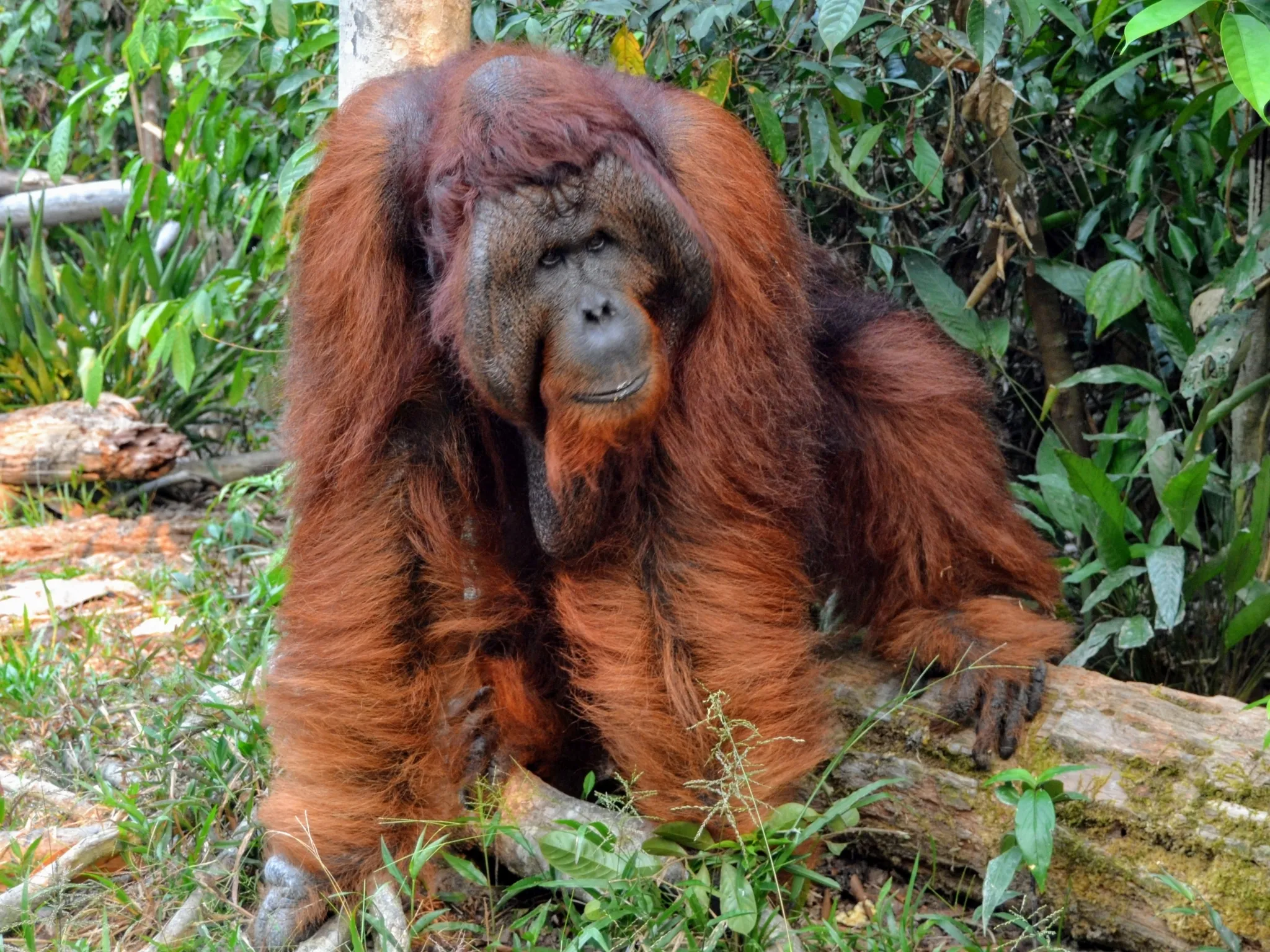
Males average 970 mm tall and 87 kg1, while females average 780 mm and 37 kg. New England Primate Conservancy gives a slightly different range, 60–90 kg for males, 40–50 kg for females3; the two accounts are not averaged together.
Adult males develop large cheek pads called flanges and a sagittal crest where the temporal muscles attach, along with a throat pouch used for calling that is bigger than a female’s. The species shows bimaturism: a male can mature as a flanged male with the full cheek pads, or stay an unflanged male that resembles a female in size and does not give the species’ loud call, typically becoming flanged between the ages of 15 and 20. Fur is orange-red; compared with the Sumatran orangutan, Bornean orangutans have darker red coats and coarser hair, and males have larger flanges and throat pouches. Long arms let the species travel through the canopy, gripping with both hands and feet; young orangutans brachiate, swinging arm over arm, while older individuals mostly walk quadrupedally on the ground, or occasionally upright, and walk on their fists rather than their knuckles1, unlike the other great apes.
Where do Bornean orangutans live?
The species lives only on the island of Borneo, split between Indonesia, Malaysia and Brunei, in a patchy range that is completely absent from the southeast of the island. It occupies lowland and hilly tropical rainforest, including peat swamp and dipterocarp forest, and is rarely found above 800 m3 in elevation by New England Primate Conservancy’s account, or above 1,000 m1 by Animal Diversity Web’s; the two figures are given separately, not averaged.
What do Bornean orangutans eat?
Fruit makes up more than 60% of the diet1, including wild figs and durians, part of 400 to 500 different food types eaten overall. The rest is leaves, shoots, bark, honey, insects and bird eggs, and orangutans also eat soil and rocks for minerals3, a behaviour called geophagy.
How do Bornean orangutans live?
Bornean orangutans are diurnal and, unlike most primates, live mostly alone1: females travel with one or two dependent offspring through home ranges that overlap with a dominant male’s, and gatherings of six or more individuals are rare. New England Primate Conservancy describes Bornean populations as even more solitary than Sumatran orangutans. Every night the species builds a fresh nest high in the treetops3 from branches and foliage.
The species’ most distinctive sound is the long-call, a call lasting one to two minutes given only by flanged males, audible several kilometres away under the right conditions; it advertises a male’s presence and can attract receptive females. Orangutans also give a fast-call, most often after conflict between males, smack their lips1 to produce sound in small groups, and scream when frightened.
How do Bornean orangutans reproduce and how long do they live?
Gestation lasts about eight months. Females typically have their first offspring at about 15 years of age; Animal Diversity Web separately gives a female sexual maturity range of 5.8 to 11.1 years (males 8 to 15 years). Weaning comes at six to seven years, and the interval between births, at about eight years, is the longest of any mammal3. Female fertility ends around an estimated menopause age of 481.
On lifespan, Animal Diversity Web reports more than 50 years in the wild1, while New England Primate Conservancy gives 35 to 45 years in the wild; the two figures disagree and are given separately, not averaged. In captivity, both sources describe a maximum of around 59 to 60 years3.
Is the Bornean orangutan endangered?
The IUCN lists the Bornean orangutan as Critically Endangered, under Red List version 2022.22. The IUCN places the total population at about 104,700 individuals, corroborated by a 2022 World Wildlife Fund estimate, down from roughly 230,000 a decade earlier and over 300,000 in the 1970s; continued deforestation was projected to cut numbers by as much as 86% by 20253.
The main threat is habitat loss from illegal logging and slash-and-burn clearing, including for palm oil plantations, which the World Wildlife Fund says clear an area equivalent to 300 football fields of rainforest every hour. Hunting also takes a toll: the EIA estimates that more than 2,000 orangutans are hunted annually, and infants are captured for the illegal pet trade after their mothers are killed. The species is listed on CITES Appendix I, banning international trade, and is protected under Indonesian, Malaysian and Bruneian law, though New England Primate Conservancy notes enforcement remains weak3.
Similar species
- Sumatran orangutan (Pongo abelii): found only on the northern tip of Sumatra, in forest fragmented by logging, this orangutan is distinguished from the Bornean orangutan by longer, finer fur and a more slender build, with white facial and groin hair and long beards in both sexes. Males weigh 50 to 90 kg and stand up to 1.8 m4, with cheek pads covered in fine white hair, against the Bornean orangutan’s darker, coarser-haired flanges.
- Western gorilla (Gorilla gorilla): a much larger, ground-dwelling ape of equatorial Africa, from the forests near the Cameroon coast through several Central African countries. It has jet-black skin, a short muzzle and a prominent brow ridge, travels on the ground on its knuckles instead of mainly through the canopy, and wild males average 180 kg5, roughly twice the weight of a male Bornean orangutan.