Contents
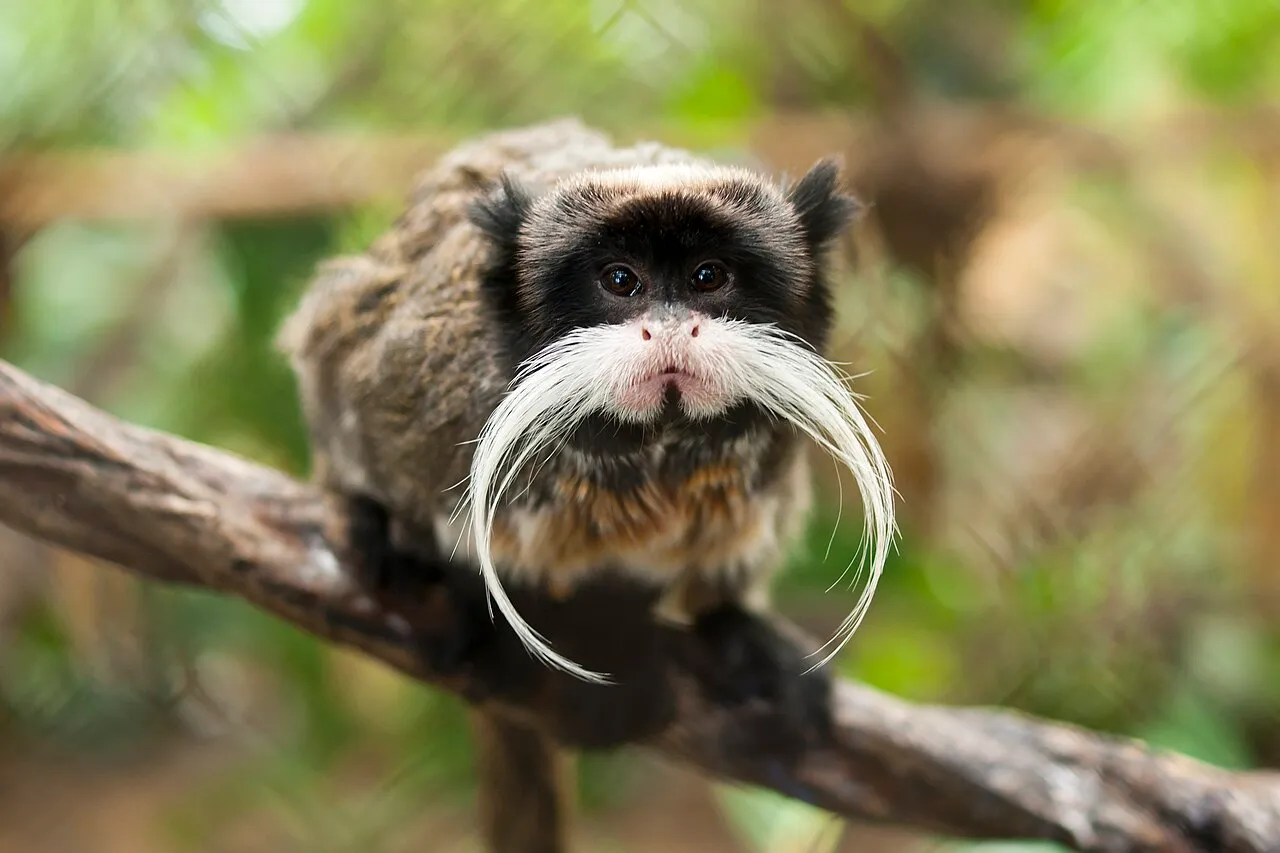
The emperor tamarin, Saguinus imperator, is a small monkey of the Amazonian tropical forests of southeast Peru, northwest Bolivia and northwest Brazil. It is best known for its extremely long white moustache, which hangs down to its chest in two strands. The species was named after the German emperor Wilhelm II1: the Swiss zoologist Goeldi gave it the name “emperor” as a joke, and the name stuck. AnAge places it in the family Callitrichidae2, genus Saguinus.
What does an emperor tamarin look like?
Emperor tamarins measure approximately 9.2 to 10.4 inches (23 to 26 cm) in body length, with a tail of 14 to 16.6 inches (36 to 42 cm). Animal Diversity Web gives a weight of only 10.7 to 14.2 oz1 (about 300 to 400 g) at full size.
The body is mainly gray, with fine yellow hair on the back and a rusty-red scattering of colour on the breast. The crown is silvery brown, the hands and feet are black and the tail is reddish brown. The white moustache extends past its shoulders when laid back. Like most tamarins, it has claws on all of its fingers and toes1 except the great toe, which has a nail.
Two subspecies are recognised: the black-chinned emperor tamarin and the bearded emperor tamarin3. The bearded form has a prominent white beard besides its moustache, whereas S. i. imperator has only faint black whiskers on its chin. The New England Primate Conservancy treats the bearded emperor tamarin under the name Tamarinus subgrisescens4.
Where do emperor tamarins live?
The range covers southeast Peru, northwest Bolivia and northwest Brazil, and Animal Diversity Web names the Acre, Purus and Jurua river drainages1 as holding populations. In Brazil the species lives in the states of Acre and Amazonas3.
Emperor tamarins live in light, dry-bottom to densely grown Amazonian forest margins in seasonally inundated regions. Their territories cover 75 to 100 acres (about 30 to 40 ha) and also span open woodlands and secondary growth. The species is arboreal and spends most of its time in trees, usually below 80 to 95 feet1 (24 to 29 m).
What do emperor tamarins eat?
The diet consists mainly of fruits, insects and tree sap. Emperor tamarins feed on the fruit, flowers and nectar of different trees, usually those with small crowns, and their light weight lets them feed on the outermost twigs and branches of such trees. Most of their protein comes from invertebrates such as locusts, beetles, butterflies, spiders and ants1.
They use tree sap left by the earlier tapping of other animals, a source of carbohydrates and minerals. Emperor tamarins have also been known to eat lizards, tree frogs and bird eggs1.
How do emperor tamarins live?
Emperor tamarins are active by day. They are leapers that move through the trees with quick, jerky movements1.
They generally live in groups of 2 to 8 individuals, up to 15. For the bearded emperor tamarin, the New England Primate Conservancy describes small extended family units of 4 to 15 individuals4. Group members are ranked by sex and age, so that the oldest female has the highest rank1.
In parts of southeastern Peru, emperor tamarins live in association with saddle-back tamarins1. The two species share territorial boundaries, exchange vocal calls and coordinate their movements without seeing the other group. Such associations are believed to help both groups detect and defend against predators and to make food harvesting more efficient. Emperor tamarins have been reported to spend up to 20% of their day3 foraging in mixed troops with Weddell’s saddle-back tamarins.
The long call is the most likely call in the tamarin repertoire to serve as a coordinating signal, and it can be heard by humans over 150 m away3. Emperor tamarins often give the long call on leaving their sleeping sites in the morning.
How do emperor tamarins reproduce and how long do they live?
The estrous cycle lasts about 15 days, and the female mates with all of the males of the group. Gestation lasts 140 to 145 days1, after which 1 or 2 young are born, rarely 3. Most births occur during the wet season3, when food resources are abundant.
Both males of the group usually help with the birth, receiving the baby and washing it. A newborn is completely helpless and weighs approximately 35 g. The mother feeds her baby every 2 to 3 hours for about half an hour, then returns it to the father. The young ride on their parents’ backs for 6 to 7 weeks1 and are weaned at around 2 to 3 months.
Most emperor tamarins become sexually mature at around 16 to 20 months1.
Animal Diversity Web puts the life span at between 10 and 20 years, and gives an average lifespan in captivity of 17.9 years1. In captivity, emperor tamarins have been reported to live up to 23.7 years2.
Is the emperor tamarin endangered?
The IUCN lists the emperor tamarin as Least Concern5 in its Red List version 2022.2. For the bearded emperor tamarin, the New England Primate Conservancy states that much of the once-remote range is increasingly subject to progressive deforestation, largely as a result of colonisation along highways, associated with logging and cattle ranching. It also notes that their unique appearance makes them potential victims of the illegal pet trade4.
Emperor tamarins are found in protected areas at Manú National Park in Peru3 and the Manuripi-Heath Amazonian Wildlife National Reserve in Bolivia.
Similar species
- Weddell’s saddle-back tamarin (Leontocebus weddelli): the emperor tamarin’s partner in mixed troops. It is a smaller-bodied tamarin that usually stays below 10 m in the canopy, while emperor tamarins tend to stay higher. Emperor tamarin long calls generally cover a broader frequency range3, with shorter notes repeated more quickly.
- Moustached tamarin (Saguinus mystax): a tamarin of the middle Amazon region of northern Peru and western Brazil. It has jet black fur on its body and tail6 and a white stripe on its upper lip, against the emperor tamarin’s mainly gray body and long white moustache1.