Contents
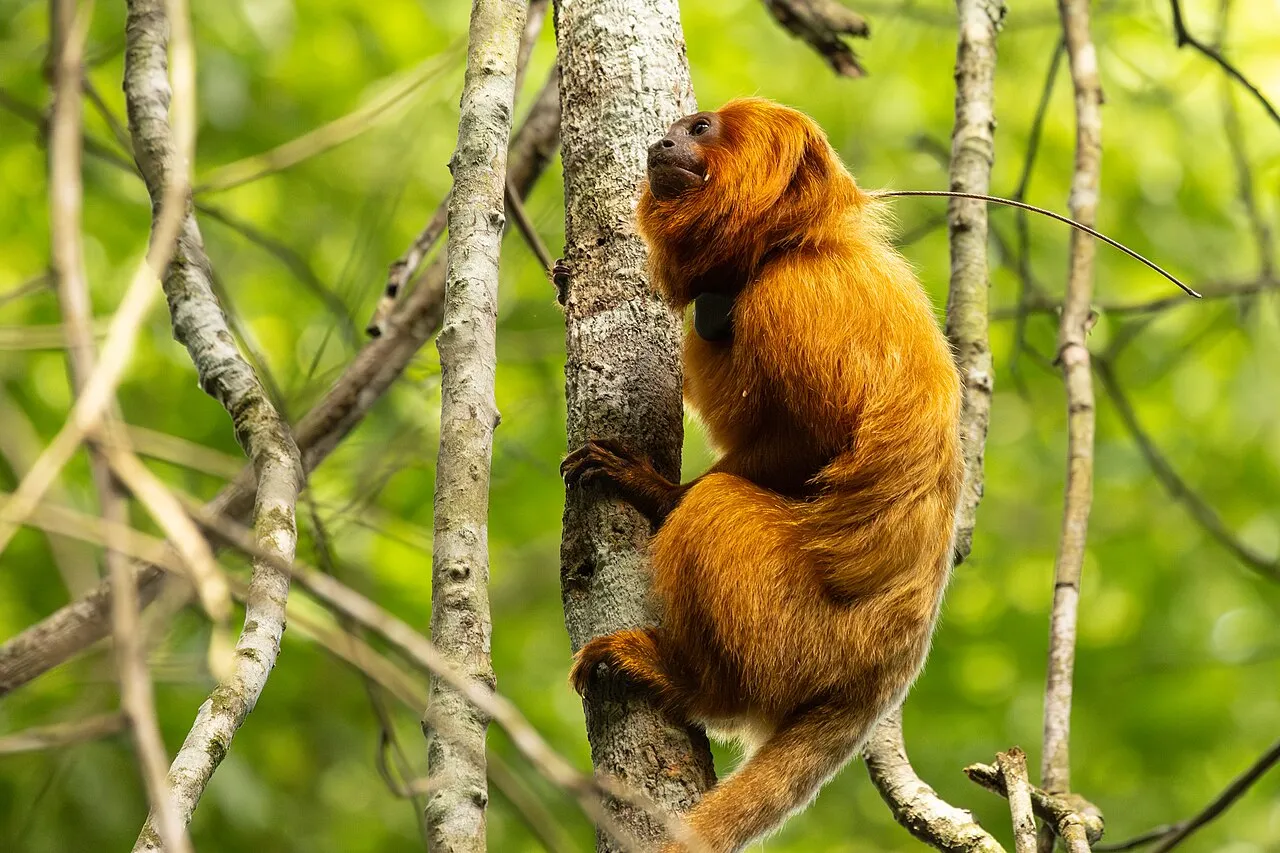
The golden lion tamarin, Leontopithecus rosalia, is a small New World monkey of the Atlantic Forest of southeastern Brazil, where it is considered a flagship species. It is known for its lustrous, golden mane, which frames a dark, hairless face. All four lion tamarin species belong to the family Callitrichidae1, which also includes other tamarins and the marmosets.
What does a golden lion tamarin look like?
Golden lion tamarins weigh 0.4 to 0.8 kg and have a head-and-body length of 19 to 22 cm, with little size difference between males and females. The non-prehensile tail adds another 26 to 34 cm1. Animal Diversity Web gives a wider body length of 200 to 366 mm, with a tail of 315 to 400 mm, and an average mass of 654.5 g2.
The head is small and rounded, with a thick golden mane on the crown, cheeks, throat, ears and shoulders. The bare face is flat, with widely spaced nostrils, and the long, soft, silky body hair ranges from pale golden to a rich reddish-gold. The long tail, hands and feet are either brown or black. There is no sexual dimorphism2. Golden lion tamarins have modified claws on all digits except the big toes1, which carry nails, and their thumbs are non-opposable.
Where do golden lion tamarins live?
The species was once found throughout the lowland coastal regions of Rio de Janeiro and Espirito Santo. Today it is restricted to four small fragments of hilltop and swamp forest below 300 m above sea level, in the São João River Basin of Rio de Janeiro state. Annual rainfall there is about 150 cm1.
Golden lion tamarins live in dense forest that is entangled with many vines and has a high density of fruit, in an extremely humid climate. They occupy the closed canopy, often 10 to 30 m off the ground2. The species has adapted to degraded and secondary forests1.
What do golden lion tamarins eat?
The diet is omnivorous, covering flowers, fruits, nectar, plant gums, bird eggs, snails, spiders and insects. In the rainy season they feed mainly on pulpy fruits, with insects making up an additional 10 to 15 percent of their meals. In the dry season, when insects are not abundant, they eat nectar, along with small frogs and lizards1.
Plants of the bromeliad family are favoured1 because they are loaded with insects. The tamarins catch insects by probing into crevices in the tree bark with their long, slender fingers, a technique called “micromanipulation”. Food is shared among family members2, but rarely with others.
How do golden lion tamarins live?
Groups typically number 2 to 8, often made up of family members2: a breeding pair, the offspring of one or two litters and possibly other relatives. The New England Primate Conservancy gives an average of eight individuals per troop. Adult females inherit rank from their mothers and dominate new males who join the troop. Both sexes typically leave their family group at age four, and the average dispersal distance is 0.85 km. Home ranges cover 0.4 to 1 km²1, depending on troop size.
The species is diurnal and sleeps from dusk until sunrise, often with a midday nap. Golden lion tamarins spend 9 to 12 hours each day foraging, eating, resting, playing and grooming. At night a family sleeps together inside tree hollows1, and it periodically changes its sleeping site to reduce the chance of discovery by predators such as hawks and large snakes. They run and walk through the trees2, and spring and leap between branches and vines.
Golden lion tamarins are territorial and defend their area with scent markings and vocal threats. They have about 17 specific calls2, used for things such as alarms and defence. Long-distance trills1 tell group members where the caller is.
How do golden lion tamarins reproduce and how long do they live?
Golden lion tamarins normally breed twice per year, between September and March. Females give birth to twins after a gestation of 130 to 135 days. Only the dominant female reproduces. Infants are born fully furred with their eyes open, and fathers and other troop members carry them on their backs. Young are considered fully weaned by 90 days of age. The infant mortality rate is nearly 50 percent1. Sexual maturity comes at 18 months for females and 24 months for males2.
In the wild, golden lion tamarins are known to live from 10 to 15 years1. In captivity the average lifespan is 24.8 years for males and 22.0 years for females2.
Is the golden lion tamarin endangered?
Under the 2022.2 version of its Red List, the IUCN lists the golden lion tamarin as Endangered3. It was down-listed from Critically Endangered in 2003, as the population grew from fewer than 200 in the 1960s to a reported 3,200 in 2014. More than a third of that population died in a yellow fever outbreak in 2017, and the wild population stood at around 2,500 individuals in 20221.
Loss of habitat remains the greatest threat; the species survives on only 2 percent of its original territory. Forests have been cleared for timber, charcoal production, cattle ranching, agriculture and urban expansion. The species is listed in Appendix II of CITES. The first wild golden lion tamarins were vaccinated against yellow fever in October 2018. Captive breeding with reintroduction into the wild1, translocation and planted forest corridors are part of its conservation.
Similar species
- Golden-headed lion tamarin (Leontopithecus chrysomelas): found only in Brazil; a 1986 study placed it in the southern part of the state of Bahia. It is mostly black with a thick, long golden mane4, whereas the golden lion tamarin’s body hair ranges from pale golden to a rich reddish-gold2.
- Black lion tamarin (Leontopithecus chrysopygus): it once inhabited the tropical forest of central and western São Paulo state, Brazil. It is covered almost completely in silky, dense black hair5, with reddish-brown thighs, buttocks and tail base.