Contents
The lar gibbon, Hylobates lar, is also known as the white-handed gibbon or common gibbon. It lives in the tropical rainforests of Southeast Asia, in Indonesia, Laos, Malaysia, Myanmar and Thailand. Mated pairs sing loud duets that can be heard up to one kilometer away2. Lar gibbons have the greatest north-south range of any of the gibbons1, and Primate Info Net recognises four subspecies: H. l. carpenteri, H. l. entelloides, H. l. lar and H. l. vestitus.
What does a lar gibbon look like?
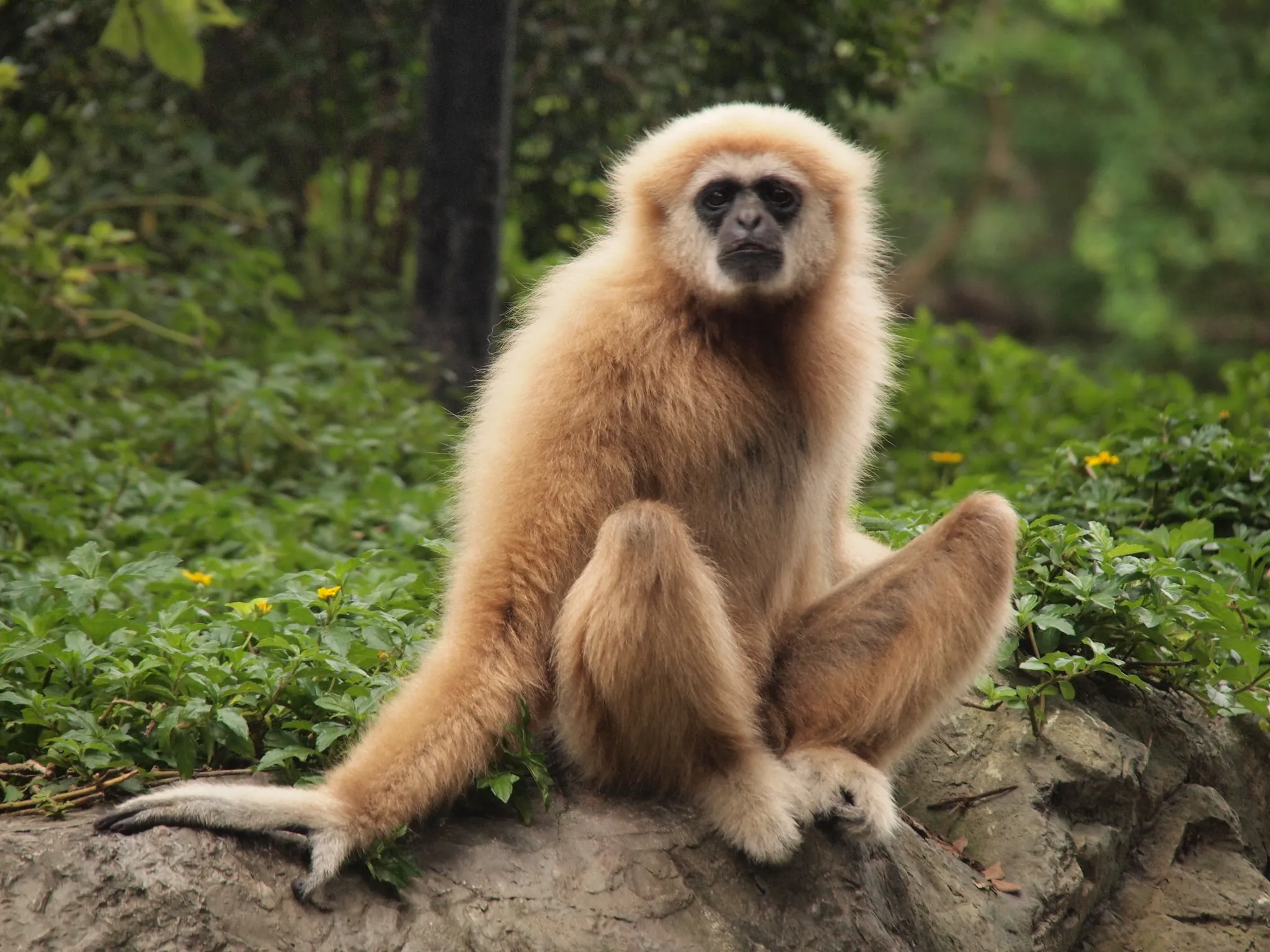
Males weigh 5.0 to 7.6 kg and females 4.4 to 6.8 kg. Head-and-body length is 43.5 to 58.4 cm in males and 42.0 to 58.0 cm in females; Primate Info Net gives 43.5 to 58.5 cm for males. Like all apes, lar gibbons have no tail1, and they have small ischial callosities as well as long arms suited for brachiation. Their elongated forelimbs, hands and feet are adaptations for brachiation, their primary mode of travel2 through forest canopies.
The coat is creamy, brown or black in both sexes and at all ages. Individuals are either light or dark, often called light and dark phases: light animals have buff or creamy fur, dark animals brown or black fur. Whether a lar gibbon is dark or light is simple genetic inheritance from its parents, with the dark form the dominant allele. Some populations are mostly light and others mostly dark. Adults have a ring around the hairless face, less apparent in lighter individuals, and white feet and hands that contrast with the rest of the body. The Sumatran subspecies, H. l. vestitus, is always light with no dark form1.
Where do lar gibbons live?
The species is found in Indonesia, Laos, Malaysia, Myanmar and Thailand. As of Primate Info Net’s 2010 account, lar gibbons were probably extinct in China; if they still existed there, they would only be found in southwest Yunnan, their former range. In Thailand they live in the majority of the country excepting the north-eastern areas. The range extends through southern and eastern Myanmar, but only east of the Salween River. They are found through the Malay Peninsula, with a gap between the Perak and Muda Rivers, and west of the Mekong River in northwestern Laos. In Indonesia, H. l. vestitus is found over the northern third of the island of Sumatra1.
Lar gibbons live in lowland, hill and upper dipterocarp forest, including primary lowland and submontane rainforest, mixed deciduous bamboo forest and seasonal evergreen forest, and also in peat swamp forest. They are not usually found higher than 1200 meters above sea level. Lar gibbons are a high canopy species, rarely found in the understory. At Khao Yai in Thailand, the average height of feeding trees was 23.7 meters. Animal Diversity Web gives home ranges of 17 to 40 hectares2, while Primate Info Net puts the average home range at 0.4 km²1, with a daily path length of 1.4 km.
What do lar gibbons eat?
Lar gibbons eat a large variety of foods, especially fruit, including figs and other small, sweet fruits, liana fruit, tree fruit and berries. They also eat young leaves, buds and flowers, new shoots, vines, insects including mantids and wasps, and even birds’ eggs. They are known to eat parts of over 100 species of plants. With data combined among study sites, the diet includes fruit (66%), leaves (24%), flowers (1%), and insects (9%), though individual studies vary by locality. Figs make up around 27%1 of the diet on average, but sometimes up to half of the total foods eaten.
Lar gibbons are very selective feeders2 when it comes to fruit: fruits are tasted and either accepted or rejected based on ripeness. One way lar gibbons drink water is from tree holes by cupping their hands1.
How do lar gibbons live?
Lar gibbons are mostly monogamous, living in groups of 2 to 6 members2. Primate Info Net says they usually live in serial monogamous pairs with up to 4 offspring in each group, but some sites also have multi-male groups and groups with several adult females. At one location, multi-male groups made up over 20% of groups. There is no personal leadership of a lar gibbon group, although adult females lead group progressions most often. In one long-term study, males left their natal groups at around 10 years of age1.
Lar gibbons are diurnal. In Thailand they are active for an average of 8.7 hours per day, leaving their sleeping sites around sunrise and entering sleeping trees an average of 3.4 hours before sunset. On average they spend their days feeding (32.6%), resting (26.2%), traveling (24.2%), in social activities (11.3%) and vocalizing (4.0%). Group members usually sleep one to a tree near each other. Grooming is the most common social interaction within a group. Besides brachiation, lar gibbons are capable of rapid movement on the ground using 7 types of gait1.
A mated pair’s normal duet is made up of an introductory call, a great call, and an interlude sequence; the great call begins with the female, and the male answers. Duets occur between sunrise and noon and average 11 minutes2. The great call of each female is distinct and unique from those of other females. Duets also serve in territorial defense1 and in communication with other lar gibbon groups.
How do lar gibbons reproduce and how long do they live?
Mating occurs in every month of the year, but most conceptions occur during the dry season. Gestation in wild lar gibbons is around six months, according to Primate Info Net; Animal Diversity Web gives 7 months. Newborns weigh on average 383.4 g and are nearly naked. Infants are weaned at around two years of age, while Animal Diversity Web says weaning lasts about 20 months2. The interbirth interval is at a minimum 3 years and averages 41 months. On average, wild females reproduce for the first time at about 11 years of age, much later than in captivity. Infant mortality in the first year of life is low, at 6.3%1.
Lar gibbons live on average 30 years in the wild2, according to Animal Diversity Web, which gives up to 44 years in captivity. Primate Info Net says captive lar gibbons have lived up to around 50 years1. AnAge records a wild-born female acquired by San Antonio Zoo in 1954 that died in 2008 at an estimated 56 years of age3.
Is the lar gibbon endangered?
The IUCN lists the lar gibbon as Endangered4, under Red List version 2022.2. Geissmann estimated in 2007 that Thailand probably held between 15,000-20,000 lar gibbons1. Animal Diversity Web links the status in part to the illegal pet trade in Thailand2, and names deforestation as a growing threat.
Primate Info Net’s conservation account, last updated in 2010, lists the threats to lar gibbon habitat as forest clearance for roads, shifting agriculture, nature tourism, forest fires, illegal logging, new settlements and palm oil plantations. Hunting for food is also a major threat, partly because the species is relatively easy to hunt. Because infants are preferred as pets, often the mother is shot and killed to gain access to the infant. Khao Yai National Park, a site of long-term lar gibbon studies, is part of the Dong Phayayen-Khao Yai Forest Complex, designated a UNESCO World Heritage Forest1.
Similar species
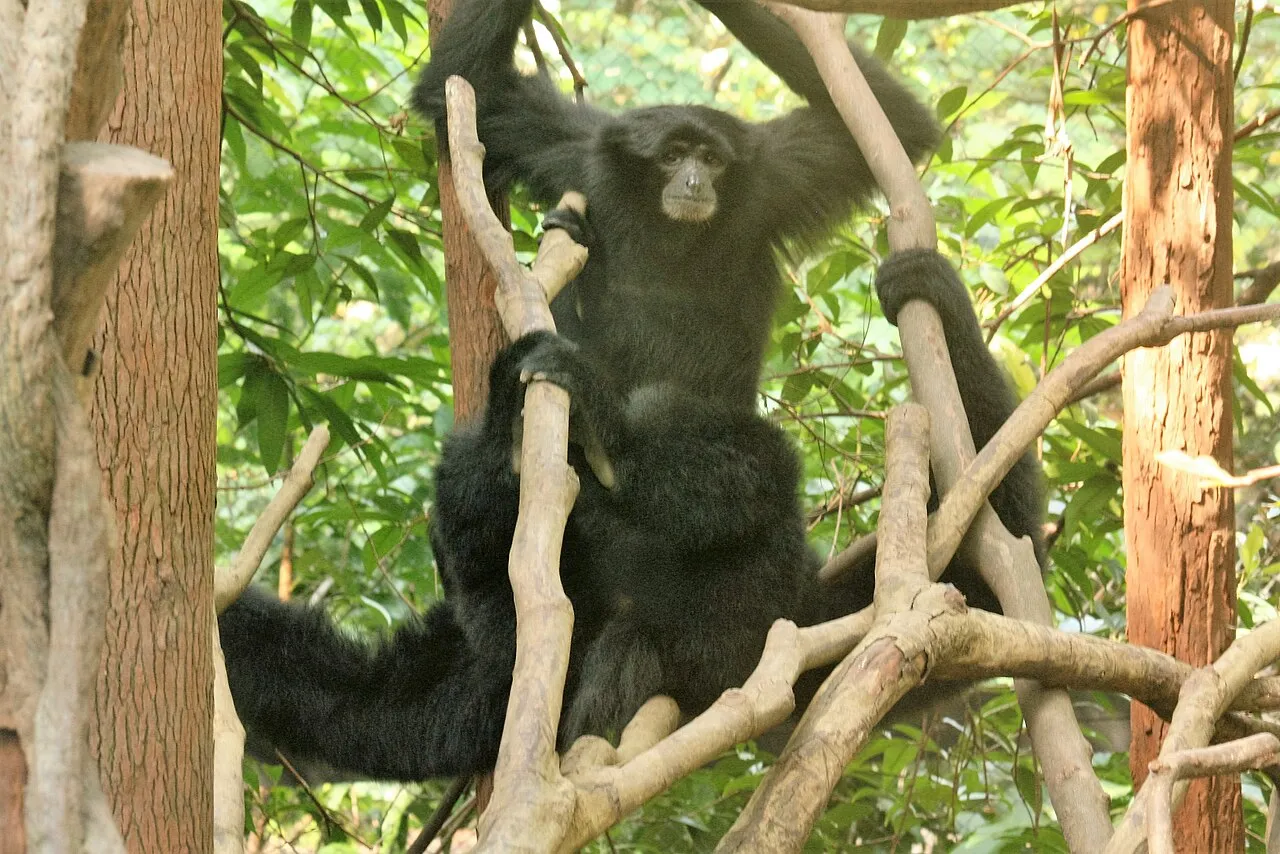
- Siamang (Symphalangus syndactylus): lar gibbons compete with sympatric siamangs1, whose presence usually causes conflict. The siamang is the largest of the gibbons, weighing between 10 and 12 kg5, with a thick black coat and an enlarged throat sac used as a sound box.
- Agile gibbon (Hylobates agilis): a gibbon of the rainforests of Thailand, Malaysia, and Indonesia, with an average weight of 5.4 kg for females and 5.8 kg for males. Agile gibbons of both sexes have white eyebrows6, and males also have white cheeks.
- Pileated gibbon (Hylobates pileatus): Animal Diversity Web’s 2011 account placed it only in southeast Thailand, extreme southwestern Laos and northwestern Cambodia, and in sympatry with lar gibbons1 in southeastern Thailand. Adult females are light gray or buff with a large black patch7 from the top of the head to the groin, forming an inverted triangle; adult males are almost completely black.