Contents
The siamang, Symphalangus syndactylus, is the largest of the gibbons and lives in the Barisan Mountains of Sumatra and the mountains of the Malay Peninsula. Its most distinguishing feature is an enlarged throat sac1 that works as a sound box for its loud calls. It is the only species in the genus Symphalangus2, with two subspecies: the Sumatran siamang (S. s. syndactylus) and the Malaysian siamang (S. s. continentis).
What does a siamang look like?
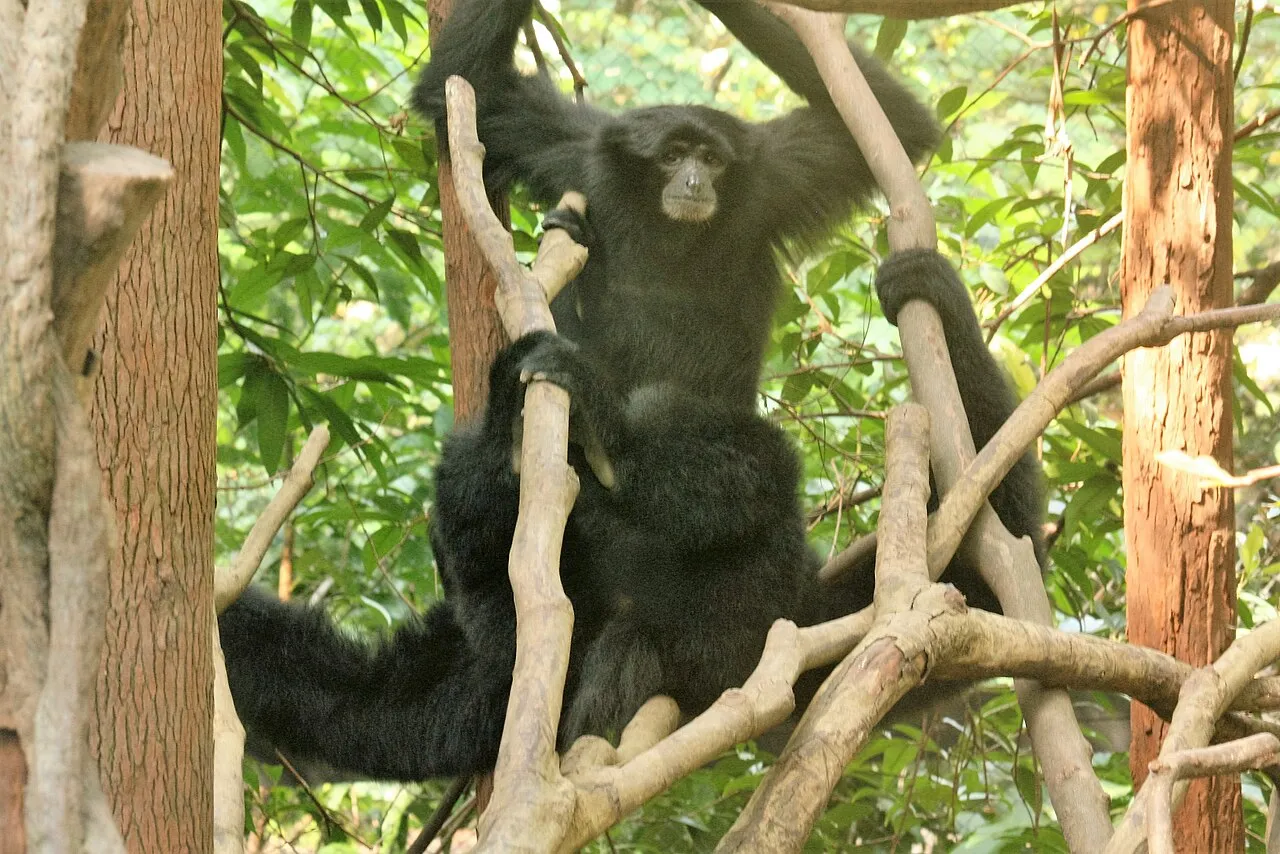
Among the gibbons, siamangs are stocky, with glossy black hair, long hair on the upper body and a broad chest. The arms may reach 2.3 to 2.6 times the body length. The face is short-muzzled and nearly hairless1, with pale hair around the mouth and chin. The throat sac is grayish or pinkish and hair-free2, and it inflates before and during calls. When fully inflated it is comparable in size to the head. Like all lesser apes, siamangs have no tail, although males have a downward-directed genital tassel up to 13.5 cm long that resembles one. The second and third toes are connected by webbing3 of variable extent, a condition reflected in the scientific name.
Animal Diversity Web gives a weight of 10 to 12 kg and a head-body length of 71 to 90 cm1. Males are slightly heavier than females: the New England Primate Conservancy puts females at about 10.5 kg and males at about 12 kg2 on average. In a small wild-shot sample, adult males averaged 11.9 kg and adult females 10.7 kg. In a much larger survey of captive animals, adult males averaged 12.8 kg and adult females 10.5 kg3.
Where do siamangs live?
Siamangs are found on the island of Sumatra (Indonesia) and on the Malay Peninsula, in Malaysia and Thailand. Each region has its own subspecies: S. s. syndactylus is confined to Sumatra and S. s. continentis to the northwest and central Malay Peninsula. On the peninsula the range is bounded by the Pahang River in the east, the Maur river and Tasek Bera in the south, and the Perak river in the north. There is at least one report from Narathiwat Province in extreme southern Thailand, very near the border with Malaysia. On Sumatra the species occurs over most of the island3 but is mainly found in the west.
The primary habitat is tropical hill forest. The species is most often found above 300 m, but can also live in lowland forests, in selectively logged swamp, lowland and hill forests, and in primary submontane forest. The New England Primate Conservancy says siamangs can be found at altitudes up to 3,800 m2. Siamangs spend most of their time over 24 m above the ground3, descending to around 7.5 m and rarely lower.
What do siamangs eat?
Siamangs survive mainly on leaves and fruit, but also eat insects, bird eggs and small vertebrates. Averaged across several study sites in Malaysia and Indonesia, the diet is 49% fruit, 38% leaves, 3% flowers and 10% insects. Figs can make up up to 37% of the diet. Siamangs eat mostly young leaves and only small amounts of mature leaves. Overall, they eat more than 160 plant species3. The Sumatran siamang is more frugivorous than the Malaysian siamang2, with 60% of its diet consisting of fruit. During much of their feeding time siamangs are suspended by one arm1.
How do siamangs live?
Most siamangs live in monogamous pairs. The New England Primate Conservancy describes a group as an adult breeding pair and two or three offspring2 that have yet to leave the group. Groups with multiple adult males are also known, and such groups can last several years. In the wild, gibbons including siamangs show a lack of dominance over one another3. Animal Diversity Web describes grooming as a display of dominance1, with the more dominant animal receiving more grooming than it gives.
Siamangs are diurnal, and the daily activity period is usually over ten hours. At night a group enters the highest branches of a single tree, sometimes lower and in several trees. Sleeping trees are often reused3. Siamangs do not make nests2.
Brachiation, swinging from branch to branch by the arms, makes up around 80% of siamang movement. Flights of 8 to 10 m have been witnessed. On the ground, locomotion is usually bipedal1. Home ranges cover 0.2 to 0.48 km², with no or little overlap. Average day ranges of siamang groups are 640 to 1289 m3.
The adult pair of each group sings loud duets each morning and late afternoon for up to 30 minutes to mark its territory. Such calling can be heard more than 2 km away3. The New England Primate Conservancy says the songs can reach up to 113 decibels2.
How do siamangs reproduce and how long do they live?
The gestation period is 230 to 235 days, about 7 months. Females typically give birth every 2 to 3 years to one young, but twins sometimes occur. Offspring cling to the mother’s belly constantly for their first 3 to 4 months. The infant is weaned at 18 to 24 months and reaches maturity at about 6 to 7 years. Males assist in parental care by helping to defend young and the territory, and sometimes by grooming, playing with or carrying the young. An individual female rarely gives birth to more than 101 offspring in her lifetime.
The New England Primate Conservancy gives a lifespan of 25–40 years in the wild2. In captivity, the AnAge database, citing a 2005 compilation by Richard Weigl, records one wild-born siamang still alive at about 43 years4.
Is the siamang endangered?
The IUCN lists the siamang as Endangered5, in an assessment the New England Primate Conservancy dates to 2015. The New England Primate Conservancy wrote in December 2023 that infants are captured for the illegal pet trade throughout southeast Asia, often involving the killing of adults, and that numbers have declined by 50% over the last 40 years through the pet trade and habitat loss. Habitat destruction from commercial timber harvesting or conversion to agriculture, particularly palm oil, poses a critical threat. The siamang is listed in Appendix I of CITES2.
Similar species
- White-handed or lar gibbon (Hylobates lar): lives alongside siamangs in northern Sumatra3. It is much smaller, with males weighing 5.0 to 7.6 kg and females 4.4 to 6.8 kg. Its hairless face is surrounded by a ring of very short white or lightly colored fur6, and the hands and feet are both white.
- Agile gibbon (Hylobates agilis): another gibbon that lives alongside the siamang3. Its average weight is 5.4 kg for females and 5.8 kg for males. Agile gibbons come in a variety of colours, including black, brown, light tan and reddish-brown7.