Contents
The tufted capuchin, Sapajus apella, is a monkey found only in South America, and it has the largest range of all of the New World primates. Wild tufted capuchins are known for using tools to open fruits whose husks they cannot open with their teeth. Linnaeus described it in 1758 as Simia apella2, and many sources still list it as Cebus apella. Primate Info Net places it in the family Cebidae and notes that its taxonomy is debated: some researchers treat forms such as C. libidinosus, C. nigritus and C. xanthosternos as subspecies, others as full species. Other names include black-capped capuchin, brown capuchin and Guianan brown capuchin1.
What does a tufted capuchin look like?
Head and body length averages 444 mm in males and 390 mm in females, and the tail is about as long as the rest of the body. Wild males average 3.65 kg and wild females 2.52 kg. Captive animals are significantly heavier: in an extreme example, males averaged 6.089 kg and females 3.19 kg1. Animal Diversity Web gives a mass range of 1.3 to 4.8 kg and reports that males are 34% larger in body size3, with canines 22% larger than those of females.
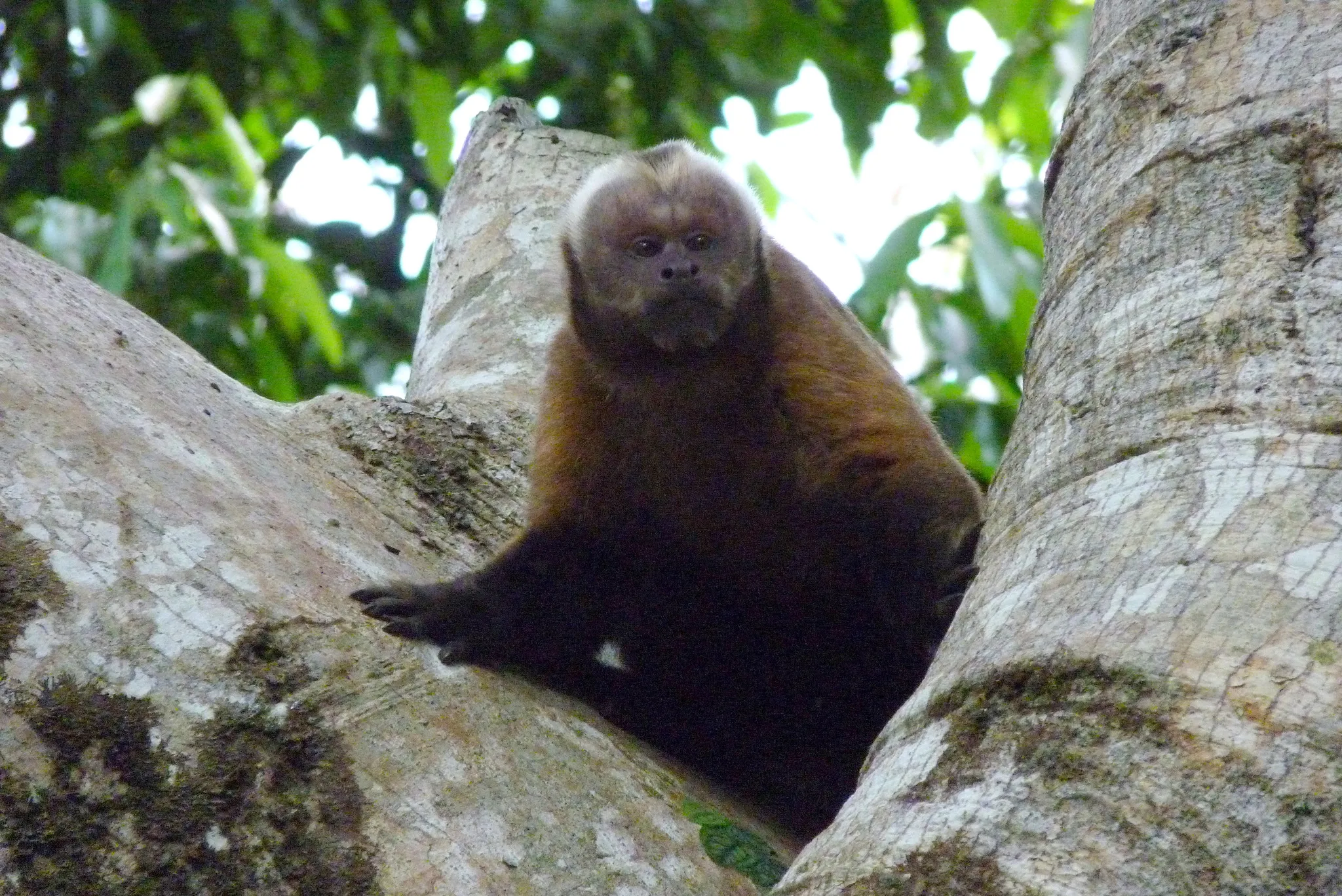
The species is robust and stocky, with a deep lower jaw and large jaw muscles. The head carries a black or dark brown cap with dark sideburns, and on either side of the cap there are tufts of dark fur above the ears. Those tufts give the species one of its common names. The shoulders are paler than the back, which ranges from shades of yellow to red-brown, darkest in the middle; the legs, hands and tail are darker than the rest of the coat. The face can be brown to pink1. Face colour varies even within one group, but adult males tend to be darker than females. The tail is long and prehensile3, and this is the only capuchin known to carry its tail in a tight coil.
Where do tufted capuchins live?
Primate Info Net lists the tufted capuchin in Colombia, Ecuador, Peru, Bolivia, Brazil, French Guiana, Suriname, Guyana and Venezuela. The heart of the range is the northwestern half of Brazil and the Amazon basin. To the north the range extends up to Venezuela, where it is limited by savannahs; to the west it reaches the eastern foothills of the Andes, and in the south it appears to be limited by the bush savannah of central Brazil. The Margarita Island tufted capuchin lives off the north coast of Venezuela, around 800 km1 from the nearest mainland population. Animal Diversity Web’s 2003 account still counts the Atlantic-forest forms xanthosternos and robustus, which it says may be threatened, as subspecies, and gives a wider range east of the Andes, from Colombia and Venezuela to Paraguay and northern Argentina3.
The tufted capuchin lives in moist subtropical or tropical forests, and has also been seen in dry, gallery, disturbed and secondary forest. In Suriname it lives in at least five different forest types, including high rain forest and swamp forest, and it is also found in edge habitats. Within the forest it typically remains in the understory and lower and middle canopy, but it often descends from the trees3 to forage and play. It has been seen as high as 2,350 m1 in the Peruvian highlands.
What do tufted capuchins eat?
The tufted capuchin is omnivorous and can exploit a wide range of food resources, including many not used by other neotropical primates. Its diet contains fruits, insects, leaves, nectar, nuts and pith, in proportions that vary considerably with the seasons. In one Amazonian study the diet was 82% plants and 18% animal matter1. Fruits are a large part of the diet3, and Animal Diversity Web says its robust jaws let it eat larger fruits than other capuchins.
In the dry season, when food is often scarce, it relies on palm nuts and pith, and foraging for insects increases. Animal prey includes many insects and vertebrates such as frogs, lizards and birds, and the species is a confirmed predator of titi monkeys, observed killing and consuming an infant. Foraging is a noisy and destructive activity3: the monkeys rip apart vegetation and crack nuts open against branches. To open such fruits they smash them on tree surfaces1 or use baton-like pieces of branch; young animals try to copy the adults but often fail.
How do tufted capuchins live?
Tufted capuchins are diurnal and arboreal3. Feeding is the main activity of the day: one study recorded 66% feeding, 21% travel and 12% rest. Locomotion is principally quadrupedal; the tail is used mainly during feeding and foraging, and as a brake while descending. The average daily path is around 2.1 km. Home ranges vary with habitat, from as high as 8-9 km² in one study to around 2.6 km² or as low as 0.5 to 0.7 km² elsewhere. The group spends the night in tall trees1, and the sleeping site changes frequently.
Groups often number in the teens or lower twenties, with one to several adult males and around the same number of adult females; Animal Diversity Web gives 8 to 15 animals3. When a troop approaches around twenty individuals, the chances of the group splitting are thought to increase. Both sexes have rank hierarchies correlated with age, older individuals typically ranking higher. The alpha male dictates group movement and activity patterns. Females usually stay in their natal group, while young males often transfer between groups several times before settling. A group does not defend a territory, and the ranges of more than two groups1 often overlap.
In captivity the species uses several calls with specific purposes, among them contact calls, and at an alarm call the entire troop flees. Captive animals show 7 discrete facial displays, the silent bared-teeth and relaxed open-mouth displays being the most common. They scent mark themselves by washing their hands in their own urine3 and rubbing their hands on their fur. Males that have been apart greet each other with a reunion display1: they approach quickly, embrace and vocalize loudly.
How do tufted capuchins reproduce and how long do they live?
Estrus does not show any strict seasonality, though it is more common at some times of the year, and most births may occur during the dry season or early rainy season. Female behaviour is the only sign of estrus, as there are no external clues or genital swelling that might indicate it, and females actively solicit the alpha male; toward the end of estrus they mate with several lower-ranked males. Average gestation in captivity is 153 days1, ranging from 149 to 158 days. One infant is born, and twins are very rare3.
For its first three weeks in the wild the infant clings to its mother’s back. After the fourth week, 20-70% of the infant’s time is spent with other group members. Weaning has been estimated at around 16.5 months in the wild and 13.7 months in captivity. Primate Info Net says females produce offspring only about once every two years1, while Animal Diversity Web says capuchins give birth once yearly3.
Wild females reach reproductive maturity at around four years of age, against around five years in captivity, and captive males are fertile by about four and a half years. Animal Diversity Web says males are considered sexually mature at 7 years of age. Animal Diversity Web’s 2003 account3 says typical longevity in the wild is unknown. In a captive case of extreme longevity, a male lived until he was at least 45 years old1.
Is the tufted capuchin endangered?
The IUCN lists the tufted capuchin as Least Concern2 in its Red List version 2022.2. Animal Diversity Web’s 2003 account credited its high reproductive potential and its habitat flexibility for the fact that hunting and habitat destruction had not hit it as hard as other primates, and called it the most commonly seen monkey in Amazonia. Primate Info Net’s conservation notes, last updated in 2009, name habitat loss and fragmentation as the biggest threat, driven by logging, agriculture and flooding for hydroelectric power. The same 2009 notes call hunting for food and as a crop pest a significant threat as well; in one instance a village of indigenous Brazilians killed and consumed over two hundred tufted capuchins in under a year. In 20091 Primate Info Net described the Margarita Island population as having far fewer animals and being critically endangered, and noted that escaped or released pet wedge-capped capuchins could compete with it for the same resources. Animal Diversity Web lists the species on CITES Appendix II3.
Similar species
Tufted capuchins can live in the same habitat as both C. albifrons and C. olivaceus1.
- White-fronted capuchin (Cebus albifrons): found in Ecuador, Colombia, Venezuela, eastern Peru and much of Amazonian Brazil. It is one of the smaller capuchins, slender with long, narrow limbs, where the tufted capuchin is robust and stocky. Its crown has a round, dark patch, and the face, covered by sparse pale hair, has a thin border of white4 instead of the tufted capuchin’s black sideburns3.
- Wedge-capped capuchin (Cebus olivaceus), also called the weeping capuchin: its range runs from northwestern Venezuela to the southern reaches of the Amazon Basin. Its body is mostly off-white to pale buff, with a black to dark grey wedge-shaped patch from the forehead back over the crown instead of a cap with tufts of fur above the ears3. Its black-tipped tail is often carried coiled at the tip5.