Contents
The ring-tailed lemur, Lemur catta, is a lemur of the family Lemuridae that is found only in southern and southwestern Madagascar1. It is best known for its long tail with alternating bands of black and white rings, and it is the most terrestrial of all lemurs2.
What does a ring-tailed lemur look like?
Animal Diversity Web gives a body length of 39 to 46 cm1, a tail of 56 to 63 cm and an average weight of 2.2 kg. Primate Info Net says males and females are about the same size, in the wild measuring about 42.5 cm from head to rump and weighing between 2207 and 2213 g on average. In captivity they weigh slightly more, with males averaging 2705 g and females 2678 g2.
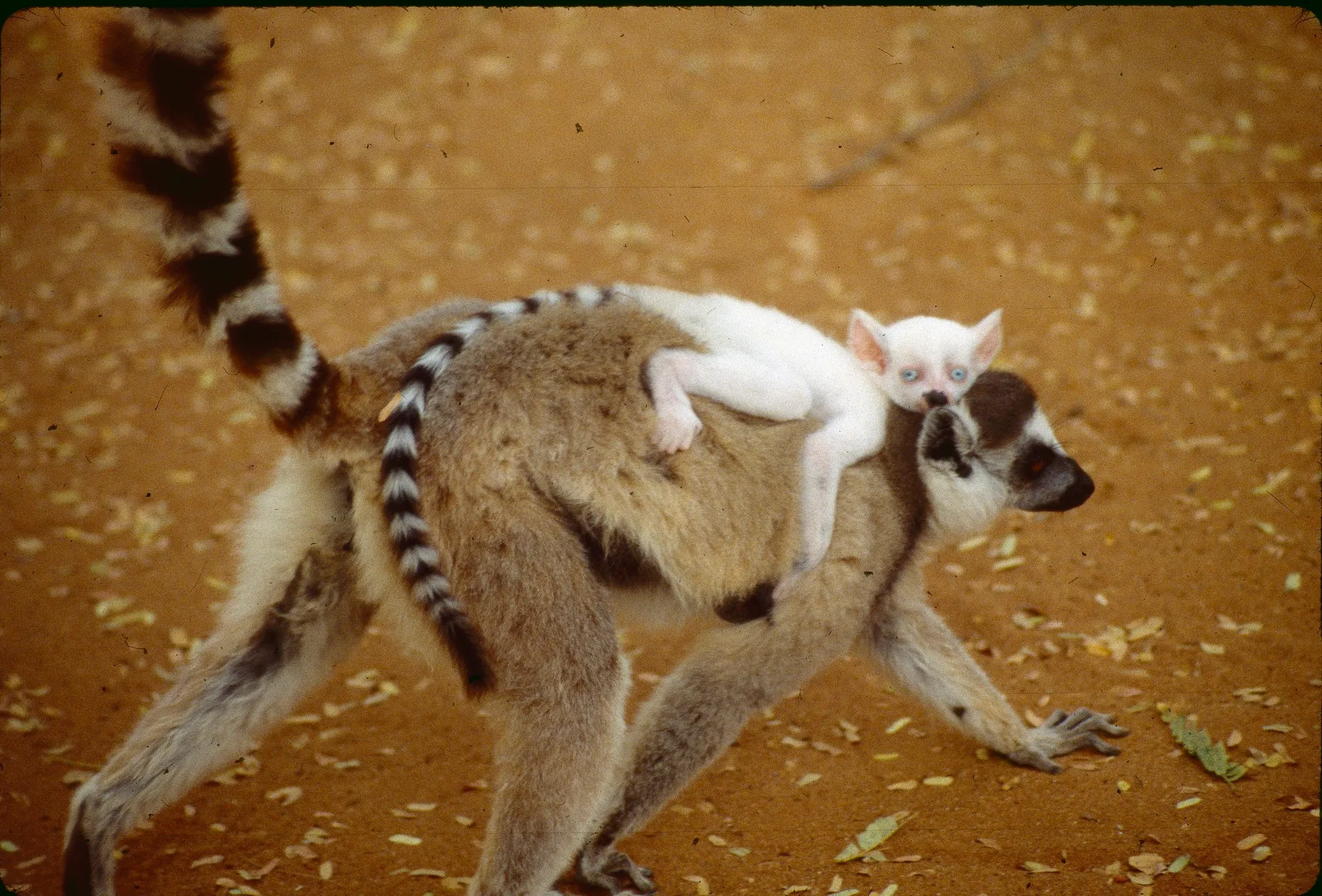
The fur is thick and dense1, and the tail has thick, well defined black and white rings from stem to tip. Primate Info Net describes the body as light reddish gray to dark red-brown, with white undersides, hands and feet. The face is white with dark brown or black triangular eye patches that look like a mask around the light brown eyes, and the muzzle is black. The ears are white and angular, similar to a cat’s2.
The sexes differ in their scent glands: females only have anogenital scent glands, while males have darkly colored scent glands on the inside of their wrists, each overlaid by a spur-like fingernail, and further glands on the chest. Like other members of the superfamily Lemuroidea, ring-tailed lemurs have specialized teeth in the lower jaw that form a dental comb2, thought to aid in grooming.
Where do ring-tailed lemurs live?
The range reaches a northern limit near Morondava on the west coast and Ambalavao in the east, with Tolagnaro on the southern coast as its southeastern limit. Ring-tailed lemurs prefer gallery forests along riverbanks1, but can be found in dry scrub, montane humid forests and deciduous forests. Primate Info Net lists habitats from sea level to 2600 m, including rainforests, subalpine, deciduous, gallery and spiny bush forests. They are found in the vicinity of nine forests2, among them Andohahela, Berenty, Beza Mahafaly and Isalo.
The species requires some forest cover and is not successful at resettling in secondary growth areas once they have been cleared; its distribution is patchy and dependent on forest cover. Home ranges average 0.1 to 0.35 km², depending on habitat. A free-ranging population was also introduced to St Catherine’s Island, Georgia2, in the United States.
What do ring-tailed lemurs eat?
Ring-tailed lemurs are opportunistic omnivores that eat fruits, leaves, stems, flowers, exudates such as resin and sap, spiders, spider webs, chameleons, caterpillars, insects and small birds. Animal Diversity Web names fruit from the tamarind tree1 as the most important food source. Tamarinds can provide up to 50% of the total food consumed2 during some times of the year, and during the dry season the tamarind tree is one of the only sources of fruit.
In the driest parts of the range, ring-tailed lemurs obtain water from succulent plants including aloe and prickly pear cactus, as well as from dew and water collected in tree holes. Flowers, fruit and young leaves are at their lowest levels during June and July2, the period of highest nutritional stress.
How do ring-tailed lemurs live?
Primate Info Net gives troops of about 11 to 17 animals, ranging from six to 35 at Beza Mahafaly Special Reserve, while Animal Diversity Web gives groups of 15 to 20 individuals1. When a group grows, usually beyond 15 to 25 animals2, it breaks apart and forms new, smaller groups.
Females stay in the troop they were born into, while males typically move between troops every 2 to 5 years. In the 2017 account of Animal Diversity Web, all females are dominant over all males1, and the lowest ranking female is still higher in the hierarchy than the highest ranking male. There is usually a single, top-ranking female that initiates the direction of the group. Young males leave their natal groups in pairs or trios between three and five years of age2.
The day starts before dawn in the group’s sleeping tree. Between 5:30 and 8:30 a.m. the animals move into the sun and begin feeding and “sunning”, sitting upright with their undersides exposed to the sun. About 70% of group travel is terrestrial, and the average day range is about 1000 m. They walk or run on all fours, holding their tails almost completely vertically2.
Ring-tailed lemurs have 28 distinct call types, 22 of them used by adults. Males engage in “stink battles”, rubbing secretions from their scent glands onto the tail and wafting them at opponents; Primate Info Net records such stink fights lasting from 10 minutes to one hour2. Possible predators include raptors, fossas, civets, domestic cats, snakes and brown lemurs1.
How do ring-tailed lemurs reproduce and how long do they live?
Females are sexually receptive for one to two days each year, and in the wild the breeding season lasts between seven and 21 days in May. Animal Diversity Web gives a gestation period of 130 to 144 days1, Primate Info Net 135 to 145 days. Females in the wild almost always give birth to singletons, and the average interbirth interval is 1.2 years2.
Newborns spend their first two weeks riding on the underbellies of their mothers, then ride on their backs. Weaning starts at eight weeks of age, and the young are fully weaned at five months. Other group members provide infant care in a behaviour called alloparenting. Normal infant mortality within one year after birth is around 37%2, and in drought years it can be as high as 80%. Females are not reproductively active until 2.5 years of age1.
Animal Diversity Web says ring-tailed lemurs typically live to be 16 years old1, with the oldest known individual reaching 33 years in captivity. Primate Info Net says it is rare for wild females to live past 16 years, that the oldest known wild female was between 18 and 20 years old, and that in captivity life span has reached 27 years2.
Is the ring-tailed lemur endangered?
The IUCN lists the ring-tailed lemur as Endangered, under Red List version 2022.23. Primate Info Net’s conservation account, last updated in 2005, names habitat destruction and hunting as the threats causing the wild population to dwindle. In the southwest, forest loss is linked to supplying fuel wood, charcoal and construction wood to urban centres. In some regions ring-tailed lemurs are hunted with dogs for food2.
As of 2005, ring-tailed lemurs occurred in all of the protected areas within their range, though these offer differing levels of protection. Animal Diversity Web’s 2017 account lists the species in Appendix I of CITES1. Primate Info Net’s 2005 factsheet counted almost 2000 ring-tailed lemurs in captivity2.
Similar species
- Brown lemur (Eulemur fulvus): one of the primates sharing the ring-tailed lemur’s range. Its males and females have different fur patterns, and the common brown lemur is brown to dark-gray with light beards and dark faces4, where the ring-tailed lemur has a white face with dark eye patches2.
- Verreaux’s sifaka (Propithecus verreauxi): another primate of the ring-tailed lemur’s range2, with white fur and a hint of yellow contrasting a hairless, black face, and a weight of 3 to 7 kg5 against the ring-tailed lemur’s average of 2.2 kg1.