Contents
The indri, Indri indri, is a lemur that lives only in Madagascar, restricted to a north/south strip of the eastern rainforests1 of the island. It is considered to be the largest of the surviving lemur species2, and it is one of the few primates that communicate by song. Regional differences in coat colour were once thought to mark separate subspecies, a theory that has since been disproven. The Malagasy name for the animal is babakoto3, often translated as ancestor.
What does an indri look like?
Fully mature adults weigh 7 to 10 kg, with a head and body length of 60 to 90 cm. Females weigh more than males. The tail is a vestigial stump, 5 to 6 cm long2, and no other lemur has a short, vestigial tail1.
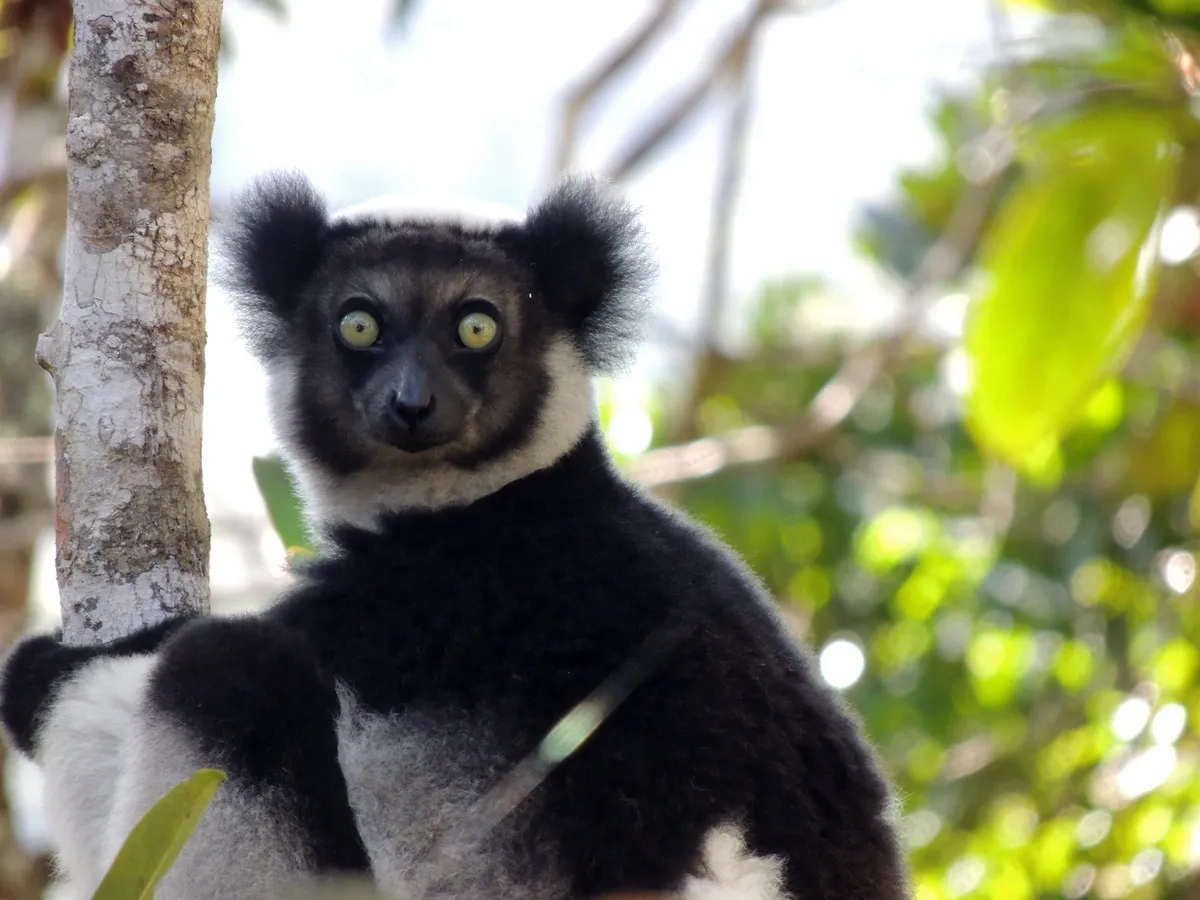
Indris have prominent tufted ears, a long muzzle, long slender legs, short arms and silky fur. All of them have yellow eyes and large black ears. The coat is black with some white, and the mix varies by location and by individual. Individuals in the south have more white in their coloration1. Northern indris have a light ring around a black face and a white triangle on the rear of the torso, while southern indris lack the face ring and have a white back of the head. The big toe is large and very opposable2, while the thumb is small, and the other toes are held together by webbing.
Where do indris live?
The northernmost locality where indris are found is the Anjanaharibe-Sud Special Reserve1. The southern limit lies south of the Bemarivo River but north of the Mangoro River. Indris are not present on the Masoala Peninsula, and they are not found in Marojejy National Park. The New England Primate Conservancy places the southern end of the range at Anosibe An’ala3.
The habitat is primary and secondary eastern tropical rainforest, in lowland, mid-altitude and montane forest, including some disturbed habitats. Indris are often found on steep terrain with many ridges and valleys, and they range from nearly sea level to 1800 meters1.
What do indris eat?
Indris are predominately folivorous, eating mostly young leaves but also fruits, seeds and flowers. At Mantadia National Park they ate 76 species of plants and spent their feeding time on young leaves (72.3%), fruits (16.4%) and flowers (6.7%). At Betampona Reserve, immature foliage made up 73.4% of records from 42 plant species, with bark at 4.5%. Mature leaves take only around 1.4% of feeding time. Indris break off the part of the plant they want with their mouth, not with their hands1.
On the forest floor indris are typically found eating clumps of soil, a practice that researchers believe may serve a medicinal purpose. Their caeca contain almost five times more protobacteria3 than other lemurs.
How do indris live?
Indri groups average 3.1 individuals, usually between two and six, typically a reproducing pair and their offspring. Adult females are dominant to adult males1, and in aggression over food females usually come out on top. Females stay in their natal group3, while males leave to start new families. Territory is defended by adult males2, which mark it with urine and secretions from glands on the muzzle.
Indris are strictly diurnal, with a daily activity period of usually only 5 to 11 hours. They sleep in trees 9.1 to 30.5 meters above the forest floor. They move mostly by leaping between tree trunks, holding the body close to vertical. Recorded average home ranges are 0.27 km²1.
The loud call is produced by a laryngeal air sac2. Calls may be audible for over 2 kilometers, and adults of both sexes sing. A song lasts from 40 seconds to around 4 minutes, and groups may call in response to the calls of other groups1. Most calling is in the morning, usually ending by around noon. In a 12-year study of more than 600 vocalizations3 from 39 adult indris, individuals created unique rhythmic patterns in their calls.
How do indris reproduce and how long do they live?
Indris are monogamous, and adults find new mates only upon death of a previous one. Mating falls in December through March, with births in May and June. Gestation lasts 120 to 150 days2. The interbirth interval in the wild is around two or three years1.
The young ride on the mother’s belly up to 4 to 5 months and then move to her back. Weaning takes place at about 6 months2, and young stay close to their mothers until after age 2. Sexual maturity comes between 7 and 9 years1.
In the wild, indris live between 15 and 18 years3, and they do not survive for long in captivity.
Is the indri endangered?
The IUCN lists the indri as Critically Endangered4, from an assessment the New England Primate Conservancy dates to 2018. The New England Primate Conservancy reported in 2022 that the population is in certain decline. Indris are among the many Madagascar animals threatened by habitat loss, and slash-and-burn farming is a particularly problematic practice on the island. In October 2016 a sapphire rush brought roughly 50,000 small-scale miners to the Ankeniheny-Zahamena Corridor, a protected area that is home to indris. The New England Primate Conservancy reported in 2022 that local taboos against hunting indris lose their value3 as local cultures erode, and that indris are increasingly hunted for meat and pelts.
The indri is listed on CITES Appendix I and occurs in protected areas that include three national parks, two nature reserves and five special reserves. Because indris cannot be kept in captivity, captive breeding programs3 are not an option.
Similar species
- Diademed sifaka (Propithecus diadema): Animal Diversity Web names the indri as the only other animal it might be confused with; the sifaka has a very long tail, which distinguishes it from the short-tailed indri. It weighs 5 to 7 kg5.
- Black-and-white ruffed lemur (Varecia variegata): another black-and-white lemur of the eastern rainforest of Madagascar, it lives alongside the indri at Betampona Natural Reserve1. It weighs 2.5 kg to 4.8 kg6, and its tail is black.