Contents
The Philippine tarsier, Carlito syrichta, is a small primate native to the southeastern Philippines. It is known for its huge eyes: tarsiers have the largest eyes in proportion to their body of any mammal, each one heavier than the brain. Some experts keep all tarsiers in the genus Tarsius, while others place the Philippine tarsier in its own genus, Carlito. Tarsiers are classified in the suborder Haplorhini with monkeys and apes, but occupy their own intraorder, Tarsiiformes1.
What does a Philippine tarsier look like?
The New England Primate Conservancy gives a body length of about 11–13 cm on average, with a tail about double that length, and a weight of 110–130 g. Animal Diversity Web gives a wider body size of approximately 85 to 160 mm and weights between 80 and 165 g2. The Wisconsin National Primate Research Center lists adult weights of 119–153 g for males and 110–132 g for females3. The New England Primate Conservancy reports no notable sexual dimorphism1 in the species.
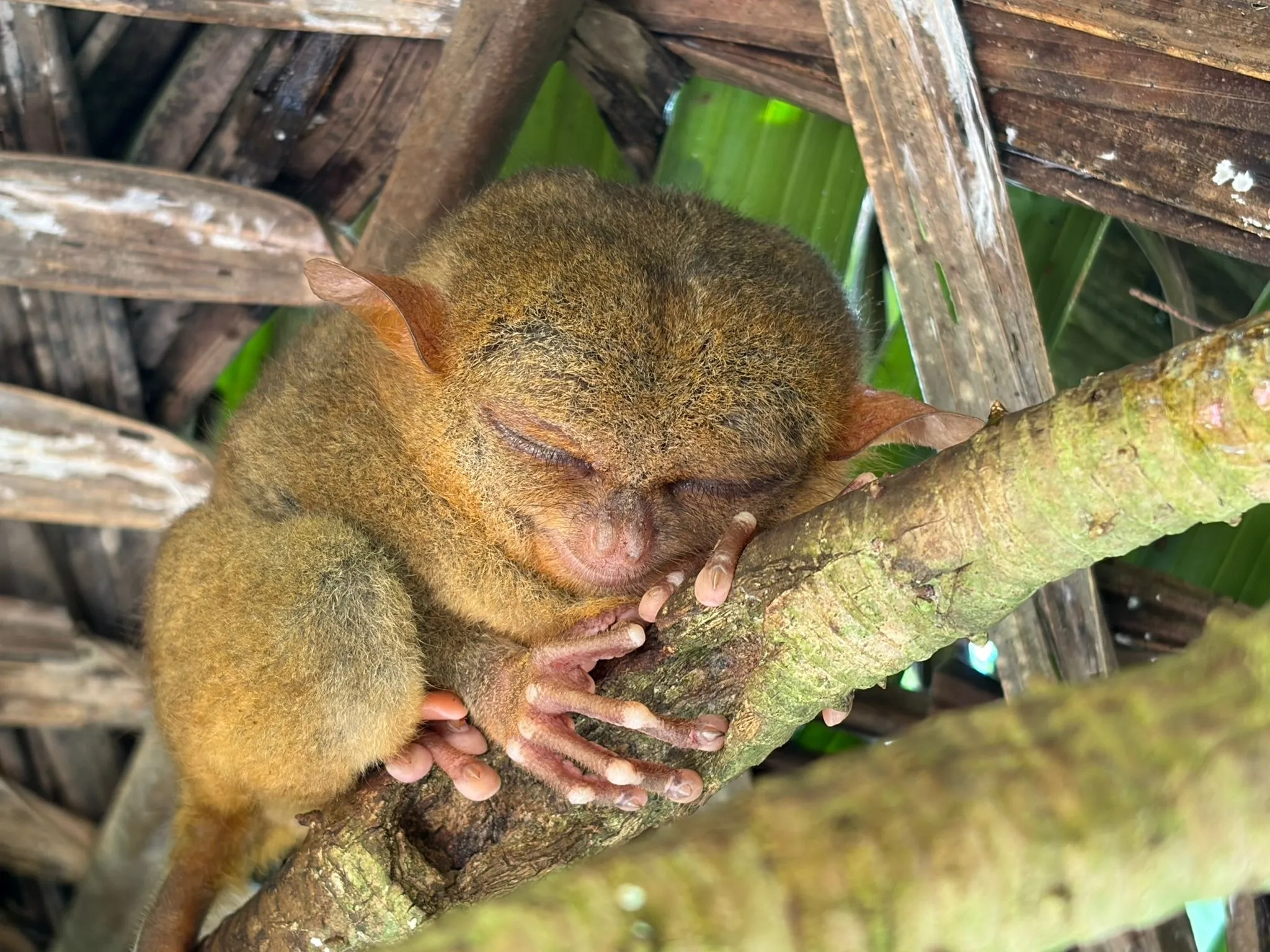
The small body is covered in gray hair1, and Philippine tarsiers may have a slightly paler and more yellow hue than other tarsiers. Animal Diversity Web describes the species as brownish-grayish2, with colours that vary by region; some have reddish-brown hair.
The large ears stick straight out from the sides of the head. The eyes are so big that they cannot move in their sockets, and a unique spine lets the head turn nearly 180 degrees. The fingers and toes are very long and end in swollen adhesive pads that help them grip branches. Each foot contains two very elongated tarsal bones that give the animal its leaping ability, and the word “tarsier” refers to them. The legs alone make up about a quarter of the weight1 of the whole body.
The tail is long, thin and bald1. The lack of hair on the tail and feet sets Philippine tarsiers apart from other tarsiers, as most other species have at least some hair there. The heels carry only sparse, fine hair3 and look hairless, while the heels of most tarsiers are fully furred.
Where do Philippine tarsiers live?
The species is restricted to the Philippines3, on the southern islands of Bohol, Dinagat, Leyte, Mindanao, Samar and Siargao. Animal Diversity Web names Samar, Leyte, Bohol and Mindanao2 as the islands where it is most commonly found. The species is native to the Mindanao faunal region1, one of about six such regions in the Philippines.
Philippine tarsiers live in rainforests up to 750 m1 and tolerate edge habitat and secondary forest, although their population density is lower in these disturbed habitats. They are found in areas of tall grasses, bushes, bamboo shoots and small trees2 in tropical rainforest. A 2002 study in fragmented forest found a density of 57 individuals per square kilometre3.
What do Philippine tarsiers eat?
Tarsiers are the only fully carnivorous primates and consume no plant material whatsoever. Philippine tarsiers mainly feed on insects and other small animals, such as frogs, lizards and even small birds1. Animal Diversity Web lists insects, spiders, lizards and small vertebrates such as birds. The Wisconsin fact sheet names orthopterans, lepidopterans, beetles, ants and termites3 among its foods. Once it seizes prey, a tarsier carries it in its mouth2 and uses both hands.
How do Philippine tarsiers live?
Philippine tarsiers are nocturnal and fully arboreal1, spending the day hiding amid thick vegetation and emerging at night to hunt. Their sleeping sites are typically dense tangles of vegetation3 near large trees and close to the ground, and each tarsier normally uses 3 to 4 of them near the edges of its range.
They are most often seen in male-female pairs1, or occasionally in small groups of about four individuals. The Wisconsin fact sheet describes a dispersed (noyau) mating system, where a male’s range overlaps the ranges of several females. It rates the Philippine tarsier as intermediate in sociality3 between the western tarsiers and the eastern species.
A home range covers about 1 to 2 hectares, and it likely expands during the dry season. Females travel an average of 1,119 m per night and males 1,636 m3. A home range overlaps considerably with members of the opposite sex, but only slightly with the same sex1, and males are known to be fiercely territorial.
Philippine tarsiers don’t often move quadrupedally; they cling vertically to trees, using the tail for support, and leap. A single leap can cover 6 m. They tend to stay 1–2 m off the ground1.
Tarsiers are less vocal than many primate species2, and they let out a high-pitched squeak when in danger. They scent-mark with urine and gland secretions to maintain their territory. Touch is mostly used between a mother and her baby1.
How do Philippine tarsiers reproduce and how long do they live?
Philippine tarsiers are most likely monogamous and breed year round, although some research indicates they may breed more when insects are more readily available. A female gives birth to a single baby after about a six month gestation1. The Wisconsin fact sheet gives a recorded gestation of 180 days and an average captive birth weight of 23.2 g3.
Babies are born fully furred and with open eyes. Young tarsiers can climb after two days and jump after four2, and normal locomotor patterns begin at approximately nineteen days. The mother carries her baby in her mouth or on her belly. At 45 days old1 the young can catch their own prey and are weaned at about the same time. The Wisconsin fact sheet gives weaning at 82 days3.
One Philippine tarsier is reported to have lived 13.5 years in captivity. Wild animals likely do not live as long2 as their captive counterparts.
Is the Philippine tarsier endangered?
In its 2015 assessment the IUCN listed the Philippine tarsier as Near Threatened4. In 2022 the New England Primate Conservancy named habitat loss a major concern, with very little primary habitat left in the native range. Infant mortality is very high1, both in the wild and in captivity, making it difficult to recover populations.
Philippine tarsiers are a prime target for the pet trade: while it is illegal, they are a common sight in the pet markets of Manila. Animal Diversity Web reported in 19992 that tarsiers had suffered greatly from hunters and trappers who shook the animals out of their trees or chopped down the branches they lived in. Tarsiers are captured for tourist facilities1 and displayed there during the day, and many facilities sell them as pets directly to tourists.
The species is listed under CITES Appendix II and is protected by law in the Philippines. Captive breeding has been attempted but has been largely unsuccessful1.
Similar species
- Horsfield’s tarsier or western tarsier (Cephalopachus bancanus), placed in the genus Cephalopachus1 by some experts, lives on southern Sumatra and Borneo. Its tail is intermediate in hairiness3, while the Philippine tarsier’s tail is usually considered naked.
- The spectral tarsier (Tarsius tarsier) of Sulawesi has white spots behind its ears3 and a scaly underside of the tail, which the other species do not have. The Philippine tarsier is paler and more yellow than the spectral tarsier.